


















Lesson 18 of 48 · The Second Law and Entropy
Heat Engines and the Second-Law Statements
Understand thermal efficiency, the Kelvin-Planck and Clausius statements of the second law, refrigerators and heat pumps with COP, and the sources of irreversibility, with worked examples.
Every machine that turns heat into work runs in a cycle, takes energy from something hot and sends some of it somewhere cold. Every refrigerator does the reverse and needs work to do it. This lesson introduces those devices, their performance measures, and the two statements of the second law that tell us what no such device can ever do.
What you will learn
- Thermal efficiency of heat engines and the coefficient of performance of refrigerators and heat pumps.
- The Kelvin-Planck and Clausius statements of the second law.
- What makes a process irreversible.
- How to check if a machine is possible.
Key terms
Thermal efficiency η: η = W_net / Q_H, the fraction of input heat converted to net work.
Coefficient of performance (COP): desired output divided by the work input for refrigerators and heat pumps.
Kelvin-Planck statement: no cyclic device can take heat from one reservoir and produce net work while exchanging heat with only that reservoir.
Clausius statement: no cyclic device can transfer heat from a colder to a hotter body with no other effect.
Heat engines
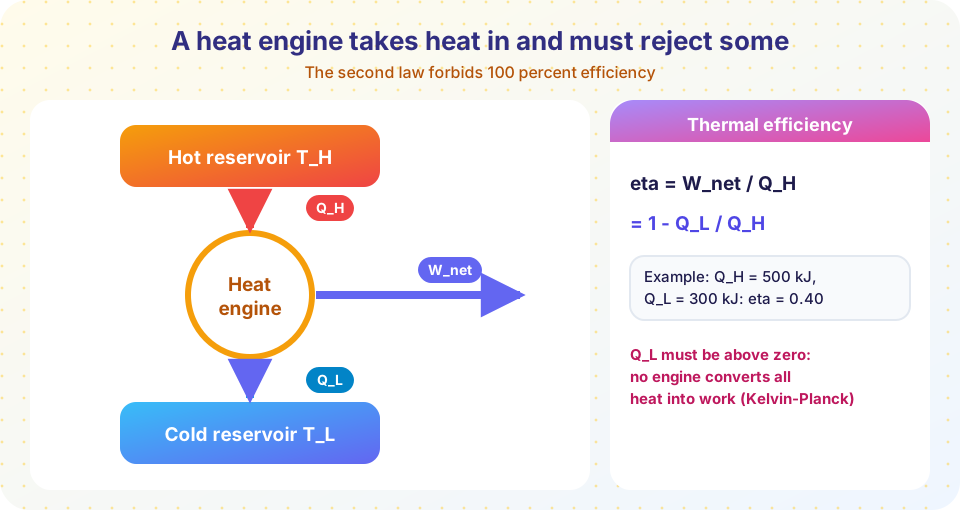
A heat engine receives heat Q_H from a hot reservoir at T_H, produces net work W_net and rejects Q_L to a cold reservoir at T_L. Over a cycle the first law gives W_net = Q_H − Q_L, so
η = W_net/Q_H = 1 − Q_L/Q_H
A coal power plant might be 38 to 45 % efficient; a modern combined-cycle gas plant over 60 %; a gasoline car engine around 25 to 35 % at best. Example: an engine takes 500 kJ per cycle from a furnace and rejects 300 kJ to a river. W_net = 200 kJ, η = 0.40.
Kelvin-Planck and Clausius
The Kelvin-Planck statement says no engine can have Q_L = 0: some heat must always be rejected to a colder reservoir, so η < 1 always. A ship could not run on the heat of the ocean alone, even though the ocean contains vast energy; there is no colder reservoir to reject heat to.
The Clausius statement says heat does not flow by itself from cold to hot. A refrigerator does move heat from the cold food compartment to the warm kitchen, but it needs work input.
The two statements are equivalent: violating one lets you build a machine violating the other. Both are observations that have never been contradicted, not derived from anything simpler; they are the starting point of the second law.
Refrigerators and heat pumps
A refrigerator removes Q_L from a cold space using work W_in, and rejects Q_H = Q_L + W_in to the warm surroundings. Its performance is the coefficient of performance:
COP_R = Q_L / W_in
A heat pump has the same hardware but the goal is to deliver Q_H to a warm space:
COP_HP = Q_H / W_in = COP_R + 1
COPs can be larger than 1 because the work only moves heat. Example: a refrigerator with COP_R = 3 and W_in = 2 kW removes Q̇_L = 6 kW and rejects Q̇_H = 8 kW to the kitchen. A heat pump with COP = 4 delivering 12 kW to a house needs only W_in = 3 kW of electricity, the other 9 kW being taken from the outdoor air. That is why heat pumps beat electric resistance heating (COP = 1).
Irreversibility
A process is reversible if both system and surroundings can be returned exactly to their initial states. Real processes are irreversible because of:
- Friction (mechanical energy becomes heat).
- Heat transfer across a finite temperature difference.
- Unrestrained expansion (gas expanding into a vacuum).
- Mixing of different substances.
- Electric resistance, chemical reactions and plastic deformation.
Reversible processes are quasi-equilibrium and free of these effects. They are idealizations but give the upper bound for performance: the more irreversibilities, the less work an engine produces and the more a refrigerator needs.
Common misconceptions
"Efficiency below 100 % is a design flaw." For a heat engine it is a law of nature: some heat must be rejected.
"COP is an efficiency, so it must be below 1." COP compares moved heat to work and is often 3 or more.
"Refrigerators violate the Clausius statement." They move heat from cold to hot but consume work, which is a separate effect.
Try it
Press Run (or Ctrl + Enter) to see the result here.
Program input · what you'd type while the program runs
Type the answers before you press Run, one per line. Each time the program reads a line (with input()), it gets the next line from this box.
Press Run (or Ctrl + Enter) to see the result here.
Program input · what you'd type while the program runs
Type the answers before you press Run, one per line. Each time the program reads a line (with input()), it gets the next line from this box.
Check your understanding
Quick check · 5 questions
of 5 answered You scored / 5 · perfect!
-
1. An engine takes 800 kJ from a hot source and rejects 560 kJ. Its thermal efficiency is
W = 240 kJ, eta = 240/800 = 0.30. -
2. A heat pump has COP 3.5 and delivers 7 kW of heat. The electrical power is
W = Q_H / COP = 7 / 3.5 = 2 kW. -
3. The Kelvin-Planck statement forbids
A cyclic engine exchanging heat with a single reservoir cannot produce net work. -
4. Which is a source of irreversibility?
Finite temperature differences, friction, mixing and unrestrained expansion all create irreversibility. -
5. COP_HP is related to COP_R by
Q_H = Q_L + W, so COP_HP = (Q_L + W)/W = COP_R + 1.
Summary
η = W_net/Q_H = 1 − Q_L/Q_H; a heat engine must reject heat (Kelvin-Planck).- Heat does not flow spontaneously from cold to hot (Clausius); refrigerators need work.
COP_R = Q_L/W_in,COP_HP = Q_H/W_in = COP_R + 1.- Friction, finite-ΔT heat transfer, mixing and unrestrained expansion make processes irreversible.
Track your progress
Create a free account to tick off lessons and pick up where you left off on any device.
of Engineering Thermodynamics lessons completed