


















Lesson 31 of 48 · Refrigeration Cycles
Heat pumps and refrigerants
Understand heating COP, why heat pumps weaken in the cold, how refrigerants are chosen (R-134a, propane, CO2, ammonia) and how absorption systems use heat instead of work.
Burn a liter of fuel in a furnace and you get at most the fuel's heat. Run the same refrigeration cycle as a refrigerator but aimed at the house and you can deliver three or four times as much heat as the electricity you buy. This is why heat pumps are at the center of low-carbon heating plans around the world. This lesson explains how they behave across the seasons, what the fluids inside them are, and what to do when electricity is unavailable.
What you will learn
- Compute the heating COP of a vapor-compression cycle.
- Explain how outdoor temperature changes COP and what a seasonal average means.
- Compare refrigerants by safety, pressure and environmental impact.
- Describe the idea of absorption refrigeration.
Key terms
Heating COP is Q_H / W. Seasonal performance factor (SPF) is the heat delivered over a whole season divided by the electricity used. GWP is global warming potential, the warming caused by a kilogram of a gas relative to a kilogram of CO₂ over (usually) 100 years. ODP is ozone depletion potential. Absorption cycle is a refrigeration cycle driven by heat instead of mechanical work.
Heating COP
Take the R-134a cycle from the last lesson. The heat rejected in the condenser is q_H = h₂ − h₃ = 179.92 kJ/kg and the compressor work is 36.23 kJ/kg. As a heat pump it has
COP_HP = 179.92 / 36.23 = 4.97 = COP_R + 1
so each kilowatt-hour of electricity delivers 4.97 kWh of heat. An electric resistance heater has COP exactly 1, so even a mediocre heat pump with COP 2.5 cuts electricity use for heating by 60 %.
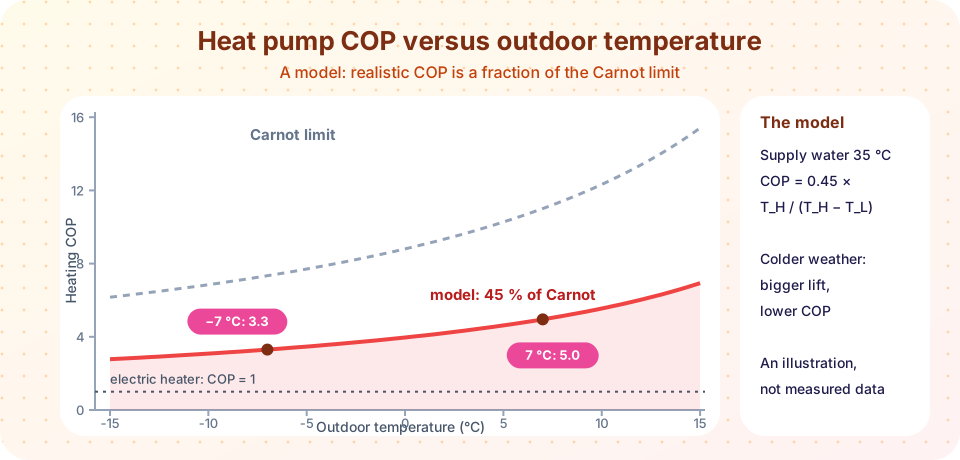
The Carnot limit COP_HP = T_H / (T_H − T_L) shows the dependence on the temperature lift. A heat pump heating water to 35 °C from outdoor air at 7 °C has a Carnot COP of 308.15 / 28 = 11.0; at −7 °C it is 308.15 / 42 = 7.3. Real machines achieve a fraction of these values, commonly somewhere around 40 to 55 %, because of compressor losses, throttling losses and heat exchanger temperature differences. As a rough model, take 45 % of Carnot: about 5.0 at 7 °C and 3.3 at −7 °C.
Why heat pumps weaken in the cold, and what to do
Two effects work together when it gets colder. The lift grows, so COP falls, and the building needs more heat, so the machine runs more often. Designers respond in several ways:
- Low-temperature distribution. Underfloor heating or large radiators work with water at 35 to 45 °C instead of 70 °C, cutting the lift.
- Ground-source heat pumps draw heat from soil or water that stays near 8 to 12 °C all year in many climates, so the lift is steady.
- Cold-climate designs use variable-speed compressors, vapor injection, or two-stage compression.
- Defrost cycles. Below about 5 °C outdoor air at high humidity frosts the outdoor coil. The unit briefly reverses itself, costing a few percent of the seasonal output.
The seasonal performance factor (SPF) weights the COP across the hours of the whole winter. Real installations in temperate climates commonly reach SPF values between about 2.5 and 4.
Refrigerants: the working fluid matters
A refrigerant must boil at a low temperature at moderate pressure, condense at a pressure that ordinary pipes can hold, carry a lot of energy per kilogram, and be stable, safe and kind to the atmosphere.
| Refrigerant | Type | Notes |
|---|---|---|
| R-134a | HFC | Standard for decades in cars and fridges; GWP over a thousand times CO₂, so being phased down |
| R-1234yf | HFO | Very low GWP, replaces R-134a in cars; mildly flammable |
| R-290 (propane) | hydrocarbon | Very low GWP, excellent performance, flammable so charge is limited |
| R-717 (ammonia) | natural | High efficiency, toxic, used in industrial plants |
| R-744 (CO₂) | natural | Non-toxic, works at very high pressure (around 100 bar on the hot side of some cycles), good in cold climates |
History in one paragraph. Early refrigerants (ammonia, sulfur dioxide) were toxic. In the 1930s chlorofluorocarbons (CFCs) arrived as safe, stable fluids. In the 1980s scientists found that chlorine from CFCs was destroying stratospheric ozone, and the Montreal Protocol (1987) phased them out. The replacements, HFCs, protect the ozone layer but are strong greenhouse gases, so the Kigali Amendment (2016) set a schedule to reduce their production. The industry is now moving to HFOs and natural refrigerants.
Absorption refrigeration
An absorption system replaces the compressor with a generator, an absorber and a small pump. A common pair is ammonia (refrigerant) and water (absorbent). In the absorber, the low-pressure ammonia vapor dissolves in water; a pump raises the liquid pressure (cheap, because it is a liquid); in the generator, heat boils the ammonia out of the solution at high pressure; and the vapor continues to the condenser, valve and evaporator as usual.
The input is heat, not electricity, so absorption machines suit places with waste heat, solar thermal heat or gas but no spare electricity. Their COP is lower, typically 0.5 to 0.8 for single-effect machines, but the "fuel" can be nearly free.
Common misconceptions
"A heat pump creates more energy than it uses." It delivers more heat than the electricity it uses, because most of that heat was collected from outdoors. "Heat pumps stop working below freezing." Modern machines work well below −10 °C, but COP falls. "The best refrigerant is the one with the highest COP." Safety, pressure, cost and environmental impact all count.
Try it
Press Run (or Ctrl + Enter) to see the result here.
Program input · what you'd type while the program runs
Type the answers before you press Run, one per line. Each time the program reads a line (with input()), it gets the next line from this box.
Check your understanding
Quick check · 6 questions
of 6 answered You scored / 6 · perfect!
-
1. A heat pump delivers 6 kW of heat using 1.5 kW of electricity. What is its COP?
COP_HP = Q_H / W = 6 / 1.5 = 4. -
2. Why does a heat pump's COP fall in very cold weather?
A bigger lift T_H − T_L means more work per unit of heat moved. -
3. Which refrigerant is toxic but very efficient and common in industrial plants?
R-717 is ammonia: efficient and toxic. -
4. The Montreal Protocol was aimed at...
It phased out CFCs, which destroy stratospheric ozone. -
5. What energy input drives an absorption refrigeration machine?
Heat in the generator boils refrigerant out of the solution; only a small pump needs work. -
6. Which change raises a heat pump's seasonal COP?
Lower delivery temperature means a smaller lift and a higher COP.
Summary
- Heating COP is
Q_H / W = COP_R + 1; the R-134a example gives 4.97. - COP falls as outdoor temperature drops because the lift grows; SPF averages it over a season.
- Refrigerants trade safety, pressure and climate impact; the Montreal Protocol and Kigali Amendment drive the transition from CFCs and HFCs.
- Absorption machines use heat as their main input and have lower COPs.
Next: Chapter 6 review
Track your progress
Create a free account to tick off lessons and pick up where you left off on any device.
of Engineering Thermodynamics lessons completed