


















Lesson 43 of 48 · Projects and Practice
Case study: a combined-cycle power plant
Put Chapter 5 to work: a gas turbine topping cycle feeds a heat-recovery steam generator and a Rankine bottoming cycle, and we compute the energy split and combined efficiency.
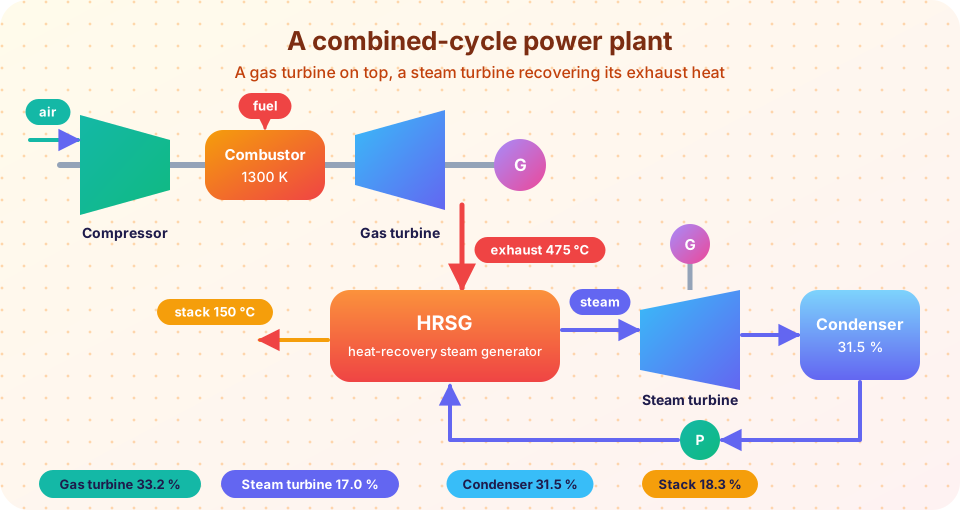
The most efficient large power plants burn natural gas twice. A gas turbine burns the fuel and produces electricity. Its exhaust, still at about 750 K in our example, is far too hot to throw away, so it boils water in a heat-recovery steam generator (HRSG), and a steam turbine produces more electricity from that heat. The result is a combined-cycle gas turbine (CCGT) plant: a Brayton cycle on top of a Rankine cycle. This case study connects Chapters 5, 7 and 8 in one design.
What you will learn
- Explain why a Brayton cycle and a Rankine cycle fit together.
- Build an energy balance for a combined plant on a 100 MW fuel basis.
- Calculate combined efficiency from the efficiencies of the two cycles.
- Identify where the energy goes and what limits the design.
Key terms
Topping cycle is the high-temperature cycle (Brayton). Bottoming cycle is the low-temperature cycle that uses the waste heat (Rankine). HRSG is a heat exchanger that boils water using hot exhaust gas. Stack temperature is the exhaust temperature leaving the HRSG. Combined-cycle efficiency is total net work divided by fuel energy.
Why two cycles beat one
A Carnot engine's efficiency rises with the average temperature at which heat is added and falls with the average temperature at which heat is rejected. A gas turbine adds heat at very high temperature (up to 1300 K and more), but it rejects heat at 750 K, which is still hot. A steam plant rejects heat near ambient (30 to 40 °C) but cannot add heat above about 900 K because of boiler materials. Put the two in series: the gas turbine covers the high end, the steam cycle the low end, and together they approximate a single engine that covers the entire temperature range.
The gas turbine (topping cycle)
Use the real Brayton cycle from the gas turbine lesson: T₁ = 300 K, r_p = 10, T₃ = 1300 K, compressor efficiency 0.85, turbine efficiency 0.88.
- Compressor exit
T₂ = 628.5 K, turbine exitT₄ = 748.5 K(475 °C). - Heat added
q_in = 674.9 kJ/kg, net workw_net = 224.1 kJ/kg. - Gas-turbine efficiency
η_GT = 33.2 %.
Take a fuel input of 100 MW (lower heating value). The gas turbine delivers 33.2 MW. The remaining 66.8 MW leaves in the exhaust as the sensible energy of hot air-gas: c_p (T₄ − T₁) = 1.005 × 448.5 = 450.7 kJ/kg, which is 66.8 % of 674.9.
The heat-recovery steam generator
Exhaust gas flows over banks of tubes: an economizer, evaporator and superheater. We cool the gas to a stack temperature of 150 °C (423 K). The recoverable heat per kilogram of gas is c_p (T₄ − T_stack) = 1.005 × (748.5 − 423.2) = 327.0 kJ/kg, which is 48.5 % of the fuel energy (327.0 / 674.9).
The gas cannot be cooled all the way to ambient, because below about 100 to 150 °C the water in the flue gas starts to condense and corrodes the tubes (remember the dew point of natural gas products, about 56 to 59 °C, plus margin for sulfur compounds). That leftover heat, c_p (T_stack − T₁) = 1.005 × 123.2 = 123.8 kJ/kg, 18.3 % of the fuel energy, goes up the stack.
The steam turbine (bottoming cycle)
The steam cycle receives the 48.5 % recovered heat. A Rankine cycle like the one in the Rankine lesson has an efficiency of about 35 %. So the steam turbine delivers 0.35 × 48.5 = 17.0 % of the fuel energy, and the condenser rejects the remaining 31.5 %.
| Where it goes | % of fuel energy | MW (100 MW fuel) |
|---|---|---|
| Gas turbine electricity | 33.2 | 33.2 |
| Steam turbine electricity | 17.0 | 17.0 |
| Condenser heat | 31.5 | 31.5 |
| Stack heat | 18.3 | 18.3 |
| Total | 100 | 100 |
The combined efficiency is 33.2 + 17.0 = 50.2 %, a gain of 17 percentage points over the gas turbine alone from the same fuel.
What real plants do better
The example uses modest component numbers. Real CCGT plants reach 58 to 62 % because of:
- Higher turbine inlet temperatures, 1700 K and above, using internal cooling and ceramic coatings.
- Better compressor and turbine efficiencies, around 0.88 and 0.90.
- Multi-pressure HRSGs with two or three steam pressures and reheat, which cool the exhaust to lower temperatures with smaller temperature differences, reducing entropy generation.
- Lower condenser pressure from cold cooling water.
Combined-cycle plants are also quick to start (hours instead of the day or more of a large coal plant) and are the usual partner of wind and solar in many electricity systems.
Common misconceptions
"The steam cycle burns extra fuel." In the basic design it burns none; it uses heat that the gas turbine already rejected. "Efficiency adds." Efficiencies combine as work over the same fuel, not by simple addition of two percentages computed on different bases. "Cooling the exhaust to ambient is possible." The dew point and the finite size of heat exchangers set a stack temperature well above ambient.
Try it
Press Run (or Ctrl + Enter) to see the result here.
Program input · what you'd type while the program runs
Type the answers before you press Run, one per line. Each time the program reads a line (with input()), it gets the next line from this box.
Press Run (or Ctrl + Enter) to see the result here.
Program input · what you'd type while the program runs
Type the answers before you press Run, one per line. Each time the program reads a line (with input()), it gets the next line from this box.
Check your understanding
Quick check · 5 questions
of 5 answered You scored / 5 · perfect!
-
1. In a combined-cycle plant, the HRSG is...
The heat-recovery steam generator transfers heat from hot exhaust gas to feedwater and steam. -
2. Which cycle is the topping cycle?
The gas turbine (Brayton) operates at the highest temperature. -
3. A 100 MW fuel input gives 33.2 MW gas turbine work and 17.0 MW steam work. What is the combined efficiency?
(33.2 + 17.0) / 100 = 50.2 %. -
4. Why can the exhaust not be cooled to ambient temperature in the HRSG?
Condensation corrodes the tubes, and a heat exchanger needs a temperature difference. -
5. How do real CCGTs reach 58 to 62 %?
Better components and heat recovery shrink the losses.
Summary
- A CCGT uses the Brayton cycle at the high end and the Rankine cycle at the low end.
- The example: 33.2 % from the gas turbine, 17.0 % from steam, 31.5 % condenser heat, 18.3 % stack heat, 50.2 % overall.
- Lower stack temperature raises efficiency, limited by dew point and heat exchanger size.
- Real plants reach near 60 % with better components and multi-pressure heat recovery.
Track your progress
Create a free account to tick off lessons and pick up where you left off on any device.
of Engineering Thermodynamics lessons completed