


















Lesson 46 of 48 · Projects and Practice
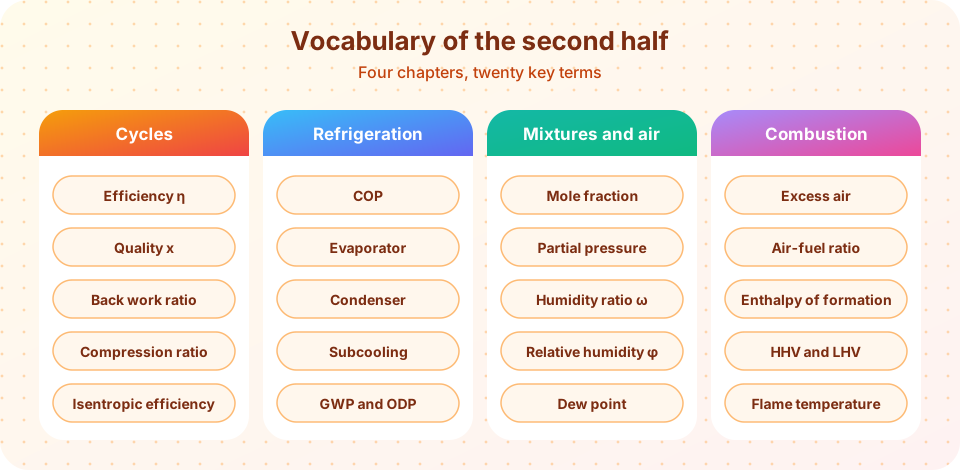
Glossary: power cycles to combustion
Definitions of the key terms from Chapters 5 to 8: power cycles, refrigeration, gas mixtures, humid air and combustion, with symbols and units, plus a flashcard drill.
Thermodynamics has a large vocabulary, and the words are precise: "quality", "saturation" and "enthalpy" each mean one specific thing. This glossary collects the terms from the second half of the course, with symbols and units where they apply. Use it as a reference and as a self-test: cover the right-hand column and try to define each term.
What you will learn
- Find the exact meaning of each technical term in Chapters 5 to 8.
- Link terms to their symbols and units.
- Drill yourself with flashcards.
Power cycles (Chapter 5)
| Term | Meaning |
|---|---|
Thermal efficiency η |
Net work divided by heat input, W_net / Q_H |
| Carnot efficiency | Upper limit, 1 − T_C / T_H, temperatures in kelvin |
| Rankine cycle | Steam cycle: pump, boiler, turbine, condenser |
Quality x |
Mass fraction of vapor in a saturated mixture |
| Back work ratio | Compressor (or pump) work divided by turbine work |
| Reheat | Heating steam again partway through expansion |
| Regeneration | Using bled steam or exhaust heat to warm the working fluid |
| Open feedwater heater | Mixing chamber where bled steam and feedwater mix |
| Otto cycle | Air-standard cycle of a spark-ignition engine; heat added at constant volume |
| Diesel cycle | Air-standard compression-ignition cycle; heat added at constant pressure |
Compression ratio r |
v₁ / v₂ for a piston engine |
Cutoff ratio r_c |
v₃ / v₂ in the Diesel cycle |
| Brayton cycle | Gas-turbine cycle with constant-pressure heat addition |
Pressure ratio r_p |
P₂ / P₁ for a compressor |
| Isentropic efficiency | Ratio of real to ideal isentropic work for a turbine or compressor |
| MEP | Mean effective pressure, net work per swept volume |
| Combined cycle | Gas turbine plus steam turbine fed by its exhaust |
Refrigeration (Chapter 6)
| Term | Meaning |
|---|---|
| COP | Coefficient of performance, useful transfer divided by work |
COP_R, COP_HP |
Refrigerator Q_L / W and heat pump Q_H / W = COP_R + 1 |
| Evaporator | Low-pressure heat exchanger where refrigerant boils |
| Condenser | High-pressure heat exchanger where refrigerant condenses |
| Throttling valve | Pressure-reducing device at constant enthalpy |
| Refrigerant | Working fluid of the cycle (R-134a, R-290, R-717, R-744) |
| Subcooling | Cooling liquid below saturation temperature |
| Superheating | Heating vapor above saturation temperature |
| SPF | Seasonal performance factor, seasonal heat over electricity |
| GWP, ODP | Global warming and ozone depletion potentials |
| Absorption cycle | Refrigeration driven by heat instead of work |
Gas mixtures and humid air (Chapter 7)
| Term | Meaning |
|---|---|
Mole fraction y |
Moles of a component divided by total moles |
Mass fraction mf |
Mass of a component divided by total mass |
| Dalton's law | Partial pressures add to the total, Pᵢ = yᵢ P |
| Amagat's law | Partial volumes add to the total, Vᵢ = yᵢ V |
Humidity ratio ω |
kg water vapor per kg dry air |
Relative humidity φ |
P_v / P_g(T) |
| Dew-point temperature | Saturation temperature at the vapor pressure |
| Wet-bulb temperature | Temperature set by evaporation from a wet wick |
| Sensible heat | Heat that changes temperature only |
| Latent heat | Heat that changes phase or humidity ratio |
| Psychrometric chart | Plot of moist-air properties and processes |
| Evaporative cooling | Cooling at nearly constant enthalpy by evaporating water |
Combustion (Chapter 8)
| Term | Meaning |
|---|---|
| Stoichiometric air | Exact air for complete combustion |
| Excess air | Air above the stoichiometric amount, in percent |
| Air-fuel ratio | Mass of air per mass of fuel |
| Equivalence ratio | Actual fuel-air ratio over the stoichiometric one |
Enthalpy of formation h_f° |
Enthalpy of a compound relative to its elements at 25 °C |
| HHV, LHV | Heating values with liquid or vapor water in the products |
| Adiabatic flame temperature | Product temperature with no heat loss |
| Dissociation | Splitting of products at high temperature |
| Thermal NOx | NO from air's nitrogen at high temperature |
| Stack loss | Energy leaving with the exhaust |
Try it
Press Run (or Ctrl + Enter) to see the console output here.
No output.
Press Run (or Ctrl + Enter) to see the result here.
Program input · what you'd type while the program runs
Type the answers before you press Run, one per line. Each time the program reads a line (with input()), it gets the next line from this box.
Check your understanding
Quick check · 4 questions
of 4 answered You scored / 4 · perfect!
-
1. What is quality in a saturated mixture?
Quality x is vapor mass over total mass. -
2. Which term describes cooling at nearly constant enthalpy by evaporating water into air?
Evaporation turns sensible energy into latent energy at nearly constant enthalpy. -
3. What is the unit of humidity ratio?
It is a mass ratio, often written in g/kg. -
4. What does LHV stand for?
It is the heating value with water vapor in the products.
Summary
- Use precise symbols and units:
η,COP,ω,φ,h_f°. - Efficiency compares work to heat input; COP compares transfer to work.
- Humid-air terms describe moisture content, saturation and evaporation.
- Combustion terms describe air supply, heat released and flame temperature.
Next: Cheat sheet
Track your progress
Create a free account to tick off lessons and pick up where you left off on any device.
of Engineering Thermodynamics lessons completed