


















Lesson 6 of 48 · Properties and State
Properties and State: Chapter Overview
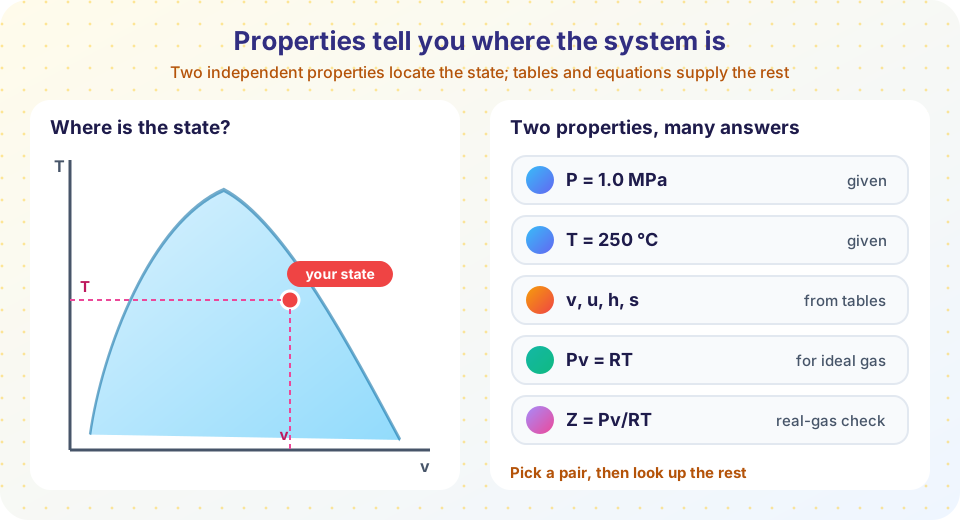
Preview chapter 2 of engineering thermodynamics: how pressure, temperature and specific volume fix a state, and how tables, the ideal gas law and the compressibility factor give every other property.
You cannot do a single energy calculation without knowing the properties of the working fluid. How much energy does 1 kg of steam at 4 MPa and 400 °C carry? How much space does 2 kg of air at 300 kPa and 350 K fill? These are not questions the laws of thermodynamics answer by themselves; they are answered by property relations, which are equations, tables or charts that tie the properties together. This chapter teaches you the three tools engineers use every day.
What you will learn
- Why two independent properties fix the state of a simple compressible substance.
- The big picture of phases, tables, the ideal gas model and its limits.
- Which tool to use for a given fluid and set of conditions.
- A quick way to decide the phase of water from
PandT.
Key terms
Pure substance: a substance with a fixed chemical composition throughout, such as water or nitrogen.
Saturation: the condition at which a phase change begins at a given pressure and temperature.
Equation of state: a relation among P, v and T; the simplest is P v = R T.
Specific internal energy u, enthalpy h, entropy s: other intensive properties, found from tables or relations.
The chapter at a glance
Step 1: describe the phase
Step 2: choose the tool
Step 3: get the numbers
What each lesson covers
- Phase change of pure substances: what happens when water is heated at constant pressure, and the saturation lines, critical point and dome on
T-vdiagrams. - Steam tables and quality: how to read saturated and superheated tables, interpolate, and handle liquid-vapor mixtures with the quality
x. - The ideal gas and compressibility: the ideal gas law, gas constants, and when the compressibility factor
Zis needed. - Chapter 2 review: a recap table, a picture and a ten-question quiz.
Why a fluid has to be looked up
A gas of widely spaced molecules behaves simply: the pressure is proportional to the absolute temperature and inversely proportional to the volume. But water near its boiling point is not simple at all. When it boils, the volume of a kilogram jumps by a factor of about 1,600 at atmospheric pressure while the temperature does not change. No short formula describes that, so we use tables built from careful measurements and detailed models (the international IAPWS formulation for water). Tables are not a nuisance: they are the compact record of how the fluid actually behaves.
A quick phase detector
The first interactive block below uses a simplified saturation curve (interpolated from a few table points) to decide whether water at a given T and P is compressed liquid, a mixture or superheated vapor. The rule is simple:
- If
Pis above the saturation pressure atT, it is compressed liquid (the pressure is too high for boiling). - If
Pis below the saturation pressure atT, it is superheated vapor. - If they are equal, it is on the saturation line and a mixture (any quality) is possible, so you need another property.
Press Run (or Ctrl + Enter) to see the result here.
Program input · what you'd type while the program runs
Type the answers before you press Run, one per line. Each time the program reads a line (with input()), it gets the next line from this box.
Check your understanding
Quick check · 4 questions
of 4 answered You scored / 4 · perfect!
-
1. Water is at 100 C and 500 kPa. The saturation pressure at 100 C is about 101 kPa. What phase is it?
The actual pressure is higher than the saturation pressure at that temperature, so the water cannot boil: it is compressed liquid. -
2. Why can't P and T alone fix the state of a boiling liquid-vapor mixture?
At saturation, T determines P. A second independent property such as quality x or specific volume is needed. -
3. Which tool is the right first choice for steam at 3 MPa and 350 C?
At high pressure near the saturation region, steam is not an ideal gas; use the tables. -
4. Which of the following are intensive properties?
Specific properties (per unit mass) are intensive: v, u, h and s.
Summary
- Two independent intensive properties fix the state of a simple compressible substance.
- Water is described by tables because boiling is far from ideal; gases at low pressure follow
P v = R T. - Compare the actual pressure with the saturation pressure at the same temperature to find the phase.
- This chapter's lessons build the tools: dome diagrams, tables with quality, and the ideal gas with corrections.
Track your progress
Create a free account to tick off lessons and pick up where you left off on any device.
of Engineering Thermodynamics lessons completed