


















Lesson 24 of 48 · Power Cycles
The Rankine steam cycle
Follow water around the ideal Rankine cycle, read its T-s diagram, and calculate pump work, turbine work, heat input and thermal efficiency with a worked example.
Carnot's engine is a beautiful idea that nobody builds. A steam power plant is what engineers build instead. Water is pumped to high pressure, boiled and superheated, expanded through a turbine, and condensed back to liquid. That loop is the Rankine cycle, named after the Scottish engineer William Rankine, and it produces most of the world's electricity from coal, natural gas, nuclear fission, biomass and concentrated solar heat.
What you will learn
- Name the four components and the four processes of the ideal Rankine cycle.
- Read the cycle on a T–s diagram and find each state.
- Compute pump work, turbine work, heat input and efficiency for a worked example.
- Explain why pumping a liquid is cheap compared with compressing a gas.
Key terms
Boiler adds heat at constant pressure. Turbine expands steam and produces shaft work. Condenser rejects heat at constant pressure until the steam is saturated liquid. Pump raises the liquid pressure. Quality x is the mass fraction of vapor in a liquid-vapor mixture.
The four processes
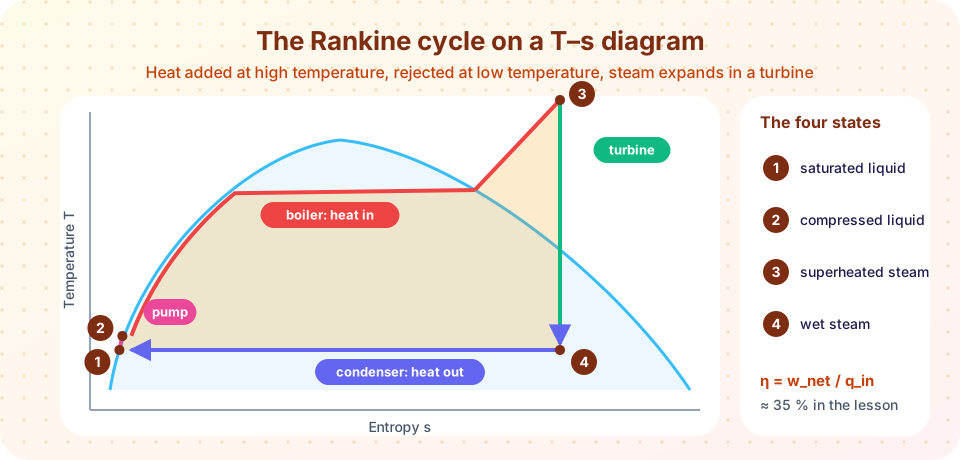
The ideal cycle has four steps, each analyzed as a steady-flow device with q − w = Δh when kinetic and potential energy changes are negligible.
- 1 → 2, pump (isentropic). Saturated liquid at condenser pressure is compressed to boiler pressure. The liquid is nearly incompressible, so
w_pump = v₁ (P₂ − P₁). - 2 → 3, boiler (constant pressure). The liquid is heated to saturation, boiled, and superheated.
q_in = h₃ − h₂. - 3 → 4, turbine (isentropic). The steam expands to condenser pressure, so
s₄ = s₃.w_turb = h₃ − h₄. - 4 → 1, condenser (constant pressure). Wet steam condenses fully.
q_out = h₄ − h₁.
Notice why this cycle uses a vapor and not a gas. Pumping a liquid takes v ΔP with v ≈ 0.001 m³/kg; compressing steam would take roughly a thousand times more work per kilogram because steam's specific volume is far larger. That is why the back work ratio, w_pump / w_turb, is under 1 % in our example but far higher in a gas turbine.
Worked example
Steam leaves the boiler at 4 MPa and 400 °C and condenses at 10 kPa. Find the efficiency.
Property values from standard steam tables (rounded, SI):
| State | Value |
|---|---|
| 3: 4 MPa, 400 °C | h₃ = 3213.6 kJ/kg, s₃ = 6.7690 kJ/(kg·K) |
| 1: saturated liquid at 10 kPa | h_f = 191.83 kJ/kg, v_f = 0.00101 m³/kg, s_f = 0.6493 |
| Evaporation at 10 kPa | h_fg = 2392.8 kJ/kg, s_fg = 7.5009 |
Pump. w_pump = 0.00101 × (4000 − 10) = 4.03 kJ/kg, so h₂ = 191.83 + 4.03 = 195.86 kJ/kg.
Turbine exit. s₄ = s₃ = 6.7690. The quality is x₄ = (6.7690 − 0.6493) / 7.5009 = 0.816, so h₄ = 191.83 + 0.816 × 2392.8 = 2144.0 kJ/kg. The steam is 18 % liquid at the exit.
Energy balance. w_turb = 3213.6 − 2144.0 = 1069.6 kJ/kg; w_net = 1069.6 − 4.0 = 1065.5 kJ/kg; q_in = 3213.6 − 195.9 = 3017.7 kJ/kg.
η = 1065.5 / 3017.7 = 35.3 %
The heat rejected is h₄ − h₁ = 1952.2 kJ/kg, and the check q_in − q_out = 3017.7 − 1952.2 = 1065.5 matches w_net.
Why the turbine exit matters
Wet steam is dangerous for turbines. Liquid droplets travelling at high speed erode the last blade rows. Designers keep the exit quality above roughly 0.85 to 0.90. Our example has x₄ = 0.816, which is lower than ideal, a hint that the next lesson on reheat and regeneration matters in practice.
The efficiency also depends on temperatures in a Carnot-like way. Raising the boiler pressure and temperature raises the average temperature at which heat is added; lowering the condenser pressure lowers the average rejection temperature. Both help efficiency, and both have limits: material strength on the hot side and the cooling water temperature on the cold side.
Real turbines are not isentropic
Friction and turbulence make a real turbine generate entropy, so s₄ > s₃ and the exit enthalpy is higher than the ideal value. The isentropic efficiency is η_t = (h₃ − h₄) / (h₃ − h₄s). A good large steam turbine has η_t around 85 to 90 %. The second TryIt below shows how quickly cycle efficiency falls when η_t drops, using the same table values.
Common misconceptions
"The turbine adds heat to the steam." No: an ideal turbine is adiabatic; the enthalpy drop becomes shaft work. "Condensing wastes the steam, so skip the condenser." The condenser lets the pump work on liquid, which is the whole reason the cycle is efficient. "Condenser heat is a defect of the plant." It is the required Q_C from the second law.
Try it
Press Run (or Ctrl + Enter) to see the result here.
Program input · what you'd type while the program runs
Type the answers before you press Run, one per line. Each time the program reads a line (with input()), it gets the next line from this box.
Press Run (or Ctrl + Enter) to see the result here.
Program input · what you'd type while the program runs
Type the answers before you press Run, one per line. Each time the program reads a line (with input()), it gets the next line from this box.
Check your understanding
Quick check · 5 questions
of 5 answered You scored / 5 · perfect!
-
1. Which Rankine process is assumed isentropic?
The ideal pump and turbine are adiabatic and reversible. The boiler and condenser are constant-pressure heat exchangers. -
2. Why is pump work so small compared with turbine work?
w_pump = v ΔP, and a liquid's specific volume is about a thousand times smaller than that of steam. -
3. In the worked example the turbine exit quality is 0.816. What does that mean?
Quality is the vapor mass fraction, so about 18 % is liquid droplets. -
4. Which change raises Rankine efficiency?
A lower condenser pressure lowers the average temperature of heat rejection, which moves the cycle closer to Carnot. -
5. A cycle receives 3000 kJ/kg and delivers 1050 kJ/kg of net work. What is its efficiency?
1050 / 3000 = 0.35, or 35 %.
Summary
- The ideal Rankine cycle is pump (isentropic), boiler (constant pressure), turbine (isentropic), condenser (constant pressure).
w_pump = v ΔP,w_turb = h₃ − h₄,q_in = h₃ − h₂,η = w_net / q_in.- In the example with 4 MPa, 400 °C and 10 kPa,
η ≈ 35.3 %and the exit quality is 0.816. - Raising boiler pressure or temperature and lowering condenser pressure improve efficiency; wet turbine exits and real losses limit the gains.
Next: Reheat and regeneration
Track your progress
Create a free account to tick off lessons and pick up where you left off on any device.
of Engineering Thermodynamics lessons completed