


















Lesson 36 of 48 · Gas Mixtures and Psychrometrics
Air-conditioning processes
Analyze heating, cooling with dehumidification, humidifying, evaporative cooling and adiabatic mixing of moist air with mass and energy balances, plus worked examples.
An air conditioner does far more than lower the temperature. It must also control humidity, which means removing water when the air is too damp and adding it when the air is too dry. Each action is a process that moves the air from one state on the psychrometric chart to another, and every process obeys two simple balances: conservation of mass (for dry air and for water) and conservation of energy.
What you will learn
- Identify each basic process on the psychrometric chart.
- Apply mass and energy balances to a steady-flow air stream.
- Compute heat removed and water condensed in a cooling coil.
- Find the state after mixing two air streams and after evaporative cooling.
Key terms
Sensible heat changes the temperature without changing humidity ratio. Latent heat changes the humidity ratio, because water evaporates or condenses. Cooling coil is a heat exchanger that cools air below its dew point to remove moisture. Adiabatic mixing is the blending of two streams with no heat transfer. Evaporative cooling is cooling air by evaporating water into it at nearly constant enthalpy.
The balances
For a steady-flow device handling ṁ_a kilograms per second of dry air:
- Dry-air mass:
ṁ_a,1 = ṁ_a,2. - Water mass:
ṁ_a ω₁ + ṁ_water,in = ṁ_a ω₂ + ṁ_liquid,out. - Energy:
Q̇ − Ẇ = ṁ_a (h₂ − h₁) + ṁ_liquid h_liquid − ṁ_water,in h_waterwithhof moist air per kg dry air.
Almost all the work lies in deciding which terms are zero.
Sensible heating and cooling
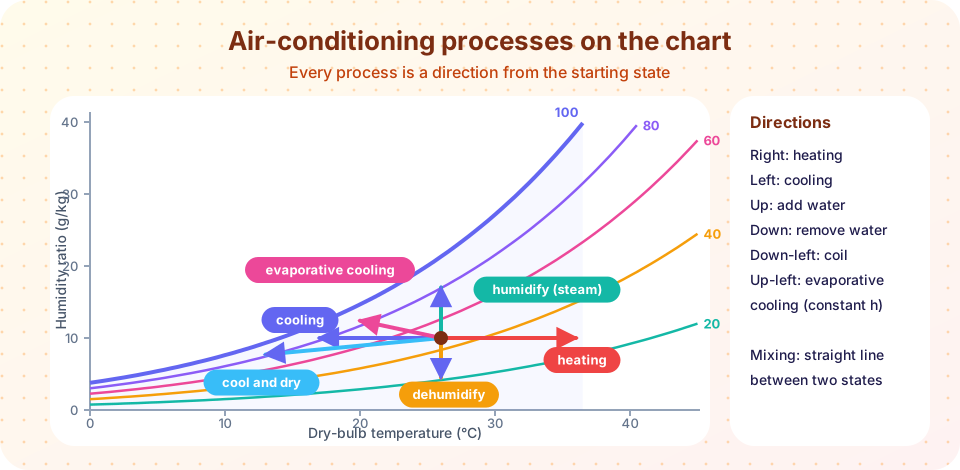
Warming air in a heating coil adds heat without changing its water content, so ω₂ = ω₁ and the process is a horizontal line on the chart: the state moves to the right, and relative humidity falls because P_g rises. For air at 10 °C and 80 % relative humidity warmed to 25 °C: ω = 0.00608, the relative humidity drops to 31 %, and the heat added is h₂ − h₁ = 40.6 − 25.4 = 15.2 kJ/kg of dry air.
Cooling without condensation is the reverse: a horizontal line to the left, with relative humidity rising. If you keep cooling, the line meets the saturation curve at the dew point, and below it condensation begins.
Cooling with dehumidification
When the coil surface is colder than the dew point, water condenses on it. The leaving air is nearly saturated at the coil temperature, and the process moves down and to the left.
Example. Air at 30 °C and 60 % relative humidity flows over a cooling coil and leaves saturated at 14 °C. Take atmospheric pressure of 101.325 kPa.
| State | Vapor pressure | ω (kg/kg) | h (kJ/kg dry air) |
|---|---|---|---|
| 1: 30 °C, 60 % | 2.55 kPa | 0.01605 | 71.2 |
| 2: 14 °C, saturated | 1.60 kPa | 0.00995 | 39.2 |
- Condensate:
ω₁ − ω₂ = 0.0061 kg per kg of dry air. - Heat removed:
q = (h₁ − h₂) − (ω₁ − ω₂) h_f = 71.2 − 39.2 − 0.0061 × 58.8 ≈ 31.6 kJ/kg.
Of that 32 kJ/kg, the latent part (removing the vapor) is large: roughly 0.0061 × 2450 ≈ 15 kJ/kg, nearly half. That is why a humid climate makes air conditioning so costly and why cooling coils are often run colder than comfort alone would require.
Humidification
To raise ω you add water as steam or as a spray. Steam humidification leaves temperature almost unchanged: the process line goes straight up. A water spray evaporates and cools the air as it humidifies: the line goes up and to the left, along a line of nearly constant enthalpy.
Evaporative cooling
If air passes through a wetted pad, water evaporates, ω rises, and the air temperature falls. With no heat exchange with the surroundings, the enthalpy is nearly constant, so the state slides along a line of constant wet-bulb temperature. The lowest temperature it can reach is the wet-bulb temperature. For air at 35 °C and 20 % relative humidity (ω = 0.00697, h = 53.1 kJ/kg), the wet-bulb temperature is about 18.9 °C, so an ideal evaporative cooler could deliver air near 19 °C, while a real one with 80 % effectiveness delivers 35 − 0.8 × (35 − 18.9) ≈ 22 °C. It works best in dry climates and adds humidity, so it fails where the air is already humid.
Adiabatic mixing of two streams
Many systems mix fresh outdoor air with recirculated room air. Energy and water balances give mass-weighted averages:
ω₃ = (ṁ₁ ω₁ + ṁ₂ ω₂) / (ṁ₁ + ṁ₂), h₃ = (ṁ₁ h₁ + ṁ₂ h₂) / (ṁ₁ + ṁ₂)
Then find T₃ from h = 1.005 T + ω(2501 + 1.82 T). On the chart, state 3 lies on the straight line joining 1 and 2, closer to the stream with the larger mass flow.
Example. Two kg/s of air at 32 °C and 70 % mixes with 1 kg/s at 12 °C and 90 %. The first has ω = 0.0211, h = 86.2; the second has ω = 0.00783, h = 31.8. The mix has ω = 0.01668, h = 68.0 kJ/kg, and from these T₃ = 25.4 °C with relative humidity of about 82 %. (If the mixing state were above saturation, fog would form.)
Common misconceptions
"Cooling air always lowers relative humidity." Cooling at constant ω raises φ, and once you hit 100 % the water condenses. "Dehumidifying only removes water." It removes energy too, because condensing vapor releases about 2450 kJ/kg. "Evaporative cooling is air conditioning." It cools by adding moisture and is limited by the wet-bulb temperature.
Try it
The calculators below use a formula for saturation pressure instead of steam tables, so their last digit can differ slightly from the table-based hand calculations above (for example, 0.00986 instead of 0.00988).
Press Run (or Ctrl + Enter) to see the result here.
Program input · what you'd type while the program runs
Type the answers before you press Run, one per line. Each time the program reads a line (with input()), it gets the next line from this box.
Check your understanding
Quick check · 6 questions
of 6 answered You scored / 6 · perfect!
-
1. During sensible heating of moist air, which quantity stays constant?
No water is added or removed, so ω is constant. Relative humidity falls. -
2. Why is condensation on a cooling coil useful and costly?
Condensing vapor releases about 2450 kJ/kg, which the coil must remove on top of the sensible cooling. -
3. Evaporative cooling follows approximately...
The cooling is adiabatic: the sensible energy lost equals the latent energy gained. -
4. What is the lowest temperature an evaporative cooler can reach?
The process stops at saturation on the constant wet-bulb line. -
5. Where does the state of two mixed air streams lie on the psychrometric chart?
Mixing averages ω and h by mass flow, so the result is on the straight line between them. -
6. A coil removes 0.006 kg of water per kg of dry air from 2 kg/s of dry air. How much condensate forms per hour?
0.006 × 2 × 3600 = 43.2 kg per hour.
Summary
- Sensible processes keep
ωconstant; latent processes changeω. - Cooling coil:
q = Δh − (ω₁ − ω₂) h_f; the example removes 31.6 kJ/kg and condenses 6.1 g/kg. - Evaporative cooling is roughly constant enthalpy and limited by the wet-bulb temperature.
- Mixing averages
ωandhby mass flow.
Next: Chapter 7 review
Track your progress
Create a free account to tick off lessons and pick up where you left off on any device.
of Engineering Thermodynamics lessons completed