


















Lesson 33 of 48 · Gas Mixtures and Psychrometrics
Chapter 7 overview: gas mixtures and psychrometrics
A map of Chapter 7: how to treat ideal gas mixtures, why air always carries some water vapor, and how psychrometric charts guide heating, cooling and humidity control.
So far we treated working fluids as pure substances: water, refrigerant, or air. Most real fluids are mixtures. Natural gas is a blend of hydrocarbons, exhaust gas holds nitrogen, carbon dioxide and water vapor, and the air in any room is a mixture of dry air and water vapor in changing proportions. This chapter gives you the tools to handle them, and then applies those tools to the most common mixture in engineering: moist air.
The big picture
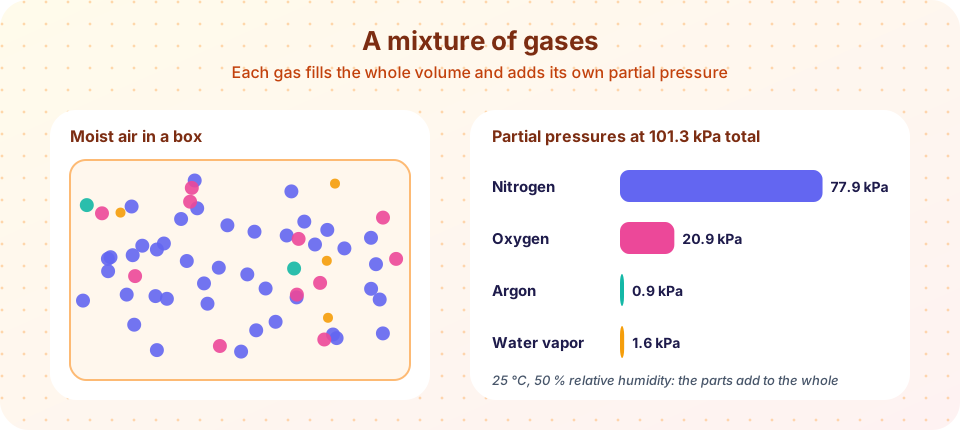
For a mixture of ideal gases, three simple rules cover most of the work:
- Dalton's law: each gas behaves as if it alone occupied the container, so the total pressure is the sum of the partial pressures,
P = Σ Pᵢ, andPᵢ = yᵢ P, whereyᵢis the mole fraction. - Mass and energy add up: mixture properties such as
M,R,c_pandhcome from weighted sums of the components. - Water is special: water vapor in air can condense, so its partial pressure cannot exceed the saturation pressure at the air temperature. That upper limit creates humidity, dew points, wet bulbs and the entire field of psychrometrics.
Psychrometrics is the thermodynamics of moist air, and it drives air-conditioning design, cooling towers, drying of food and timber, and comfort in buildings.
Mixtures are everywhere
Three tools
Humid air
The chart
What each lesson covers
| Lesson | Topic |
|---|---|
| Ideal gas mixtures | Mole and mass fractions, Dalton's and Amagat's laws, mixture properties |
| Properties of humid air | Humidity ratio, relative humidity, dew point, wet bulb, enthalpy |
| Air-conditioning processes | Heating, cooling, dehumidifying, humidifying, mixing and evaporative cooling |
| Chapter review | Recap picture, table and ten-question quiz |
Key terms
Mole fraction is moles of one gas divided by the total moles. Partial pressure is the pressure that gas would exert alone at the same temperature and volume. Humidity ratio ω is the mass of water vapor per kilogram of dry air. Relative humidity φ is the ratio of vapor pressure to saturation pressure. Psychrometrics is the study of moist air properties.
Common misconceptions
"Humid air is heavier than dry air." Water vapor (18 g/mol) is lighter than nitrogen and oxygen, so moist air is slightly less dense than dry air at the same temperature and pressure. "100 % humidity means the air is all water." It means the vapor pressure equals the saturation pressure.
Try it
Press Run (or Ctrl + Enter) to see the result here.
Program input · what you'd type while the program runs
Type the answers before you press Run, one per line. Each time the program reads a line (with input()), it gets the next line from this box.
Check your understanding
Quick check · 5 questions
of 5 answered You scored / 5 · perfect!
-
1. According to Dalton's law, the total pressure of a gas mixture is...
Each ideal gas contributes its own partial pressure, and they add. -
2. A mixture has 4 mol of N2 and 1 mol of O2 at 100 kPa. What is the partial pressure of O2?
y = 1/5 = 0.2, so P = 0.2 × 100 = 20 kPa. -
3. What is the humidity ratio ω?
ω = m_v / m_a. The ratio of pressures is relative humidity φ. -
4. Why is humid air less dense than dry air at the same T and P?
M(H2O) = 18 kg/kmol, less than the average 28.97 of dry air. -
5. The study of moist air properties is called...
Psychrometrics covers humidity, dew point, wet bulb and air-conditioning processes.
Summary
- Mixtures of ideal gases follow Dalton's law:
P = Σ PᵢandPᵢ = yᵢ P. - Mixture properties are weighted sums of component properties.
- Moist air is dry air plus water vapor, and vapor pressure is limited by saturation.
- Psychrometrics describes humidity, dew point and wet bulb and guides air-conditioning design.
Next: Ideal gas mixtures
Track your progress
Create a free account to tick off lessons and pick up where you left off on any device.
of Engineering Thermodynamics lessons completed