


















Lesson 44 of 48 · Projects and Practice
Case study: sizing an air-conditioning coil
Size the supply airflow and cooling coil for a small room using sensible and latent loads, a mixing box and a psychrometric calculation, step by step.
Psychrometrics becomes real when you have to decide how many kilograms of air per second to blow into a room, how cold the air should be and how large the cooling coil must be. This case study follows a small design from the loads to the coil, using only ideas from Chapter 7. The numbers are an illustration, not a design rule for a real building, where codes and detailed load calculations apply.
What you will learn
- Convert sensible and latent room loads into a supply airflow and a supply humidity ratio.
- Find the mixed-air state of outdoor air and return air.
- Calculate coil cooling power and condensate.
- Check that the design is physically feasible.
Key terms
Sensible load is heat that raises air temperature (people, lights, sun through windows). Latent load is moisture added to the air (breathing, cooking). Supply air is the air delivered to the room. Return air is air drawn back from the room. Coil load is the heat the cooling coil must remove from the mixed air.
The problem
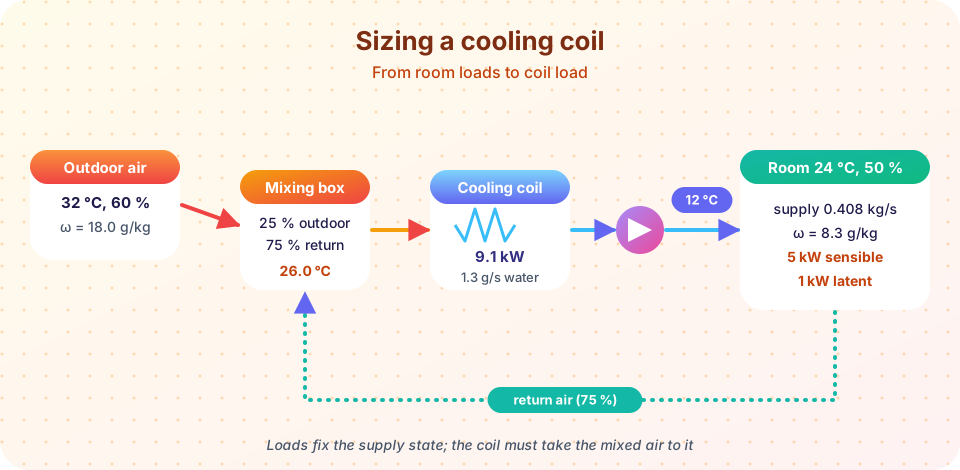
A small office is kept at 24 °C and 50 % relative humidity. The loads are 5 kW sensible and 1 kW latent (equivalent to about 0.4 g/s of moisture released inside). Outdoor design conditions are 32 °C and 60 % relative humidity, and 25 % of the supply air must be outdoor air for ventilation. Supply air leaves the coil at 12 °C. Atmospheric pressure is 101.325 kPa.
Step 1: room state
At 24 °C, P_g = 2.98 kPa and P_v = 1.49 kPa. Then ω_room = 0.622 × 1.49 / (101.325 − 1.49) = 0.00928, and the enthalpy is h_room = 47.7 kJ/kg of dry air.
Step 2: supply airflow from the sensible load
The supply air at 12 °C must absorb 5 kW as it warms to 24 °C. Moist air has a specific heat of about 1.005 + 1.82 ω ≈ 1.022 kJ/(kg·K), so
ṁ_a = 5 / (1.022 × (24 − 12)) = 0.408 kg/s
(roughly 0.35 m³/s, or 1,250 m³/h, at about 0.85 m³/kg).
Step 3: supply humidity from the latent load
The air must absorb the moisture released in the room. The latent load of 1 kW corresponds to 1 / 2450 = 0.000408 kg/s of water. The supply air has to be drier than the room by
Δω = 0.000408 / 0.408 = 0.001, so ω_supply = 0.00928 − 0.00100 = 0.00828.
At 12 °C the saturation humidity ratio is about 0.0087, so the supply state is at about 95 % relative humidity: just inside the feasible region. If the required ω had come out above the saturation value at 12 °C, the design would be impossible at that supply temperature and we would have to use a colder coil.
Step 4: mixed air at the coil inlet
Outdoor air at 32 °C and 60 % has ω_o = 0.0180 and h_o = 78.2 kJ/kg. Mixing 25 % outdoor and 75 % return air (by mass of dry air):
ω_m = 0.25 × 0.0180 + 0.75 × 0.00928 = 0.01146
h_m = 0.25 × 78.2 + 0.75 × 47.7 = 55.3 kJ/kg
which corresponds to T_m = 26.0 °C.
Step 5: coil load and condensate
The coil must take the air from state m (ω = 0.01146, h = 55.3) to the supply state (ω = 0.00828, h = 32.9 kJ/kg):
Δh = 55.3 − 32.9 = 22.4 kJ/kg.- Condensate:
ṁ_a Δω = 0.408 × (0.01146 − 0.00828) = 1.30 g/s, about 4.7 kg/h. - Condensate enthalpy at about 11 °C is
4.186 × 11 = 46 kJ/kg, so the correction is0.00132 × 46 ≈ 0.06 kW.
Q_coil = 0.408 × 22.4 − 0.06 = 9.08 kW
Compare with the room load of 6 kW: the extra 3 kW comes from cooling the outdoor air that the ventilation brings in, which shows why ventilation loads are a major part of air-conditioning design in hot, humid climates. With a refrigeration COP of about 3, the compressor would draw roughly 3 kW.
Check that the design is physically sensible
Three tests every psychrometric design should pass:
- The supply state must lie below the saturation curve.
- The coil outlet cannot be below the coil surface temperature, which is below the dew point of the mixed air if condensation is required (here, mixed-air dew point is about 16 °C).
- The sensible-to-total ratio (here
5 / 6 = 0.83) must be consistent with the coil process line: a coil handling this ratio needs to cool the air below the room dew point, and a coil at 12 °C does.
Common misconceptions
"The coil load equals the room load." It also includes the outdoor-air load and any fan and duct gains. "Cold supply air always dehumidifies." Only if its humidity ratio is below the room value, which requires a coil colder than the room dew point. "Condensate is a nuisance only." It is also a quantity to drain and an energy term in the balance.
Try it
Press Run (or Ctrl + Enter) to see the result here.
Program input · what you'd type while the program runs
Type the answers before you press Run, one per line. Each time the program reads a line (with input()), it gets the next line from this box.
Press Run (or Ctrl + Enter) to see the result here.
Program input · what you'd type while the program runs
Type the answers before you press Run, one per line. Each time the program reads a line (with input()), it gets the next line from this box.
Check your understanding
Quick check · 5 questions
of 5 answered You scored / 5 · perfect!
-
1. Which load sets the supply airflow when the supply temperature is fixed?
ṁ_a = Q_sens / (c_p ΔT). -
2. A latent load of 2 kW corresponds to about how much water per second?
2 / 2450 = 0.0008 kg/s. -
3. Why might a design be infeasible?
Air cannot hold more vapor than saturation allows. -
4. Why is the coil load larger than the room load in the example?
Mixing in warm, humid outdoor air raises the enthalpy that the coil must remove. -
5. Mixed-air enthalpy is computed as...
The energy balance on adiabatic mixing weights by dry-air mass flow.
Summary
- Sensible load fixes airflow; latent load fixes supply humidity.
- Mixed air is a mass-weighted average of
ωandh. - Coil load
≈ ṁ_a (h_m − h_s)minus the condensate enthalpy; the example needs 9.1 kW for a 6 kW room load. - Always check feasibility: supply below saturation and the coil colder than the mixed-air dew point.
Next: Practice problem set
Track your progress
Create a free account to tick off lessons and pick up where you left off on any device.
of Engineering Thermodynamics lessons completed