


















Lesson 11 of 48 · The First Law
The First Law: Chapter Overview
Preview chapter 3: the first law as an energy bookkeeping rule for closed systems and control volumes, with heat, work, internal energy and enthalpy, and a road map of the lessons.
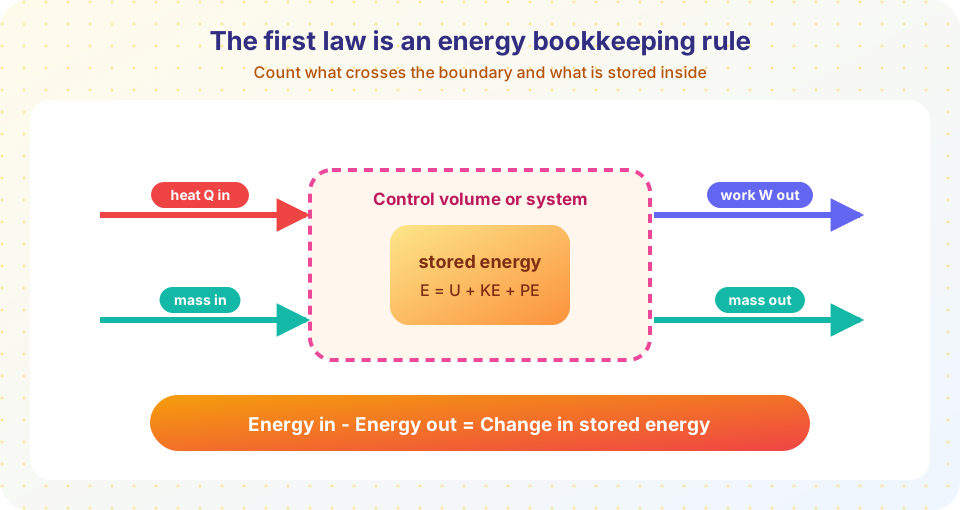
Energy cannot be created or destroyed; it can only change form or move. That one sentence, the first law of thermodynamics, is the most powerful bookkeeping rule in engineering. If you know what crosses the boundary of your system and what was stored at the start, you can find what is stored at the end. Turbines, compressors, boilers, engines and even your own body obey it, so this chapter is where thermodynamics becomes a tool for calculation.
What you will learn
- The statement of the first law and its two main forms: closed systems and control volumes.
- The ways energy crosses a boundary: heat, work and (for open systems) mass flow.
- The sign convention used throughout this course.
- A map of the four lessons that follow.
Key terms
Heat Q: energy transferred because of a temperature difference.
Work W: energy transferred by a force acting through a distance (or an equivalent such as torque and rotation).
Internal energy U: the microscopic energy of molecules (motion, vibration, bonds).
Total energy E: E = U + KE + PE, internal plus kinetic plus potential energy.
The chapter at a glance
Energy crosses the boundary
The balance
Used in devices
What each lesson covers
- Heat and work: sign convention, boundary work, and other forms of work.
- Energy balance for closed systems:
Q − W = ΔU, specific heats and worked examples. - Energy balance for control volumes: mass conservation, flow work and enthalpy.
- Steady-flow devices: turbines, compressors, nozzles, throttles and heat exchangers.
- Chapter 3 review: recap and a ten-question quiz.
The first law in one line
For any system over any time interval:
E_in − E_out = ΔE_system
For a closed system with only heat and work, this becomes Q − W = ΔU when the kinetic and potential energy of the system do not change. In this course heat into the system is positive and work done by the system is positive. Some textbooks use the opposite sign for work, so always check the convention before comparing formulas.
A useful mental picture is a bank account: the stored energy is the balance, heat and work are deposits and withdrawals, and flowing mass is a third kind of transaction. The first law says the books balance, nothing more. It does not say which transactions are possible; that is the job of the second law in chapter 4.
Try it
The first block is a one-line energy bookkeeper for closed systems; the second compares heating a gas in a rigid tank with heating it at constant pressure.
Press Run (or Ctrl + Enter) to see the result here.
Program input · what you'd type while the program runs
Type the answers before you press Run, one per line. Each time the program reads a line (with input()), it gets the next line from this box.
Press Run (or Ctrl + Enter) to see the result here.
Program input · what you'd type while the program runs
Type the answers before you press Run, one per line. Each time the program reads a line (with input()), it gets the next line from this box.
Check your understanding
Quick check · 4 questions
of 4 answered You scored / 4 · perfect!
-
1. In this course, which sign do heat into a system and work done by a system have?
Q in is positive and W by the system is positive, giving Q - W = delta U. -
2. A closed system receives 80 kJ of heat and does 30 kJ of work. Its internal energy changes by
delta U = Q - W = 80 - 30 = +50 kJ. -
3. What does the first law NOT tell you?
Possibility and direction come from the second law. -
4. Which is NOT a way for energy to cross a closed-system boundary?
Mass does not cross the boundary of a closed system; heat and work can.
Summary
- The first law is energy conservation:
E_in − E_out = ΔE. - Closed system:
Q − W = ΔU(when KE and PE are unchanged); heat in and work out are positive. - Open systems add the energy carried by flowing mass, handled with enthalpy.
- The law balances the books but does not say which processes can happen.
Next: Heat and Work
Track your progress
Create a free account to tick off lessons and pick up where you left off on any device.
of Engineering Thermodynamics lessons completed