


















Lesson 20 of 48 · The Second Law and Entropy
Entropy and the T ds Relations
Define entropy from the Clausius inequality, calculate entropy change for ideal gases, liquids and steam mixtures with the T ds relations, and use isentropic relations with worked examples.
Energy is conserved, but something else is not: usefulness. Hot coffee in a cold room has the potential to run a tiny engine; lukewarm coffee in a lukewarm room has none. The quantity that captures this loss of potential is entropy. This lesson defines it from the Carnot results, explains why it can only increase in isolated systems, and gives the formulas you need to compute entropy changes for the fluids in this course.
What you will learn
- The Clausius inequality and the definition of entropy as a property.
- The principle of increase of entropy.
- The
T dsrelations and entropy change for ideal gases and liquids. - Isentropic relations for ideal gases and entropy in mixtures.
Key terms
Entropy S: a property defined by dS = δQ_rev / T; units kJ/K (specific entropy s: kJ/(kg·K)).
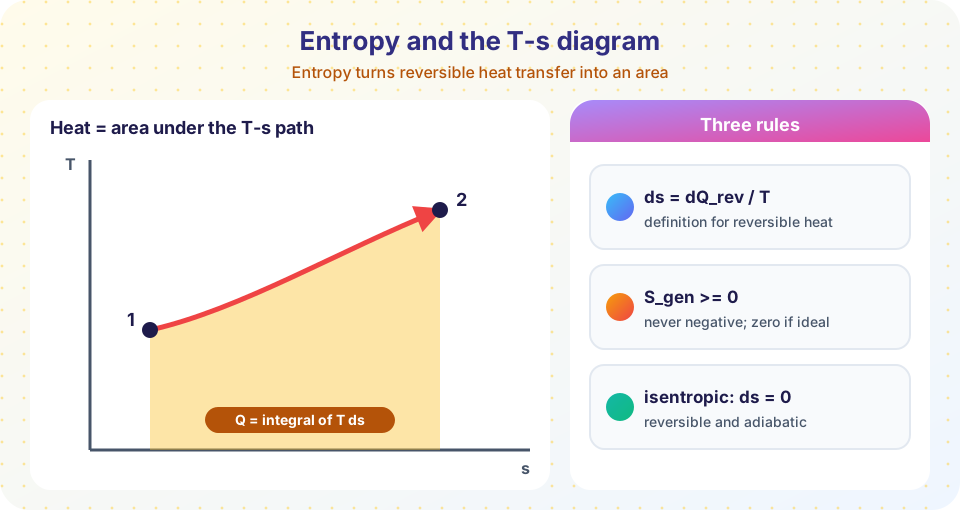
Isentropic process: a process with constant entropy, reversible and adiabatic.
Entropy generation S_gen: entropy created by irreversibilities; never negative.
Principle of increase of entropy: for an isolated system, ΔS ≥ 0.
From Carnot to entropy
For a reversible engine Q_H/T_H = Q_L/T_L. Generalizing to any cycle gives the Clausius inequality:
∮ δQ / T ≤ 0
with equality for reversible cycles. This implies that for a reversible process the integral ∫ δQ_rev / T is path-independent, so it defines a property:
dS = (δQ / T)_rev, so S₂ − S₁ = ∫₁² (δQ/T)_rev
and for any process S₂ − S₁ ≥ ∫ δQ / T. The difference is the entropy generated by irreversibilities. Consequently, for an isolated system ΔS ≥ 0: entropy increases in real processes and stays constant only in reversible ones. In a reversible process, δQ = T dS, so heat is the area under the path on a T-s diagram.
Example: heat flow across a temperature difference. 1,000 kJ flows from a reservoir at 500 K to one at 300 K. The hot one loses 1000/500 = 2.0 kJ/K; the cold one gains 1000/300 = 3.33 kJ/K. Net change +1.33 kJ/K > 0: the process is irreversible and allowed. Reverse the direction and the total would be −1.33 kJ/K: forbidden by the second law.
The T ds relations
Combining the first law for a reversible process with δQ = T dS and δW = P dV, per unit mass:
T ds = du + P dv and T ds = dh − v dP
They hold for any process between equilibrium states, because they relate properties only.
Ideal gas
With du = c_v dT, dh = c_p dT and P v = R T:
s₂ − s₁ = c_p ln(T₂/T₁) − R ln(P₂/P₁)
s₂ − s₁ = c_v ln(T₂/T₁) + R ln(v₂/v₁)
Example. Air (1 kg) is heated from 300 K to 600 K at constant pressure: Δs = 1.005 × ln 2 = 0.697 kJ/(kg·K). If instead it is compressed from 100 to 600 kPa at constant temperature: Δs = −0.287 × ln 6 = −0.514 kJ/(kg·K), a decrease, accompanied by heat leaving the gas.
For a constant s (isentropic) process with constant specific heats:
T₂/T₁ = (P₂/P₁)^((k−1)/k) and P v^k = constant
Example. Air at 100 kPa and 300 K compressed isentropically to 600 kPa: T₂ = 300 × 6^0.2857 ≈ 500 K.
Incompressible liquids and solids
Δs = c ln(T₂/T₁). Heating 1 kg of water from 20 to 80 °C: Δs = 4.18 × ln(353.15/293.15) = 0.778 kJ/(kg·K).
Water and refrigerants
Entropy is tabulated like v, u and h. In a mixture, s = s_f + x s_fg. For saturated water at 100 kPa, s_f = 1.3028 and s_fg = 6.0562 kJ/(kg·K) (rounded table values), so s_fg = h_fg/T_sat = 2257.5/372.76 = 6.056: the entropy of vaporization is the latent heat over the saturation temperature. For a reversible isothermal phase change, ΔS = Q/T.
Common misconceptions
"Entropy is disorder, period." Disorder is a helpful analogy, but engineering entropy is defined by heat and temperature and measured in kJ/K.
"Entropy of a system can never decrease." Only the entropy of an isolated system (or system plus surroundings) cannot decrease. A refrigerator lowers the entropy of its contents while raising the entropy of the room by more.
"Isentropic means adiabatic." It means adiabatic and reversible.
Try it
Press Run (or Ctrl + Enter) to see the result here.
Program input · what you'd type while the program runs
Type the answers before you press Run, one per line. Each time the program reads a line (with input()), it gets the next line from this box.
Press Run (or Ctrl + Enter) to see the result here.
Program input · what you'd type while the program runs
Type the answers before you press Run, one per line. Each time the program reads a line (with input()), it gets the next line from this box.
Check your understanding
Quick check · 5 questions
of 5 answered You scored / 5 · perfect!
-
1. Which is the correct definition of entropy change?
dS = (delta Q / T) for a reversible path. -
2. 1000 kJ flows from 600 K to 300 K. The total entropy change is
1000/300 - 1000/600 = 3.33 - 1.67 = +1.67 kJ/K. -
3. Air (cp = 1.005) is heated from 300 K to 450 K at constant pressure. Delta s is about
1.005 x ln(1.5) = 1.005 x 0.4055 = 0.407 kJ/kg K. -
4. An isentropic process is
dS = dQ_rev/T = 0 with no heat transfer and no irreversibility. -
5. For an isolated system, the entropy
Delta S >= 0 with equality only for reversible processes.
Summary
- Entropy is a property defined by
dS = δQ_rev/T; the Clausius inequality givesΔS ≥ ∫ δQ/T. T ds = du + P dv = dh − v dP; ideal gasΔs = c_p ln(T₂/T₁) − R ln(P₂/P₁); liquidsΔs = c ln(T₂/T₁).- Isentropic ideal gas:
T₂/T₁ = (P₂/P₁)^((k−1)/k). - Entropy of an isolated system never decreases; reversible heat is the area under the
T-spath.
Track your progress
Create a free account to tick off lessons and pick up where you left off on any device.
of Engineering Thermodynamics lessons completed