


















Lesson 1 of 48 · Getting Started
Course Map: Welcome to Engineering Thermodynamics
Start here: what engineering thermodynamics is, who this free course is for, the nine chapters from systems and units to power cycles and combustion, and how to study.
A car engine turns fuel into motion. A refrigerator moves heat from cold food into a warm kitchen. A power station boils water and spins a generator that lights a city. All three machines obey the same few rules, and those rules are the subject of engineering thermodynamics: how energy is stored, how it moves as heat and work, and why some conversions are easy while others are impossible.
This course is a complete introduction written for upper-secondary students, first-year engineering students and anyone who wants to finally understand how engines, power plants and air conditioners work. It follows the common core of university syllabi worldwide. You need basic algebra, a little calculus (we only integrate simple expressions) and the ideas of force, energy and power from school physics. Everything else is built from scratch, and every calculation is done in SI units.
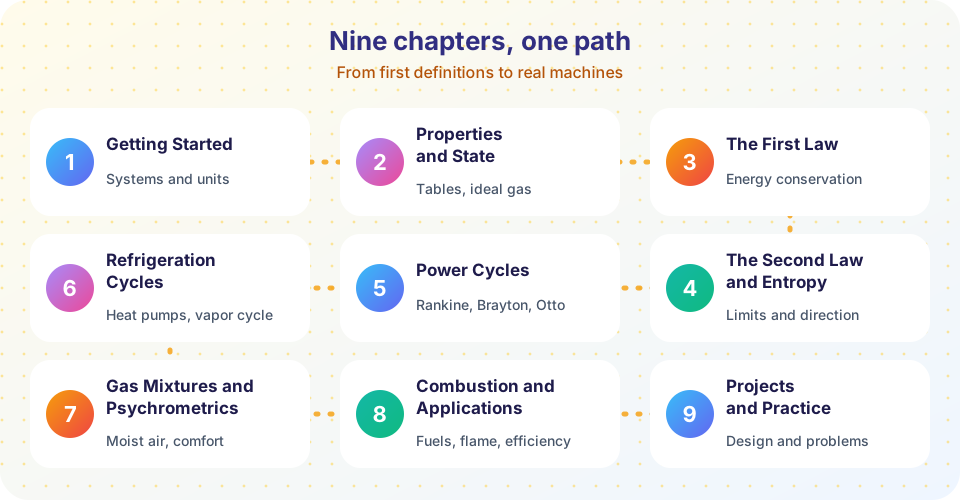
What you will learn
- What a thermodynamic system, state and process are, and how to describe them with properties.
- How to find properties of water, steam and gases from tables and equations.
- How the first law (energy conservation) and the second law (direction and limits) work together.
- How to analyze engines, refrigerators, mixtures of air and water vapor, and combustion.
- A repeatable method for solving thermodynamics problems without getting lost.
Key terms
Thermodynamics: the science of energy, its forms, and its conversion between heat and work.
System: the part of the universe you choose to study; everything else is the surroundings.
Property: a measurable characteristic of a system, such as pressure, temperature or volume.
Energy: the capacity to cause change; it is conserved, but not all of it is equally useful.
Cycle: a series of processes that returns a system to its starting state, as in every engine.
The nine chapters at a glance
Chapters 1 to 3: the foundations
- Getting Started
- Properties and State
- The First Law
Chapter 4: the second law
Chapters 5 and 6: machines
- Power Cycles
- Refrigeration
Chapters 7 to 9: mixtures and practice
- Moist Air
- Combustion
- Practice
Chapters 1 to 4 (the first half of the course) give you the language and the two great laws. Chapters 5 to 9 use them on real equipment and finish with projects.
How to study this course
Read a lesson once for the idea, then work through the examples with a pencil. Do not skim the equations: type the numbers into the interactive blocks and change them to see what happens. Every lesson has a short quiz; if you miss a question, read its explanation and try again later. Three habits separate people who master thermodynamics from people who memorize it:
- Draw the system and its boundary before writing any equation. A clear sketch prevents most sign errors.
- Write units on every number. Thermodynamics mixes kPa, kJ, kg, K and m³; the units tell you when an equation is wrong.
- List your assumptions (steady flow, ideal gas, negligible kinetic energy). Each assumption is a simplification you can justify or revisit.
Keep a one-page "formula sheet" of your own. Rewriting each rule in your own words is the best revision method, and the chapter review lessons give you a picture to copy from.
Why the subject matters
Most of the world's electricity still comes from heat engines of some kind: coal, gas, nuclear and many renewable plants boil water or burn gas to drive turbines. Making a plant 1 percentage point more efficient saves enormous quantities of fuel, and the limit on how efficient it can be is set by the second law, not by engineering skill. Engineers who understand both laws can estimate in minutes whether a proposed machine is realistic.
A first taste: heating water
Before the formal tools arrive, here is a calculation you can already do. The energy needed to warm a mass m of water by ΔT is about Q = m × c × ΔT, where c ≈ 4.18 kJ/(kg·K) is the specific heat of liquid water.
Press Run (or Ctrl + Enter) to see the result here.
Program input · what you'd type while the program runs
Type the answers before you press Run, one per line. Each time the program reads a line (with input()), it gets the next line from this box.
The next block plots the full story for 1 kg of liquid water at atmospheric pressure. It rises about 100 °C for roughly 418 kJ and then stays at 100 °C while it takes a further 2,257 kJ to turn into steam. Phase change costs more than five times as much energy as the heating. You will learn exactly why in chapter 2.
Press Run (or Ctrl + Enter) to see the result here.
Program input · what you'd type while the program runs
Type the answers before you press Run, one per line. Each time the program reads a line (with input()), it gets the next line from this box.
Check your understanding
Quick check · 4 questions
of 4 answered You scored / 4 · perfect!
-
1. What is a thermodynamic system?
You choose the system. Everything outside the boundary is the surroundings. -
2. Which habit prevents most sign and unit errors?
A sketch of the boundary and careful units catch most mistakes before they spread. -
3. How many chapters does the course have, and which two laws form the core of chapters 3 and 4?
There are nine chapters. Chapter 3 covers the first law (energy conservation) and chapter 4 the second law (direction and limits). -
4. Water at 100 C takes about 2,257 kJ/kg to boil but only about 418 kJ/kg to heat from 0 C to 100 C. What does this show?
The latent heat of vaporization is more than five times larger than the heat needed to warm the liquid through 100 degrees.
Summary
- Thermodynamics studies energy, heat, work and why conversions have limits.
- The course has nine chapters: foundations and laws first, machines and practice second.
- Good problem solving starts with a system sketch, units and stated assumptions.
- Phase change needs a lot of energy, a fact that shapes power plants and refrigerators.
Track your progress
Create a free account to tick off lessons and pick up where you left off on any device.
of Engineering Thermodynamics lessons completed