


















Lesson 13 of 48 · The First Law
Energy Balance for Closed Systems
Apply the first law to closed systems: Q minus W equals the change in energy, internal energy and enthalpy of ideal gases with cv and cp, constant-pressure heating, adiabatic compression and cycles.
Now we put heat, work and properties together. For a fixed mass of fluid in a rigid tank, a piston-cylinder or a sealed container, the first law reduces to a one-line equation that, combined with property relations from chapter 2, answers the questions engineers actually ask: how much heat is needed, how much work will this do, how hot will it get?
What you will learn
- The closed-system energy balance, including kinetic and potential energy.
- How to find
ΔuandΔhfor ideal gases withc_vandc_p. - Why heat added at constant pressure equals the change in enthalpy.
- How to apply the balance to cycles.
Key terms
Specific heat at constant volume c_v: c_v = (∂u/∂T)_v, the energy needed per kg per kelvin when volume is fixed.
Specific heat at constant pressure c_p: c_p = (∂h/∂T)_p, always larger than c_v for gases.
Enthalpy H: H = U + P V.
Specific heat ratio k: k = c_p/c_v, about 1.4 for air at room temperature.
The balance
For a closed system:
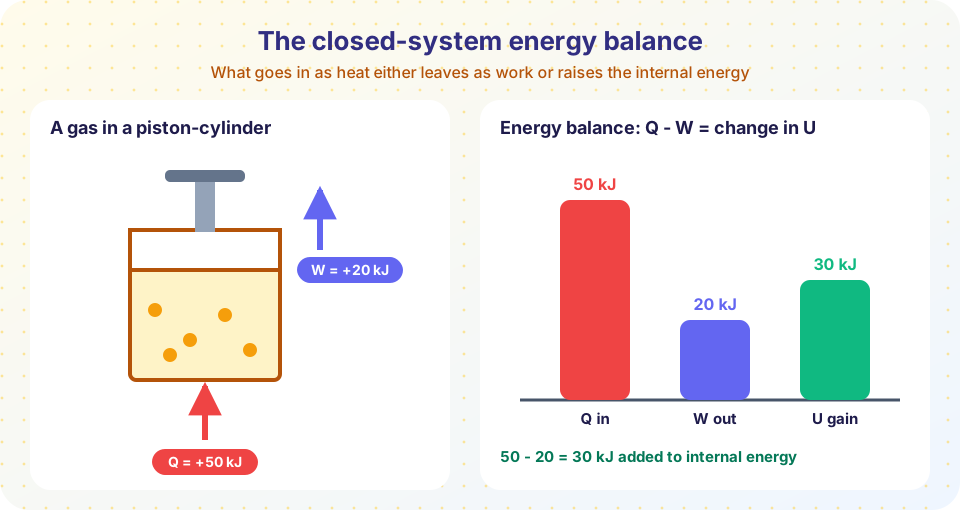
Q − W = ΔU + ΔKE + ΔPE
with ΔKE = ½ m (V₂² − V₁²) and ΔPE = m g (z₂ − z₁). For most thermodynamic systems at rest the last two vanish: Q − W = ΔU = m (u₂ − u₁). Remember that Q is net heat in and W is net work out. On a rate basis, Q̇ − Ẇ = dE/dt.
Special cases.
- Rigid container:
W = 0(no boundary movement) soQ = ΔU. - Adiabatic:
Q = 0soW = −ΔU; compressing the gas raises its energy. - Isolated:
Q = W = 0soΔU = 0. - Cycle: the system returns to its start, so
ΔU = 0andQ_net = W_net.
Internal energy and enthalpy of ideal gases
For an ideal gas, u depends only on temperature. Over modest temperature ranges Δu = c_v ΔT and Δh = c_p ΔT, with h = u + R T implying c_p − c_v = R. For air near room temperature:
c_v = 0.718 kJ/(kg·K), c_p = 1.005 kJ/(kg·K), R = 0.287, k = 1.4
(Specific heats grow slowly with temperature; for large ranges use tabulated u(T) and h(T) values.) For incompressible liquids and solids c_v ≈ c_p ≈ c and Δu = c ΔT (water: c ≈ 4.18 kJ/(kg·K)). For steam and refrigerants, read u from tables rather than assuming ideal behavior.
Worked examples
Example 1: rigid tank. 2 kg of air is heated in a rigid tank from 300 K to 500 K. W = 0, so Q = m c_v ΔT = 2 × 0.718 × 200 = 287.2 kJ.
Example 2: constant-pressure heating. 1 kg of air in a piston-cylinder at constant pressure is heated by 100 K. The work is W = P ΔV = m R ΔT = 28.7 kJ, the internal energy change is 71.8 kJ, and the heat needed is 100.5 kJ. Written generally, with only boundary work at constant pressure: Q − P(V₂ − V₁) = U₂ − U₁, so Q = H₂ − H₁. This is why enthalpy is so convenient: at constant pressure the heat equals the enthalpy change, which also explains why c_p is used for heating at constant pressure.
Example 3: adiabatic compression. 0.5 kg of air is compressed in an insulated piston-cylinder from 300 K to 400 K. Q = 0, so W = −ΔU = −0.5 × 0.718 × 100 = −35.9 kJ: 35.9 kJ of work is done on the air.
Example 4: braking car. A 1,000 kg car at 20 m/s brakes to rest. The kinetic energy ½ × 1000 × 20² = 200 kJ is converted to heat in the brakes and warms them (and the surrounding air).
Example 5: a heat engine cycle. Over one cycle, an engine receives Q_in = 500 kJ, rejects Q_out = 300 kJ. Then ΔU = 0 so W_net = 500 − 300 = 200 kJ and the thermal efficiency is η = W_net/Q_in = 0.40. Notice the first law only tells you the work; whether 40 % is possible is a second-law question (chapter 4).
Common misconceptions
"Q = m c_v ΔT for any process." That is correct only when no work is done (rigid container). Otherwise use the full balance.
"c_p and c_v are the same." For gases c_p = c_v + R; the extra energy goes into boundary work when the gas expands.
"ΔU = 0 means no heat flows." In an isothermal ideal-gas process ΔU = 0 but Q = W can be large.
Try it
The first block applies the balance to four processes and plots heat, work and internal energy side by side. The second block runs an engine cycle calculation.
Press Run (or Ctrl + Enter) to see the result here.
Program input · what you'd type while the program runs
Type the answers before you press Run, one per line. Each time the program reads a line (with input()), it gets the next line from this box.
Press Run (or Ctrl + Enter) to see the result here.
Program input · what you'd type while the program runs
Type the answers before you press Run, one per line. Each time the program reads a line (with input()), it gets the next line from this box.
Check your understanding
Quick check · 5 questions
of 5 answered You scored / 5 · perfect!
-
1. A rigid tank holds 3 kg of air heated from 300 K to 400 K (cv = 0.718 kJ/kg K). The heat added is
W = 0 so Q = m cv dT = 3 x 0.718 x 100 = 215.4 kJ. -
2. For an ideal gas, cp - cv equals
From h = u + RT: dh/dT - du/dT = R. -
3. A gas is compressed adiabatically with 60 kJ of work done on it. The change in its internal energy is
Q = 0 and W = -60 kJ, so delta U = Q - W = +60 kJ. -
4. Over a complete cycle, the net heat in equals
delta U = 0 for a cycle, so Q_net = W_net. -
5. At constant pressure with only boundary work, Q equals
Q - P delta V = delta U gives Q = delta (U + PV) = delta H.
Summary
- Closed system:
Q − W = ΔU + ΔKE + ΔPE; for cyclesQ_net = W_net. - Ideal gases:
Δu = c_v ΔT,Δh = c_p ΔT,c_p − c_v = R. - At constant pressure
Q = ΔH; in a rigid vesselQ = ΔU. - The first law gives energy amounts but not possibility; that is the second law's job.
Track your progress
Create a free account to tick off lessons and pick up where you left off on any device.
of Engineering Thermodynamics lessons completed