


















Lesson 19 of 48 · The Second Law and Entropy
The Carnot Cycle and Absolute Temperature
Learn the four processes of the reversible Carnot cycle, the Carnot efficiency 1 - TL/TH, the Carnot principles and the maximum COP of refrigerators and heat pumps, with worked examples.
How efficient can an engine possibly be? Sadi Carnot answered in 1824, long before the first law was formulated, by imagining an ideal engine free of all irreversibilities. His result is one of the most beautiful in physics: the best possible efficiency depends only on the temperatures of the hot and cold reservoirs, not on the working fluid, the size or the cleverness of the design.
What you will learn
- The four reversible processes of the Carnot cycle.
- The Carnot efficiency and the two Carnot principles.
- The Carnot COP of refrigerators and heat pumps.
- Why the Kelvin scale is called thermodynamic temperature.
Key terms
Carnot cycle: a reversible cycle of two isothermal and two adiabatic processes.
Carnot efficiency: η_Carnot = 1 − T_L/T_H with temperatures in kelvin.
Carnot principles: (1) an irreversible engine is less efficient than a reversible one between the same reservoirs; (2) all reversible engines between the same reservoirs have the same efficiency.
Thermodynamic temperature scale: a scale defined by the ratio Q_L/Q_H = T_L/T_H of a reversible engine.
The four processes
A Carnot cycle uses any fluid in a piston-cylinder, an ideal gas for simplicity:
- Isothermal expansion at
T_H: the gas absorbsQ_Hfrom the hot reservoir and does work. Heat transfer is reversible because the gas is only infinitesimally cooler than the reservoir. - Adiabatic (isentropic) expansion: the gas cools from
T_HtoT_Lwhile doing more work. - Isothermal compression at
T_L: work is done on the gas and it rejectsQ_Lto the cold reservoir. - Adiabatic (isentropic) compression: the gas is heated back to
T_H, closing the cycle.
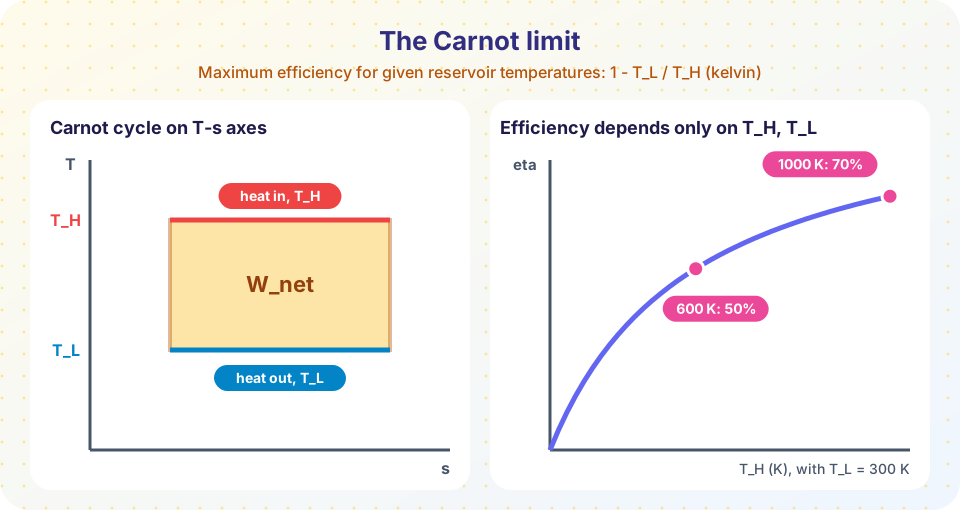
On a T-s diagram the cycle is a rectangle (the top and bottom are the isothermal steps, the vertical sides the isentropic steps), and the enclosed area is the net work, while the area under the top side is Q_H. Since both isothermal processes involve the same entropy change Δs, Q_H = T_H Δs and Q_L = T_L Δs, so Q_L/Q_H = T_L/T_H.
Carnot efficiency
For a reversible engine:
η_Carnot = 1 − T_L/T_H (temperatures in kelvin)
Example 1. T_H = 600 K, T_L = 300 K: η = 1 − 0.5 = 50 %.
Example 2. A steam plant at T_H = 800 K (527 °C) and T_L = 300 K: η = 62.5 %. Real plants reach 40 to 45 % because of irreversibilities and because heat is not added at a constant temperature.
Example 3. An ocean thermal plant using surface water at 298 K and deep water at 278 K: η = 1 − 278/298 = 6.7 % at most. Small temperature differences mean very low efficiency limits.
Two practical lessons follow: raise T_H (hotter combustion, better materials) or lower T_L (colder cooling water, lower condenser pressure). Using Celsius in the formula gives nonsense, as lesson 1.4 warned.
The Carnot principles
- No engine can be more efficient than a reversible engine operating between the same two reservoirs.
- All reversible engines between the same two reservoirs have the same efficiency, whatever the working fluid.
These principles allow a temperature scale that is independent of any material: define T_L/T_H = Q_L/Q_H for a reversible engine, then fix one point (the triple point of water, 273.16 K for historical definition) and you have the Kelvin scale, matching the ideal-gas scale.
Carnot refrigerators and heat pumps
Running the cycle in reverse gives the best possible COP:
COP_R,Carnot = T_L / (T_H − T_L) and COP_HP,Carnot = T_H / (T_H − T_L)
Example. A freezer at 255 K (−18 °C) in a 295 K kitchen: COP_R,max = 255/40 = 6.4. A real freezer manages 2 to 3. A heat pump heating a house at 295 K from outdoor air at 275 K: COP_HP,max = 295/20 = 14.8. When the outdoor air is 255 K, it drops to 295/40 = 7.4: heat pumps lose capacity on cold days because the temperature lift grows. The smaller the temperature difference, the more effective the machine.
Common misconceptions
"A Carnot engine is a practical design." It would be impractically slow and large; it is a theoretical benchmark.
"Efficiency can be improved without limit by better engineering." Engineering can approach, never exceed, the Carnot limit.
"Carnot efficiency depends on the working fluid." It does not; only the reservoir temperatures matter.
Try it
Press Run (or Ctrl + Enter) to see the result here.
Program input · what you'd type while the program runs
Type the answers before you press Run, one per line. Each time the program reads a line (with input()), it gets the next line from this box.
Press Run (or Ctrl + Enter) to see the result here.
Program input · what you'd type while the program runs
Type the answers before you press Run, one per line. Each time the program reads a line (with input()), it gets the next line from this box.
Check your understanding
Quick check · 5 questions
of 5 answered You scored / 5 · perfect!
-
1. What is the Carnot efficiency between 500 K and 300 K?
eta = 1 - 300/500 = 0.40. -
2. Which processes make up the Carnot cycle?
The Carnot cycle is isothermal expansion, adiabatic expansion, isothermal compression, adiabatic compression. -
3. Carnot principle 2 says all reversible engines between the same reservoirs
The efficiency depends only on T_H and T_L. -
4. The maximum COP of a refrigerator between 270 K and 300 K is
COP = T_L/(T_H - T_L) = 270/30 = 9. -
5. Why does a heat pump's COP fall on very cold days?
COP_HP = T_H/(T_H - T_L) decreases as the lift increases.
Summary
- Carnot cycle: isothermal expansion, adiabatic expansion, isothermal compression, adiabatic compression.
η_Carnot = 1 − T_L/T_H, kelvin only; no real engine between those reservoirs can beat it.COP_R = T_L/(T_H − T_L),COP_HP = T_H/(T_H − T_L).- Efficiency improves by raising
T_Hor loweringT_L; the limit is independent of the working fluid.
Track your progress
Create a free account to tick off lessons and pick up where you left off on any device.
of Engineering Thermodynamics lessons completed