


















Lesson 17 of 48 · The Second Law and Entropy
The Second Law: Chapter Overview
Preview chapter 4: why the first law is not enough, how the second law gives processes a direction and engines a limit, and what entropy measures, with a road map of the lessons.
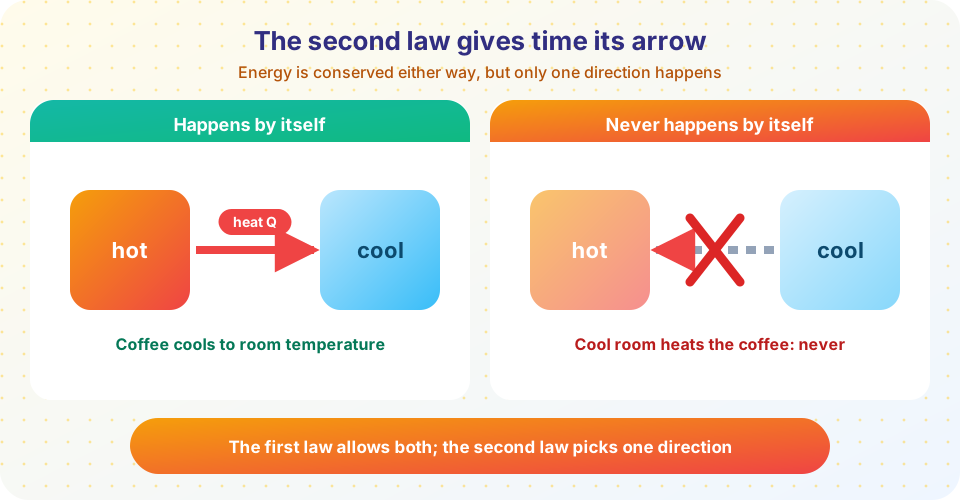
A hot cup of coffee left on a table cools to room temperature. The first law is perfectly happy with that: energy leaves the coffee and enters the room. But it would be equally happy if the room spontaneously gave energy back to the coffee and the coffee boiled. That never happens, and the first law cannot explain why. The second law of thermodynamics supplies what was missing: processes have a direction, and energy conversion has limits.
What you will learn
- Why a process can satisfy the first law and still be impossible.
- The two classic statements of the second law (Kelvin-Planck and Clausius).
- What a reversible process is, and why the Carnot cycle is the ideal.
- The idea of entropy as the quantity that tracks the second law.
Key terms
Thermal reservoir: a body so large that it can give or take heat without changing temperature.
Heat engine: a cyclic device that takes heat from a hot source, produces work and rejects heat to a cold sink.
Reversible process: one that can be undone leaving no trace on the system or surroundings; an idealization.
Entropy S: a property that measures irreversibility; it can be created but never destroyed.
The chapter at a glance
Why a second law?
The tools
The payoff
What each lesson covers
- Heat engines and the second-law statements: thermal efficiency, refrigerators, heat pumps, irreversibility.
- The Carnot cycle and absolute temperature: the best possible efficiency and COP.
- Entropy and the T ds relations: defining entropy and calculating its change.
- Entropy balance and isentropic efficiency: entropy generation and real devices.
- Chapter 4 review: recap and quiz.
Two things the first law cannot say
First, direction: heat flows from hot to cold, gases expand into vacuum rather than gather in a corner, friction turns motion into heat and never the reverse. Second, limits: even a perfect engine cannot convert all of the heat from a fuel into work; some must be rejected to a colder place. Both are consequences of the same principle, summarized by entropy. You will see that the maximum efficiency of an engine depends only on two temperatures, which is a remarkable result: the best possible design is known before anyone builds a machine.
Try it
The first block simulates two bodies exchanging heat, showing energy is conserved while temperatures approach each other (a simple model). The second checks whether a proposed engine violates the second law.
Press Run (or Ctrl + Enter) to see the result here.
Program input · what you'd type while the program runs
Type the answers before you press Run, one per line. Each time the program reads a line (with input()), it gets the next line from this box.
Press Run (or Ctrl + Enter) to see the result here.
Program input · what you'd type while the program runs
Type the answers before you press Run, one per line. Each time the program reads a line (with input()), it gets the next line from this box.
Check your understanding
Quick check · 4 questions
of 4 answered You scored / 4 · perfect!
-
1. Which of these does the first law alone forbid?
The first law forbids creating energy. Spontaneous cold-to-hot heat flow conserves energy, so the second law forbids it. -
2. A cup of coffee at 80 C in a 20 C room
Heat flows from hot to cold until the temperatures match. -
3. What does a heat engine always do with some of the input heat?
The second law requires waste heat rejection to a cold sink. -
4. A reversible process
It is the limiting case that no real process quite achieves.
Summary
- The second law gives processes a direction and engines a limit.
- Engines take heat from a hot reservoir, produce work and must reject heat to a cold one.
- The Carnot cycle is the reversible ideal; entropy measures how far a process is from it.
- The chapter builds from the statements to entropy balances and device efficiencies.
Track your progress
Create a free account to tick off lessons and pick up where you left off on any device.
of Engineering Thermodynamics lessons completed