


















Lesson 34 of 48 · Gas Mixtures and Psychrometrics
Ideal gas mixtures
Calculate mole and mass fractions, molar mass, gas constant, partial pressures, specific heat and mixing entropy for ideal gas mixtures, with a fully worked example.
When you inflate a tire with air, fill a balloon with a helium-oxygen blend for divers, or analyze the exhaust of an engine, you are working with a gas mixture. If the gases do not react, and the pressure is low enough that each behaves ideally, mixture analysis reduces to a few bookkeeping rules. Learn them well: they are the foundation of both psychrometrics and combustion.
What you will learn
- Convert between mass fractions and mole fractions.
- Compute the molar mass and gas constant of a mixture.
- Apply Dalton's and Amagat's laws to find partial pressures and partial volumes.
- Calculate mixture
c_pand the entropy generated when gases mix.
Key terms
Mole fraction yᵢ = nᵢ / n. Mass fraction mfᵢ = mᵢ / m. Apparent molar mass M = m / n. Partial pressure Pᵢ, the pressure component i would have alone in the same volume at the same temperature. Partial volume Vᵢ, the volume component i would have alone at the same temperature and total pressure.
Composition: moles versus mass
Two ways to describe a mixture are needed, and engineers switch between them constantly. With nᵢ moles of component i and molar mass Mᵢ:
mᵢ = nᵢ Mᵢ, and the total mass ism = Σ mᵢ; the total moles aren = Σ nᵢ.yᵢ = nᵢ / nandmfᵢ = mᵢ / m, and each set sums to 1.- Apparent molar mass:
M = m / n = Σ yᵢ Mᵢ. - Gas constant of the mixture:
R = R_u / M, withR_u = 8.314 kJ/(kmol·K). - Conversion:
mfᵢ = yᵢ Mᵢ / M.
For dry air the mole fractions are about 0.7808 nitrogen, 0.2095 oxygen, 0.0093 argon, which give M ≈ 28.97 kg/kmol and R = 0.287 kJ/(kg·K).
Dalton's and Amagat's laws
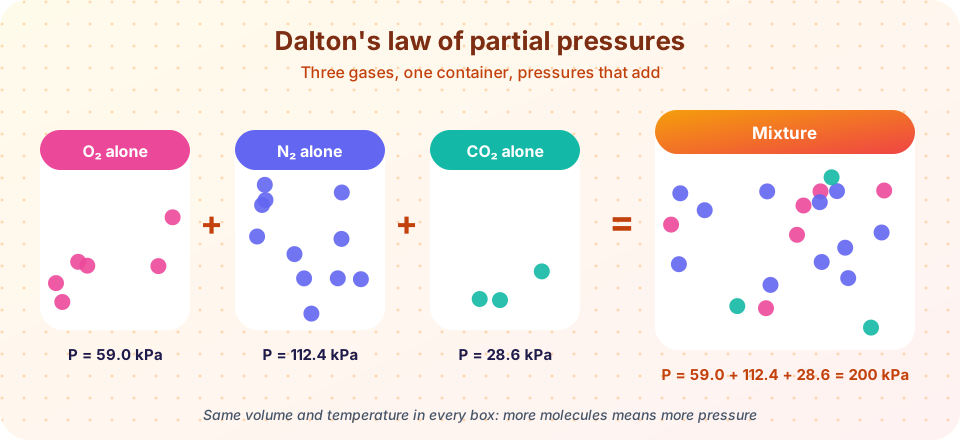
Dalton's law of additive pressures. The pressure of a mixture equals the sum of the pressures each component would exert if it alone occupied the mixture volume at the mixture temperature. For ideal gases, Pᵢ = nᵢ R_u T / V = yᵢ P.
Amagat's law of additive volumes. The volume of a mixture equals the sum of the volumes each component would occupy alone at the mixture temperature and pressure. For ideal gases, Vᵢ = yᵢ V.
For ideal gases both laws are exactly true and give the same answer. For real gases at high pressure they differ, and Amagat's law is often more accurate.
Mixture properties
Extensive properties add up. Per unit mass, intensive properties are mass-weighted; per mole, mole-weighted:
u = Σ mfᵢ uᵢ, h = Σ mfᵢ hᵢ, c_p = Σ mfᵢ c_pᵢ, c_v = Σ mfᵢ c_vᵢ
and c_p − c_v = R still holds for the mixture. Entropy has one subtlety: each component's entropy must be evaluated at its partial pressure, not at the total pressure:
s = Σ mfᵢ sᵢ(T, Pᵢ)
This detail is what causes entropy to rise when different gases mix.
Worked example
A tank holds 3 kg of O₂ (32 kg/kmol), 5 kg of N₂ (28 kg/kmol) and 2 kg of CO₂ (44 kg/kmol) at 300 K and 200 kPa. Find the composition, M, R, the partial pressures and c_p.
Moles: n(O₂) = 3/32 = 0.09375, n(N₂) = 5/28 = 0.17857, n(CO₂) = 2/44 = 0.04545; total n = 0.31778 kmol.
Mole fractions: y(O₂) = 0.295, y(N₂) = 0.562, y(CO₂) = 0.143. (Mass fractions are 0.3, 0.5 and 0.2.)
Molar mass: M = 10 / 0.31778 = 31.47 kg/kmol, so R = 8.314 / 31.47 = 0.2642 kJ/(kg·K).
Partial pressures at 200 kPa: P(O₂) = 0.295 × 200 = 59.0 kPa, P(N₂) = 112.4 kPa, P(CO₂) = 28.6 kPa; the sum is 200 kPa.
Specific heat with c_p of O₂, N₂ and CO₂ equal to 0.918, 1.039 and 0.846 kJ/(kg·K) at 300 K:
c_p = 0.3 × 0.918 + 0.5 × 1.039 + 0.2 × 0.846 = 0.964 kJ/(kg·K)
Entropy of mixing
Imagine the three gases initially in separate compartments at the same T and P, then the partitions are removed. Each gas expands into the whole volume, dropping its partial pressure from P to yᵢ P. No heat or work crosses the boundary, yet entropy increases:
ΔS = −R_u Σ nᵢ ln yᵢ
Because every yᵢ < 1, each logarithm is negative and ΔS is always positive. Mixing is irreversible: you never see gases unmix on their own, and separating them costs work. The fact that ΔS depends only on mole fractions, not on the type of gas, is the famous Gibbs paradox (identical gases do not generate entropy when they "mix").
Common misconceptions
"Mass fractions and mole fractions are interchangeable." They are the same only when all molar masses are equal. "The heavier gas settles at the bottom of the container." In a mixture at equilibrium, each gas spreads through the whole volume at a uniform composition (apart from tiny gravity effects over kilometers). "Partial pressure is a property of the gas alone." It depends on the amount of gas, the volume and the temperature.
Try it
Press Run (or Ctrl + Enter) to see the result here.
Program input · what you'd type while the program runs
Type the answers before you press Run, one per line. Each time the program reads a line (with input()), it gets the next line from this box.
Press Run (or Ctrl + Enter) to see the result here.
Program input · what you'd type while the program runs
Type the answers before you press Run, one per line. Each time the program reads a line (with input()), it gets the next line from this box.
Check your understanding
Quick check · 6 questions
of 6 answered You scored / 6 · perfect!
-
1. A mixture contains 2 kmol of N2 and 3 kmol of O2 at 100 kPa. What is the partial pressure of N2?
y(N2) = 2/5 = 0.4 and P = 0.4 × 100 = 40 kPa. -
2. How do you compute the apparent molar mass of a mixture?
It is the mole-fraction weighted sum, equal to total mass over total moles. -
3. Amagat's law of additive volumes says...
Vᵢ is the volume the component would occupy alone at T and P, and V = Σ Vᵢ. -
4. Why does entropy increase when two different ideal gases mix at constant T and P?
Each component's partial pressure falls from P to yᵢP, which raises its entropy. -
5. Which quantity must be used when evaluating the entropy of one component in a mixture?
sᵢ is evaluated at (T, Pᵢ). -
6. A mixture is 25 % CO2 and 75 % N2 by mole. What is M (CO2 = 44, N2 = 28)?
0.25 × 44 + 0.75 × 28 = 11 + 21 = 32 kg/kmol.
Summary
yᵢ = nᵢ/n,mfᵢ = mᵢ/m,M = Σ yᵢ Mᵢ,R = R_u / M.- Dalton:
Pᵢ = yᵢ P; Amagat:Vᵢ = yᵢ V; both exact for ideal gases. - Mixture
c_p = Σ mfᵢ c_pᵢ; entropy uses partial pressures. - Mixing different gases generates entropy
ΔS = −R_u Σ nᵢ ln yᵢ.
Next: Properties of humid air
Track your progress
Create a free account to tick off lessons and pick up where you left off on any device.
of Engineering Thermodynamics lessons completed