


















Lesson 26 of 48 · Power Cycles
Otto and Diesel engines
Analyze piston engines with the air-standard Otto and Diesel cycles: compression ratio, cutoff ratio, temperatures, pressures, efficiency and mean effective pressure.
A car engine and a truck engine look similar, but they burn fuel in two different ways. In a spark-ignition engine a spark ignites a mixture that is already inside the cylinder, and it burns almost at constant volume. In a compression-ignition engine, air is squeezed so hard that fuel sprayed in lights by itself, and it burns while the piston moves, roughly at constant pressure. The air-standard models of those two engines are the Otto cycle (Nikolaus Otto, 1876) and the Diesel cycle (Rudolf Diesel, 1890s).
What you will learn
- Describe the four ideal processes of the Otto and Diesel cycles.
- Compute state temperatures, pressures and efficiency for given compression and cutoff ratios.
- Explain why higher compression ratios raise efficiency, and what limits them.
- Compare the two engines on efficiency and mean effective pressure.
Key terms
Compression ratio r is the cylinder volume at bottom dead center divided by the volume at top dead center, r = v₁ / v₂. Cutoff ratio r_c is v₃ / v₂ in the Diesel cycle, the volume growth during heat addition. Mean effective pressure (MEP) is the constant pressure that would give the same net work over the same piston displacement. Knock is uncontrolled self-ignition of fuel that limits Otto compression ratios.
The ideal Otto cycle
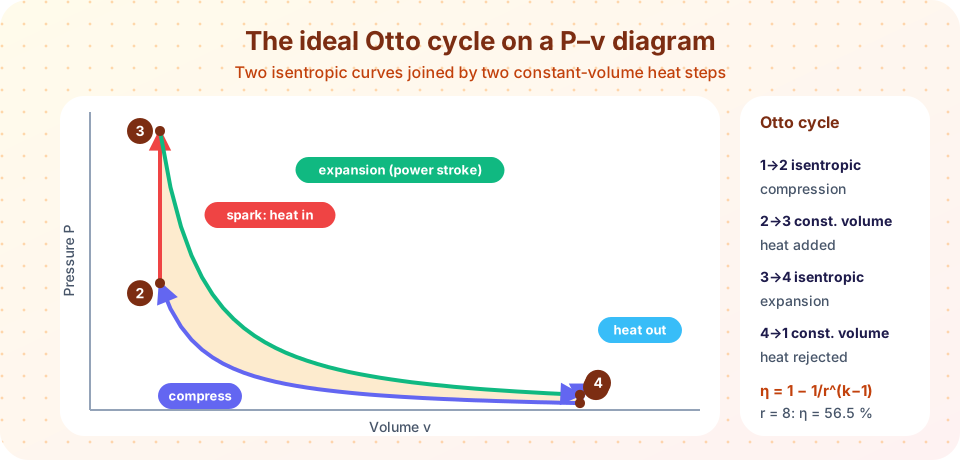
The four processes, with air as an ideal gas of constant specific heats (k = 1.4, c_v = 0.718 kJ/(kg·K), R = 0.287 kJ/(kg·K)):
- 1 → 2: isentropic compression,
T₂ = T₁ r^(k−1)andP₂ = P₁ r^k. - 2 → 3: heat added at constant volume,
q_in = c_v (T₃ − T₂). - 3 → 4: isentropic expansion,
T₄ = T₃ / r^(k−1). - 4 → 1: heat rejected at constant volume,
q_out = c_v (T₄ − T₁).
Because both heat steps are at constant volume and both curves are isentropes, the efficiency depends on one number:
η_Otto = 1 − 1 / r^(k−1)
Each temperature ratio equals r^(k−1), so T₄/T₁ = T₃/T₂. That cancels everything but r.
Worked example
T₁ = 300 K, P₁ = 100 kPa, r = 8, and a heat input of 1000 kJ/kg.
T₂ = 300 × 8^0.4 = 689.2 K,P₂ = 100 × 8^1.4 = 1838 kPa.T₃ = 689.2 + 1000 / 0.718 = 2082 K,P₃ = P₂ T₃ / T₂ = 5552 kPa.T₄ = 2082 / 8^0.4 = 906.2 K.q_out = 0.718 × (906.2 − 300) = 435.3 kJ/kg, sow_net = 564.7 kJ/kg.
η = 564.7 / 1000 = 56.5 %, which agrees with 1 − 1/8^0.4. Real spark-ignition engines reach 25 to 35 % because of heat losses to the cylinder wall, friction, incomplete combustion, throttling at part load and the fact that gases are not ideal.
Why higher compression helps, and where it stops
The formula says efficiency rises with r. Physically, higher compression means higher temperature at the start of heat addition, so the average heat-addition temperature is higher. In a petrol engine, though, the compressed fuel-air mixture can ignite by itself (knock) if r is too large, which is why ordinary spark-ignition engines stay around 9 to 12. Fuel octane rating is a measure of knock resistance.
The ideal Diesel cycle
Compression ignition compresses only air, so knock is not an issue, and ratios from 14 to 22 are common. Fuel is injected near top dead center and burns as the piston starts down, so heat is added at constant pressure:
- 1 → 2: isentropic compression,
T₂ = T₁ r^(k−1). - 2 → 3: heat added at constant pressure,
q_in = c_p (T₃ − T₂), withT₃ = T₂ r_c. - 3 → 4: isentropic expansion,
T₄ = T₃ (r_c / r)^(k−1). - 4 → 1: heat rejected at constant volume,
q_out = c_v (T₄ − T₁).
The efficiency is
η_Diesel = 1 − (1 / r^(k−1)) × (r_c^k − 1) / (k (r_c − 1))
The last fraction is always larger than 1 for r_c > 1, so at the same compression ratio the Diesel cycle is less efficient than Otto. But it can use a much larger r, and that more than wins.
Worked example
T₁ = 300 K, r = 18, r_c = 2, c_p = 1.005 kJ/(kg·K).
T₂ = 300 × 18^0.4 = 953 K;T₃ = 2 T₂ = 1907 K.q_in = 1.005 × (1907 − 953) = 958 kJ/kg.T₄ = 1907 × (2/18)^0.4 = 792 K;q_out = 0.718 × (792 − 300) = 353 kJ/kg.w_net = 958 − 353 = 605 kJ/kg, soη = 63.2 %.
The formula gives the same value, 63.2 %. Real diesel engines reach 35 to 45 %. They are the most efficient common piston engines.
Mean effective pressure
Two engines can have the same efficiency but very different size. The MEP, MEP = w_net / (v₁ − v₂), tells you how much work you get per unit of swept volume. For the Otto example v₁ = R T₁ / P₁ = 0.861 m³/kg, so v₁ − v₂ = 0.861 × 7/8 = 0.753 m³/kg and MEP = 564.7 / 0.753 = 750 kPa. A higher MEP means a smaller, lighter engine for the same power.
Common misconceptions
"Diesel is better because the cycle is better." At the same compression ratio Otto wins; Diesel wins because its ratio can be higher. "The spark releases the heat." The spark only starts combustion; the heat comes from the fuel. "Real efficiency equals the formula." The formula is an upper bound for an air-standard model.
Try it
Press Run (or Ctrl + Enter) to see the result here.
Program input · what you'd type while the program runs
Type the answers before you press Run, one per line. Each time the program reads a line (with input()), it gets the next line from this box.
Press Run (or Ctrl + Enter) to see the result here.
Program input · what you'd type while the program runs
Type the answers before you press Run, one per line. Each time the program reads a line (with input()), it gets the next line from this box.
Check your understanding
Quick check · 5 questions
of 5 answered You scored / 5 · perfect!
-
1. In the ideal Otto cycle, heat is added...
The Otto cycle models combustion as an instantaneous heat addition at constant volume. -
2. An Otto cycle has r = 10 and k = 1.4. What is its efficiency?
1 − 1/10^0.4 = 1 − 1/2.512 = 0.602, about 60 %. -
3. Why can a Diesel engine use a higher compression ratio than a petrol engine?
Fuel is injected near the end of compression, so premature ignition (knock) cannot occur during compression. -
4. At the same compression ratio, which cycle is more efficient?
The Diesel correction factor (r_c^k − 1) / (k (r_c − 1)) is larger than 1, which subtracts more from 1. -
5. What does mean effective pressure measure?
MEP = w_net / (v₁ − v₂). It compares engine size for the same power.
Summary
- Otto: constant-volume heat,
η = 1 − 1/r^(k−1); exampler = 8gives 56.5 %. - Diesel: constant-pressure heat,
η = 1 − r^(1−k)(r_c^k − 1)/(k(r_c − 1)); exampler = 18,r_c = 2gives 63.2 %. - Knock limits Otto compression; Diesel engines compress only air and use higher ratios.
- MEP compares work per swept volume, and real engines reach about half the ideal air-standard efficiency.
Next: Brayton gas turbines
Track your progress
Create a free account to tick off lessons and pick up where you left off on any device.
of Engineering Thermodynamics lessons completed