


















Lesson 16 of 48 · The First Law
Chapter 3 Review: The First Law
Review chapter 3: heat and work signs, boundary work, closed-system balance, enthalpy and the steady-flow energy equation for turbines, compressors, nozzles and valves, with a 9-question quiz.
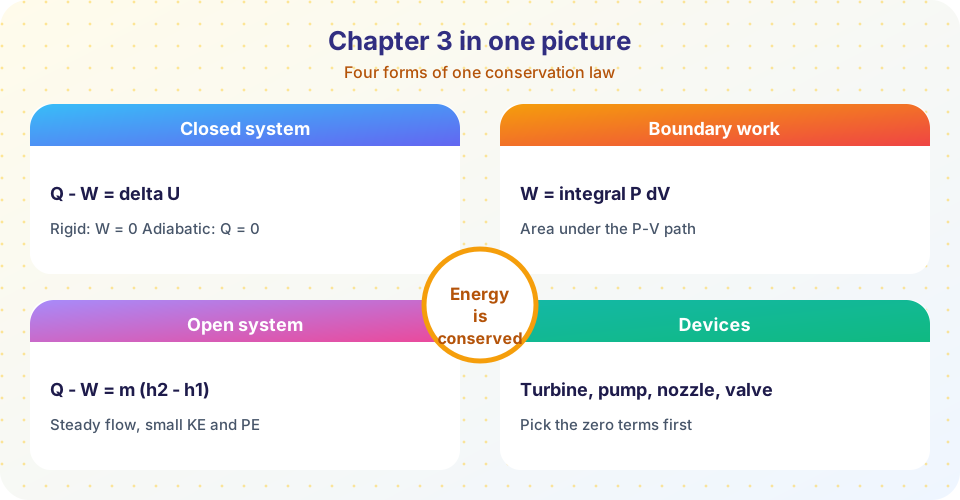
You now own the first law in both forms: for a fixed mass (Q − W = ΔU) and for a flowing stream (q − w = Δh + ΔKE + ΔPE). This review puts them next to each other, adds a decision routine for choosing between them and gives you a nine-question quiz covering the whole chapter.
What you will learn
- How to choose closed-system or control-volume form of the first law.
- The key equation for each device in one table.
- A checklist for avoiding the usual first-law mistakes.
Recap table
| Case | Equation | Notes |
|---|---|---|
| Closed system | Q − W = ΔU + ΔKE + ΔPE |
Q in +, W out + |
| Boundary work | W = ∫ P dV |
area under P-V path |
| Isobaric / isothermal / polytropic | P ΔV, P₁V₁ ln(V₂/V₁), (P₂V₂ − P₁V₁)/(1 − n) |
ideal gas for the middle one |
| Ideal gas | Δu = c_v ΔT, Δh = c_p ΔT |
c_p − c_v = R |
| Constant pressure heating | Q = ΔH |
boundary work only |
| Mass balance | Σ ṁ_in = Σ ṁ_out |
ṁ = A V / v |
| Steady flow | q − w = Δh + ΔKE + ΔPE |
h = u + P v |
| Turbine / compressor | w = h₁ − h₂ / w_in = h₂ − h₁ |
adiabatic |
| Nozzle | V₂ = √(2 Δh) |
inlet speed negligible |
| Throttle | h₁ = h₂ |
no work, no heat |
Choosing the form
- Does mass cross the boundary? If not, use the closed form and track
ΔU. - If mass flows through a fixed region, use a control volume and track
h. - Write the full equation, then cross out terms with reasons: rigid (no
W), insulated (Q = 0), steady (no storage), small speeds (noΔKE). - Look up or compute properties (
u,h) and solve; check the sign and size.
Review problem. Air flows steadily through a compressor at ṁ = 0.2 kg/s, entering at 100 kPa and 290 K and leaving at 480 K. Heat loss is 4 kW. KE and PE are negligible. Find the power input. Energy balance: Q̇ − Ẇ = ṁ c_p ΔT with Q̇ = −4 kW (heat leaves): −4 − Ẇ = 0.2 × 1.005 × 190 = 38.19 kW, so Ẇ = −42.2 kW: the compressor needs 42.2 kW.
Try it
Press Run (or Ctrl + Enter) to see the result here.
Program input · what you'd type while the program runs
Type the answers before you press Run, one per line. Each time the program reads a line (with input()), it gets the next line from this box.
Check your understanding
Quick check · 9 questions
of 9 answered You scored / 9 · perfect!
-
1. A closed rigid vessel of gas receives 120 kJ of heat. Its internal energy change is
Rigid means W = 0, so delta U = Q = 120 kJ. -
2. A gas expands from 0.2 to 0.5 m3 at constant 400 kPa. The work done by the gas is
W = P dV = 400 x 0.3 = 120 kJ. -
3. Which statement about enthalpy is correct?
Enthalpy is u + Pv, the energy carried by flowing fluid. -
4. An adiabatic compressor with air going 300 K to 500 K (cp = 1.005) has w_in of
w_in = cp dT = 1.005 x 200 = 201 kJ/kg. -
5. A throttling valve changes
Throttling is an isenthalpic pressure drop. -
6. Which device has no shaft work, no heat and an increasing KE?
A nozzle converts enthalpy into kinetic energy. -
7. Over a cycle, a heat engine takes in 800 kJ and rejects 500 kJ. Net work is
delta U = 0, so W_net = 800 - 500 = 300 kJ. -
8. For an ideal gas, which is correct?
From h = u + RT. -
9. Steady flow of 2 kg/s of water through a heater gains 4.18 x 2 x 30 = 250.8 kW. The water temperature rises by
Q = m c dT with m = 2 kg/s and c = 4.18 gives dT = 30 K.
Summary
- Closed:
Q − W = ΔU; open steady:q − w = Δh + ΔKE + ΔPE. - Write the full equation first, then strike out zero terms with reasons.
- Turbine, compressor, pump, nozzle, throttle and heat exchanger are all special cases.
- The first law counts energy; the second law decides what is possible.
Track your progress
Create a free account to tick off lessons and pick up where you left off on any device.
of Engineering Thermodynamics lessons completed