


















Lesson 38 of 48 · Combustion and Applications
Chapter 8 overview: combustion and applications
A map of Chapter 8: how fuel and air react, how to balance combustion equations, where the heat comes from, and how flame temperature and emissions follow from the first law.
Every power cycle in Chapter 5 needs a heat source, and most of the time that source is combustion: a fast chemical reaction between a fuel and oxygen that turns chemical energy into thermal energy. Burning fuels supplies most of the world's primary energy. It heats homes, drives engines, fires boilers and gas turbines, and, as a side effect, releases carbon dioxide and pollutants. Thermodynamics tells us how much heat we can get, how hot the flame becomes, and how much air we need.
The big picture
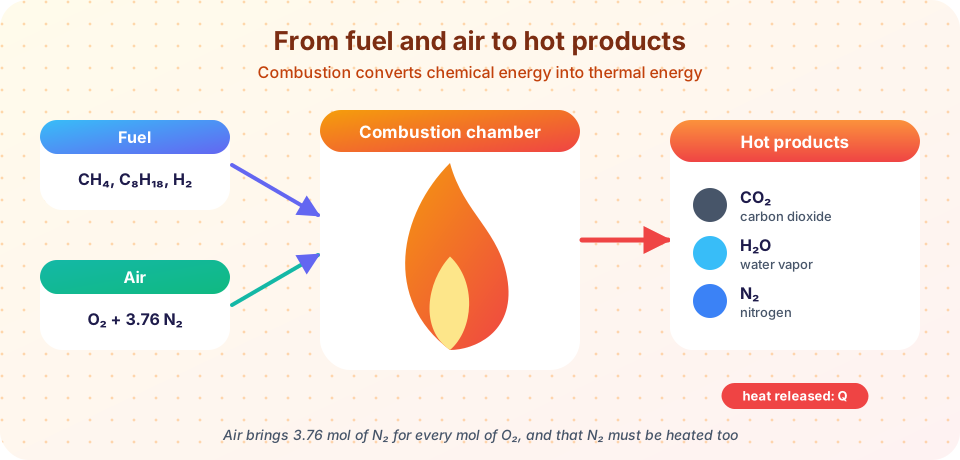
A combustion process has three parts. First stoichiometry: how many moles of oxygen each mole of fuel needs, and what the products are. Second the first law for reacting systems, which includes the chemical energy stored in molecular bonds, measured by the enthalpy of formation. Third the limits: the adiabatic flame temperature (how hot the products can get when no heat is lost), the effect of excess air, and the role of the second law.
Because air is only 21 % oxygen by mole, every mole of oxygen brings about 3.76 moles of nitrogen. Nitrogen does not burn (at least not much), but it must be heated to the flame temperature, so it dilutes the reaction and lowers the temperature.
Fuel + air
Products
Energy
Real life
What each lesson covers
| Lesson | Topic |
|---|---|
| Combustion stoichiometry | Balancing reactions, air-fuel ratio, excess air, product analysis and dew point |
| The first law for reacting systems | Enthalpy of formation, heat of combustion, higher and lower heating values |
| Flame temperature and applications | Adiabatic flame temperature, efficiency of boilers and engines, emissions |
| Chapter review | Recap picture, table and quiz |
Key terms
Stoichiometric (theoretical) air is the exact amount of air that converts all the fuel to CO₂ and H₂O with nothing left over. Excess air is air beyond that amount, usually expressed as a percentage. Air-fuel ratio is the mass of air per mass of fuel. Heating value is the heat released when 1 kg of fuel burns completely and products return to the reactant temperature. Adiabatic flame temperature is the product temperature when no heat is lost.
Common misconceptions
"Combustion creates energy." It converts stored chemical energy; the energy was in the fuel's bonds. "Burning more air gives a hotter fire." Extra air carries away heat and lowers the flame temperature. "The water in the exhaust is a defect." It is a product of burning hydrogen, and whether it is liquid or vapor decides which heating value applies.
Try it
Press Run (or Ctrl + Enter) to see the result here.
Program input · what you'd type while the program runs
Type the answers before you press Run, one per line. Each time the program reads a line (with input()), it gets the next line from this box.
Press Run (or Ctrl + Enter) to see the console output here.
No output.
Check your understanding
Quick check · 5 questions
of 5 answered You scored / 5 · perfect!
-
1. Air is about 21 % O2 and 79 % N2 by mole. How many moles of N2 come with each mole of O2?
79 / 21 = 3.76. -
2. What is stoichiometric air?
It is the theoretical minimum for complete combustion. -
3. Why does excess air lower the flame temperature?
The same heat is shared by more moles of gas, so the temperature rise is smaller. -
4. Which is the main product of burning hydrogen?
2 H2 + O2 gives 2 H2O. -
5. What does the heating value of a fuel measure?
It is the energy released by complete combustion at the reference temperature.
Summary
- Combustion converts chemical energy to heat; its analysis uses stoichiometry, the first law and flame temperature.
- Air brings 3.76 mol of N₂ per mole of O₂, which dilutes the flame.
- Theoretical air depends on the fuel: about 17 kg per kg for methane and about 15 kg per kg for octane.
- Heating value and flame temperature depend on whether water leaves as vapor or liquid and on excess air.
Next: Combustion stoichiometry
Track your progress
Create a free account to tick off lessons and pick up where you left off on any device.
of Engineering Thermodynamics lessons completed