


















Lesson 9 of 48 · Properties and State
The Ideal Gas and Compressibility
Use P v = R T with gas constants, solve mass and volume problems, and learn when the compressibility factor Z and reduced properties are needed for real gases.
For gases far from condensing, the complicated behavior of tables gives way to one of the most useful equations in science: P v = R T. It links pressure, specific volume and absolute temperature of air, nitrogen, helium and many others. This lesson shows how to use it, why each gas has its own constant R, and how to tell when the equation stops being trustworthy and a correction called the compressibility factor is required.
What you will learn
- The ideal gas equation in specific, mass and molar forms.
- How to get the gas constant
Rof any gas from its molar mass. - When the ideal gas model is accurate.
- How to use the compressibility factor
Zand reduced properties.
Key terms
Ideal gas: a gas whose molecules have negligible volume and no attraction, obeying P v = R T.
Gas constant R: R = R_u / M, where R_u = 8.314 kJ/(kmol·K) and M is the molar mass.
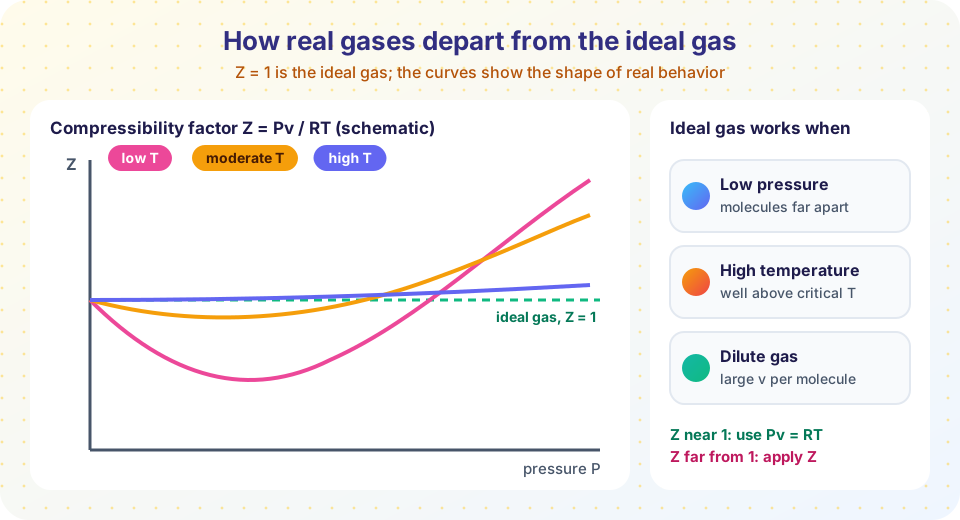
Compressibility factor Z: Z = P v / (R T), equal to 1 for an ideal gas.
Reduced properties: P_r = P/P_cr and T_r = T/T_cr, pressure and temperature divided by their critical values.
The equation in three forms
P v = R T (per unit mass) P V = m R T (whole system) P V = n R_u T (per kmol or mol)
P is absolute pressure and T is in kelvin (lesson 1.3 and 1.4). With P in kPa, v in m³/kg and R in kJ/(kg·K), units work out because kPa·m³ = kJ.
The specific gas constant follows from the molar mass: R = 8.314 / M.
| Gas | M (kg/kmol) |
R (kJ/(kg·K)) |
|---|---|---|
| Air | 28.97 | 0.2870 |
| Nitrogen | 28.01 | 0.2968 |
| Oxygen | 32.00 | 0.2598 |
| Helium | 4.003 | 2.077 |
| Carbon dioxide | 44.01 | 0.1889 |
| Steam (as a gas) | 18.015 | 0.4615 |
Example 1. What volume do 2 kg of air at 300 kPa and 350 K occupy? V = m R T / P = 2 × 0.287 × 350 / 300 = 0.670 m³.
Example 2. A 0.5 m³ rigid tank holds air at 200 kPa and 300 K. How much air is added if the pressure rises to 500 kPa at 300 K? Initial mass m1 = 200 × 0.5 / (0.287 × 300) = 1.161 kg; final m2 = 500 × 0.5 / (0.287 × 300) = 2.904 kg; added 1.743 kg.
Example 3 (two states of the same gas). For a fixed mass, divide the equation at state 2 by that at state 1: P1 V1 / T1 = P2 V2 / T2. This is the form used for a sealed gas whose conditions change.
When is the ideal gas model good?
Molecules in an ideal gas are far apart and do not attract. That is true when the gas is at low pressure and high temperature relative to its critical point. Air at room conditions has T_r about 2.3 and P_r below 0.03, so ideal gas errors are well under 1 %. Water vapor in a power-plant boiler, with P of several MPa near saturation, is not an ideal gas: use the steam tables.
A rule of thumb: the gas is nearly ideal if P_r ≪ 1, or if T_r > 2 and P_r < 3. Real data show the deviation by the compressibility factor Z = P v / (R T). If Z is between 0.95 and 1.05 many engineers accept the ideal gas law. Z < 1 means attractive forces dominate (the gas is easier to compress than ideal); Z > 1 means molecular size dominates (harder to compress).
Reduced properties and the generalized chart
Different gases show similar behavior when compared at the same reduced conditions. This principle of corresponding states lets one chart of Z against P_r and T_r serve for many gases. Critical constants (rounded):
| Gas | T_cr (K) |
P_cr (MPa) |
|---|---|---|
| Air | 132.5 | 3.77 |
| Nitrogen | 126.2 | 3.39 |
| Carbon dioxide | 304.2 | 7.39 |
| Water | 647.1 | 22.06 |
Procedure: compute T_r and P_r, read Z from the chart (or a program), then use P v = Z R T. For example, nitrogen at 10 MPa and 300 K has P_r = 2.95 and T_r = 2.38, and the generalized chart gives a Z close to 1 (slightly above), so the ideal gas law is a decent approximation at that high pressure; carbon dioxide at 10 MPa and 310 K has T_r about 1.02 and P_r about 1.35, where Z is far below 1 and the ideal gas law fails badly.
Equations of state
The van der Waals equation, (P + a/v²)(v − b) = R T, adds corrections for attraction (a) and molecular volume (b). It captures the dips in the Z curves qualitatively. Modern engineering uses more accurate forms (Peng-Robinson, Redlich-Kwong, virial equations), but the idea is the same: start from P v = R T and correct it.
Common misconceptions
"The ideal gas law works for any gas at any condition." It fails near condensation and at high pressure.
"I can use gauge pressure and Celsius if I am careful." The law needs absolute pressure and absolute temperature, always.
"R is the same for all gases." R_u is universal; the specific constant R = R_u/M depends on the gas.
Try it
The first block computes Z for carbon dioxide from the van der Waals equation (a model, not measured data) at three temperatures. The second is a gas-tank calculator.
Press Run (or Ctrl + Enter) to see the result here.
Program input · what you'd type while the program runs
Type the answers before you press Run, one per line. Each time the program reads a line (with input()), it gets the next line from this box.
Press Run (or Ctrl + Enter) to see the result here.
Program input · what you'd type while the program runs
Type the answers before you press Run, one per line. Each time the program reads a line (with input()), it gets the next line from this box.
Check your understanding
Quick check · 5 questions
of 5 answered You scored / 5 · perfect!
-
1. What is the specific gas constant R of nitrogen (M = 28.01 kg/kmol)?
R = 8.314 / 28.01 = 0.2968 kJ/(kg K). -
2. 2 kg of air at 300 kPa absolute and 350 K occupy about
V = mRT/P = 2 x 0.287 x 350 / 300 = 0.67 m3. -
3. A real gas has Z less than 1. What does this say?
Z < 1 means the actual specific volume is smaller than the ideal-gas value, because attraction pulls molecules together. -
4. The ideal gas model is most accurate for a gas at
Low reduced pressure and high reduced temperature keep molecules far apart. -
5. A sealed rigid vessel of air goes from 300 K to 450 K. The absolute pressure is multiplied by
At constant V and m, P2/P1 = T2/T1 = 450/300 = 1.5.
Summary
P v = R Twith absolutePandT;R = R_u/MwithR_u = 8.314 kJ/(kmol·K).- It is accurate at low
P_rand highT_r; check withZ = P v/(R T). - Use reduced properties and a generalized chart (or an equation of state) when
Zdiffers from 1. - Near saturation, as in boilers, use the property tables instead.
Next: Chapter 2 Review
Track your progress
Create a free account to tick off lessons and pick up where you left off on any device.
of Engineering Thermodynamics lessons completed