


















Lesson 12 of 48 · The First Law
Heat and Work
Learn what heat and work are, the sign convention, how to compute boundary work as the area under a P-V path for isobaric, isothermal and polytropic processes, and other forms of work.
Heat and work are the two ways energy crosses the boundary of a closed system, and students often confuse them. The key idea is that neither is stored: a gas does not "contain" heat or work, it contains energy. Heat and work describe how that energy gets in or out during a process. This lesson defines both, fixes the sign convention for good, and teaches the most common calculation: the work done when a gas expands or is compressed.
What you will learn
- The definition of heat and work and why both depend on the path.
- The sign convention:
Qin positive,Wout positive. - How to compute boundary work for isobaric, isothermal and polytropic processes.
- Other forms of work: shaft, electrical, spring.
Key terms
Heat transfer: energy moving across a boundary because of a temperature difference (conduction, convection or radiation).
Adiabatic: a process with no heat transfer (Q = 0).
Boundary work: work done by or on a fluid as the boundary moves, W_b = ∫ P dV.
Power: rate of energy transfer, Ẇ = W/Δt, in watts.
Heat
Heat is energy that moves because of a temperature difference. It travels by conduction (through solids and still fluids, Fourier's law: Q̇ = −k A dT/dx), convection (carried by moving fluid, Q̇ = h A (T_s − T_f)) and radiation (electromagnetic waves, Q̇ = ε σ A T⁴ for a surface, σ = 5.67 × 10⁻⁸ W/(m²·K⁴)). In this course we usually treat Q as given or as the unknown in a balance, rather than computing it from the transfer mechanism; that is the subject of a heat transfer course.
A process with no heat transfer is adiabatic: perfect insulation, or simply so fast that no heat has time to flow (a bicycle pump heats up on compression almost adiabatically). Adiabatic does not mean constant temperature.
Work
Mechanical work is a force acting through a distance, W = ∫ F dx. In thermodynamics we define work generally: energy transferred that is not heat. Examples: a piston pushed by gas, a rotating shaft, a battery pushing current through a motor, a stretched spring.
Boundary work
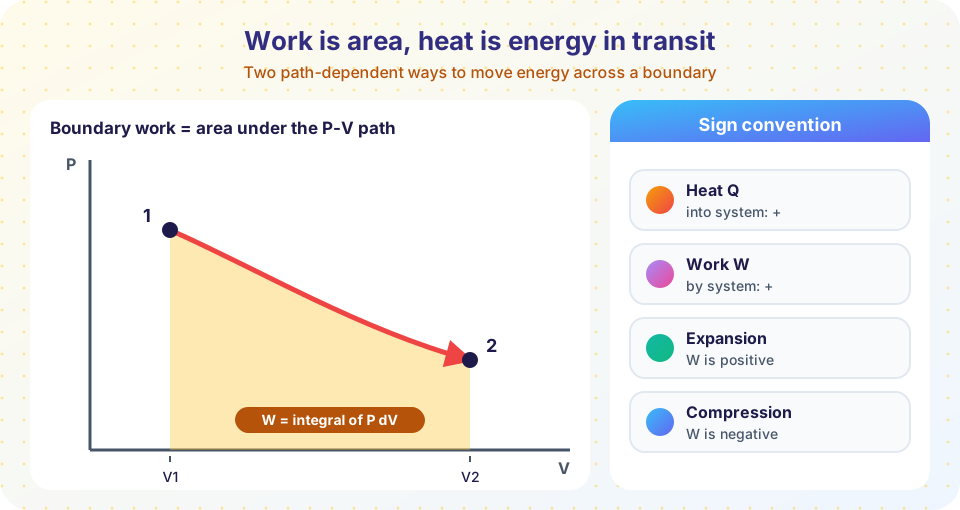
For a gas in a piston-cylinder, the force on the piston is P A and the displacement is dx, so δW = P A dx = P dV. Integrating over a quasi-equilibrium path:
W_b = ∫₁² P dV
This is the area under the process curve on a P-V diagram. Expansion (dV > 0) gives positive work; compression gives negative work. Because the area depends on the path, the same two end states can have different work.
Isobaric (constant P): W = P (V₂ − V₁). A gas at 200 kPa expanding from 0.1 to 0.3 m³ does 200 × 0.2 = 40 kJ.
Isothermal ideal gas (P V = m R T = constant): W = P₁V₁ ln(V₂/V₁). From P₁ = 500 kPa, V₁ = 0.2 m³ to V₂ = 0.6 m³: W = 100 × ln 3 = 109.9 kJ.
Polytropic (P V^n = constant, n ≠ 1): W = (P₂V₂ − P₁V₁)/(1 − n). With n = 1.3 and the same end volumes, P₂ = 500 × (1/3)^1.3 = 119.9 kPa and W = (119.9 × 0.6 − 100)/(1 − 1.3) = 93.6 kJ.
Notice the three paths between the same volumes give 109.9, 93.6 and (isobaric at 500 kPa) 200 kJ. Heat and work are path functions.
Other forms of work
- Shaft work:
Ẇ = 2π n Twith torqueT(N·m) and rotational speedn(rev/s); it drives compressors and is produced by turbines. - Electrical work:
Ẇ = V I(volts times amperes). - Spring work:
W = ½ k (x₂² − x₁²).
Sign convention in practice
| Situation | Q |
W |
|---|---|---|
| Heat added to gas | + | |
| Heat removed | − | |
| Gas expands against piston | + | |
| Piston compresses gas | − | |
| Electric heater inside a closed insulated tank | − (work done on system) |
The last row is a classic: an electric resistor in an insulated tank adds energy to the gas as work on the system, so W is negative.
Common misconceptions
"Heat is stored in a hot object." Objects store internal energy; heat is the transfer process.
"Adiabatic means isothermal." An adiabatic compression heats the gas; a constant-temperature expansion requires heat input.
"Boundary work formula applies to any process." ∫ P dV assumes quasi-equilibrium; a free (unresisted) expansion into vacuum does no work even though V increases.
Try it
The first plot compares the three expansion paths between the same two volumes. The second calculator computes boundary work for any polytropic exponent.
Press Run (or Ctrl + Enter) to see the result here.
Program input · what you'd type while the program runs
Type the answers before you press Run, one per line. Each time the program reads a line (with input()), it gets the next line from this box.
Press Run (or Ctrl + Enter) to see the result here.
Program input · what you'd type while the program runs
Type the answers before you press Run, one per line. Each time the program reads a line (with input()), it gets the next line from this box.
Check your understanding
Quick check · 5 questions
of 5 answered You scored / 5 · perfect!
-
1. A gas at a constant 300 kPa expands from 0.1 to 0.4 m3. The boundary work is
W = P (V2 - V1) = 300 x 0.3 = 90 kJ, positive for expansion. -
2. An electric heater runs inside a rigid insulated tank of gas. For the gas as the system, the heater is
Electrical energy crossing the boundary is work, and it enters the system, so W is negative. -
3. Which statement about heat and work is true?
Both are path functions, unlike properties. -
4. Compressing a gas quickly in a well-insulated pump will
With Q = 0, the work done on the gas raises its internal energy and temperature. -
5. What does the area under a P-V curve represent?
W = integral of P dV.
Summary
- Heat is energy transfer driven by temperature difference; work is any other energy transfer; both are path functions.
- Sign convention:
Qin positive,Wby the system positive. - Boundary work is the area under the
P-Vpath:P ΔVfor isobaric,P₁V₁ ln(V₂/V₁)isothermal,(P₂V₂ − P₁V₁)/(1 − n)polytropic. - Shaft, electrical and spring work follow the same bookkeeping.
Track your progress
Create a free account to tick off lessons and pick up where you left off on any device.
of Engineering Thermodynamics lessons completed