


















Lesson 18 of 48 · Climate Records and Proxies
Chapter overview: climate records and proxies
Get the big picture of how scientists reconstruct climate: thermometers and satellites for recent history, and tree rings, corals, ice cores and sediments for the deep past, with dating and calibration.
Nobody was around with a thermometer 20,000 years ago, and yet scientists can tell you roughly how cold the last ice age was, how much carbon dioxide was in the air and how fast the ice sheets shrank afterward. They can do this because nature keeps records. Trees add a ring each year, corals build skeletons whose chemistry reflects the water they grew in, ice sheets trap bubbles of ancient air, and ocean mud holds the shells of tiny animals that lived in the warm or cold seas of long ago.
This chapter explains how those records are read. You will meet the instrumental record of the last two centuries and the proxy records that extend our view back tens of thousands to millions of years, and you will learn how scientists date them, calibrate them and judge how much to trust them.
What you will learn
- Distinguish direct (instrumental) records from indirect (proxy) records.
- Explain the three questions asked of every proxy: what does it measure, how is it dated and how is it calibrated.
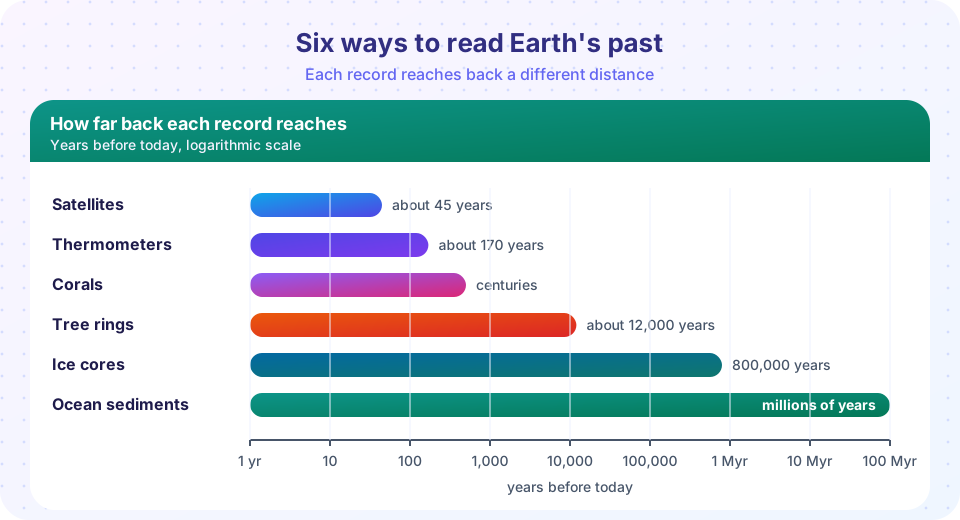
- Compare the time span and resolution of the main archives.
- Know what each lesson in this chapter covers.
Key terms
Instrumental record: measurements made with instruments such as thermometers and satellites. Proxy: a natural recorder whose physical or chemical properties depend on climate. Calibration: relating the proxy signal to the climate variable using the period when both are known. Resolution: the smallest time step the record can separate (yearly, monthly, centuries). BP: years before present, where "present" is defined as 1950.
Direct versus indirect records
A direct record measures the climate variable with an instrument. Thermometers, rain gauges, ship measurements of sea surface temperature, weather balloons and, since 1979, satellites that measure the temperature of the atmosphere and the extent of sea ice, are all direct. They are the gold standard, but they only reach back so far: a handful of stations began in the 1600s (the Central England record starts in 1659), and the coverage that is good enough for a global average begins around 1850.
Everything earlier relies on proxies. A proxy is not a thermometer. It is a natural process that responds to temperature, rainfall or atmospheric composition and leaves a lasting trace. The widths of tree rings depend on summer warmth, the ratio of two oxygen isotopes in ice depends on the temperature at which the snow formed, and the chemistry of a coral skeleton depends on the temperature of the sea. A proxy needs to be turned into a number with an equation, and scientists develop that equation by comparing the proxy with instrumental data in the period they overlap.
Three questions for every record
Whenever you meet a climate reconstruction, ask three questions.
- What does it measure? A proxy usually responds to more than one thing. A tree ring is wider in a warm, wet summer; in a dry place the main control is rainfall. Scientists choose sites where one factor dominates.
- How is it dated? A record is only useful if you know when each part formed. Rings can be counted, ice layers can be counted, and older materials are dated with radioactive decay, such as radiocarbon (carbon-14, half-life 5,730 years, useful back to about 50,000 years) and uranium-thorium series (for cave deposits and corals, back to several hundred thousand years).
- How is it calibrated and how uncertain is it? Every conversion from a proxy to a temperature adds uncertainty. Good studies report error bars and check results with independent proxies, so that, for example, a tree ring series is compared to a coral from the same region.
The strength of the field comes from agreement among independent archives that measure different things in different ways. When tree rings, ice cores, coral skeletons and lake sediments all show a cold period in the same century, the conclusion is far stronger than any single record can make it.
What the records show
Combining these archives gives a consistent picture. Global surface temperature in the decade 2011-2020 was about 1.1 °C above the 1850-1900 level. According to the IPCC's sixth assessment, global temperature increased faster since 1970 than in any other 50-year period in at least the last 2,000 years, and the recent decade is warmer than any multi-century period in at least about 6,500 years; the last time the world was comparably warm or warmer for a lasting period was about 125,000 years ago. Atmospheric CO₂ is higher today than at any time in at least the last 800,000 years of ice core data, and probably for millions of years. The ice ages of the last million years followed a rhythm set by slow changes in Earth's orbit, which is the subject of lesson 5.
Two kinds of record
Three questions
How far back?
Why more than one record is needed
Each archive answers a different part of the question. Thermometers give accurate, frequent numbers but only for a short time. Tree rings give yearly numbers for thousands of years, but only for places where trees grow and only for the season in which they grow. Ice cores can reach hundreds of thousands of years and hold the only samples of ancient air, but they exist only at the poles and in high mountains. Ocean sediments reach the farthest back and cover the ocean floors, but their resolution is coarse. No single record is complete, so scientists treat them like witnesses in a court case: the most convincing story is the one that independent witnesses, who could not have coordinated, tell in the same way. Where they disagree, the disagreement is itself a clue, pointing to a local effect, a dating error or a proxy that responds to something other than temperature.
Roadmap
| Lesson | Topic |
|---|---|
| The instrumental record | Thermometers, ships, satellites, urban heat islands and the Keeling curve |
| Ice cores | Layers, bubbles, isotopes and 800,000 years of CO₂ and temperature |
| Tree rings, corals and sediments | Annual and long-term proxies and how they are calibrated |
| Orbital cycles and ice ages | Milankovitch cycles, the last glacial maximum and how Earth's past warm periods compare |
| Chapter review | One-page recap and quiz |
Try it
The first example prepares you for the lessons ahead by converting calendar years to "years before present" and counting how many separate data points each archive provides for a thousand-year window. Resolution matters as much as span.
Press Run (or Ctrl + Enter) to see the result here.
Program input · what you'd type while the program runs
Type the answers before you press Run, one per line. Each time the program reads a line (with input()), it gets the next line from this box.
The second example is a decision helper: choose a question and see which archive is a good fit.
Check your understanding
Quick check · 4 questions
of 4 answered You scored / 4 · perfect!
-
1. Which of these is a direct measurement of climate rather than a proxy?
A thermometer measures temperature itself. Tree rings and isotopes are indirect signals calibrated against temperature. -
2. Why must a proxy be calibrated?
Calibration relates the proxy's property (for example ring width) to the variable you want (for example temperature). -
3. About how far back do tree-ring chronologies reach?
The longest tree-ring chronologies, built by matching overlapping trees, reach about 12,000 years. -
4. What does 'BP' mean in dating?
BP counts years back from 1950, a standard reference for radiocarbon dating.
Summary
- Instrumental records (thermometers, ships, satellites) are direct but cover only recent centuries; proxies extend the record to millions of years.
- For each proxy, ask what it measures, how it is dated and how it is calibrated and how uncertain the result is.
- Independent archives, such as tree rings, corals, ice cores and sediments, agree on the main features of past climate.
- The IPCC finds that recent warming is unusual over at least 2,000 years, and that CO₂ is higher than at any time in 800,000 years of ice core data.
Next: The instrumental record
Track your progress
Create a free account to tick off lessons and pick up where you left off on any device.
of Climate Science lessons completed