


















Lesson 40 of 48 · Policy and Communication
Policy tools: agreements and carbon pricing
Compare carbon taxes with cap and trade, understand the social cost of carbon and discounting, and see how subsidies, standards and border adjustments fit in.
An international agreement sets a goal. To meet it, each country must change what millions of households and firms do. Governments have a toolkit for this, and economists have studied the tools for decades. The most discussed is carbon pricing: making emitters pay for the damage that CO₂ does. But prices are only one tool, and in practice the best policies mix several.
This lesson explains the logic of a carbon price, compares the two main designs, shows why the social cost of carbon is both useful and contested, and looks at the rest of the toolkit: standards, subsidies, public investment and the new idea of a carbon border adjustment. It also connects to the international agreements through the rules for carbon markets under Article 6 of the Paris Agreement.
What you will learn
- Explain an externality and why a carbon price corrects it.
- Compare a carbon tax with cap and trade.
- Define the social cost of carbon and the role of discounting.
- Describe complementary policies and their trade-offs.
Key terms
Externality: a cost (or benefit) of an activity borne by others, not reflected in the price. Marginal abatement cost (MAC): the cost of cutting one more tonne of emissions. Cap and trade (emissions trading system, ETS): a limit on total emissions, with tradable permits. Social cost of carbon (SCC): the estimated value of the damage caused by emitting one extra tonne of CO₂. Discount rate: the rate at which future costs and benefits are valued less than present ones.
The logic of a carbon price
When a power plant burns coal, it pays for the coal, but not for the warming, the sea level rise or the health damage its CO₂ will cause. That damage is an externality. The cheapest way to fix an externality, argued by economists since Arthur Pigou in 1920, is to put a price on it. With a price on carbon, every decision to emit now compares the benefit with the cost to society. Firms and households find the cheapest cuts first (switching a boiler, improving efficiency, changing a process), so a price achieves a given reduction at lower cost than rules that dictate the same action for everyone.
The marginal abatement cost curve
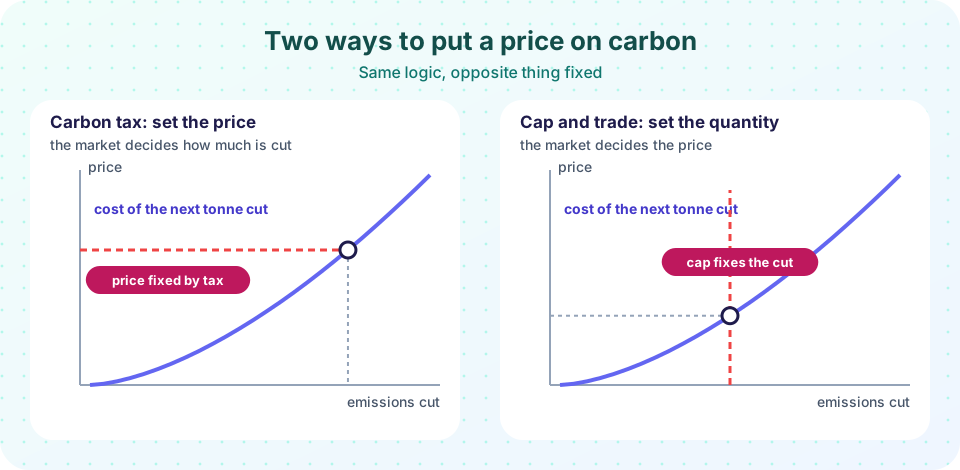
Imagine listing every possible way to cut emissions, sorted from the cheapest per tonne to the most expensive: efficiency measures that pay for themselves, then wind and solar, then switching industrial processes, and finally hard options. Plot cumulative tonnes cut against cost per tonne and you get a rising curve, the marginal abatement cost curve. A carbon price of P makes every option cheaper than P worthwhile. At P = 50 USD/t the economy would adopt everything on the curve to the left of that price. The curve is not fixed: technology learning moves it down over time.
Two designs: tax and cap
Carbon tax. The government sets a price per tonne and collects it, often on fuels at the point of sale. Advantages: simple, predictable price for investors, easy to administer, revenue can fund tax cuts, dividends or support. Disadvantage: the emissions reduction is uncertain, because it depends on how firms respond.
Cap and trade. The government sets a cap on total emissions, issues permits that sum to the cap (by auction or free allocation), and lets firms trade permits. The cap falls over time. The price emerges from the market. Advantages: the emissions outcome is certain, and it can link across countries. Disadvantage: the price may be volatile, which complicates investment, so many systems add price floors, ceilings or a market stability reserve.
In theory both produce the same result if the government knows the abatement cost curve exactly. In practice the curve is uncertain. Martin Weitzman showed in 1974 that when the cost of cutting is uncertain, a price instrument is better if the damage curve is flat (as with long-lived CO₂, where it is the cumulative total that matters), and a quantity instrument is better if there is a sharp threshold that must not be crossed.
Carbon tax
Cap and trade
In practice
Where carbon pricing exists
The EU Emissions Trading System began in 2005 and is the largest regional carbon market, covering power, industry and aviation within Europe (and extended to shipping and, later, buildings and road transport). China launched a national ETS for the power sector in 2021, covering several billion tonnes of CO₂ a year, the largest by emissions covered. Sweden introduced a carbon tax in 1991 and has among the highest rates in the world. According to the World Bank, carbon pricing instruments covered roughly a quarter of global greenhouse gas emissions in the early 2020s, with prices ranging from a few dollars to over a hundred dollars per tonne. EU allowance prices were roughly 60 to 100 euros per tonne in 2022-2023.
The social cost of carbon
What should the price be? One answer is the social cost of carbon (SCC): the present value of the damage from emitting one extra tonne of CO₂. Estimating it requires a chain of models: emissions to concentration, to warming, to physical impacts, to economic damages, and then converting future damages into today's money. The result is very sensitive to two assumptions: how damages grow with warming, and the discount rate.
Discounting means valuing a dollar of damage in 2100 less than a dollar today. The present value of a damage D in t years at discount rate r is D / (1 + r)ᵗ. At 3% a damage of 1,000 dollars in 80 years is worth about 94 dollars today. At 1% it is worth about 451 dollars; at 5%, only 20 dollars. A low rate counts the future heavily and gives a high SCC. The choice involves ethics, not just economics: how much weight do we give people who are not yet born? Estimates vary widely: the US government used about 51 dollars per tonne (2020 dollars, a 3% rate) for years, and in 2023 the Environmental Protection Agency updated its estimate to about 190 dollars per tonne with a lower rate and updated science. Many researchers argue for even higher values.
A different approach avoids damage estimates: pick a target (such as 1.5 °C), work out the emission path that meets it, and find the carbon price that makes that path happen. Such "target-consistent" prices in IPCC scenarios are often far higher than current prices.
Other tools, and why a mix is needed
A carbon price is efficient but does not fix everything. Households may not respond to price signals when renting a home with a bad boiler; investors need certainty; new technology needs support while it is expensive. Governments therefore combine instruments.
- Standards and regulation: efficiency standards for appliances and cars, building codes, phase-outs of coal or of new petrol-car sales. These are effective for sectors where prices do not work well.
- Subsidies and public investment: support for early deployment (feed-in tariffs, tax credits), research and development, grid infrastructure, public transport. These helped drive down solar and battery costs.
- Removing harmful subsidies: the International Monetary Fund has estimated explicit fossil fuel subsidies at over a trillion dollars annually in 2022, and the total including unpriced environmental and health costs much larger. Removing them while protecting poor households is a key reform.
- Information and nudges: labels, disclosure rules, default green electricity.
- Border carbon adjustments: if one region prices carbon and its trading partner does not, production may move abroad (carbon leakage). The EU's Carbon Border Adjustment Mechanism, in its transitional phase since October 2023, puts the carbon price on certain imports such as steel and cement.
- International carbon markets: Article 6 of the Paris Agreement allows countries to trade emission reductions. Rules agreed at COP26 and COP29 aim to prevent double counting, but quality, additionality and permanence remain concerns.
Fairness and politics
Carbon prices raise energy costs, which hit low-income households harder as a share of income. Returning revenue as equal per-person dividends can make most low- and middle-income households better off. A just transition also means supporting coal workers and regions and ensuring poorer countries have access to finance. Public acceptance depends heavily on how revenue is used and on perceived fairness, which is why some well-designed carbon taxes have been repealed after backlash, and others (such as Canada's rebates, Sweden's long-lasting tax) endured.
Common misconceptions
"A carbon price alone will solve the problem." It is powerful but needs complements such as standards, infrastructure and innovation support.
"The social cost of carbon is a fact of nature." It depends on modeling choices and ethical judgments about discounting, so it is a range, not a single truth.
"Carbon taxes just hurt the poor." Design matters: returning revenue to households can leave low-income families better off on average.
Try it
First, a marginal abatement cost curve. The measures and numbers are invented for illustration. The code lists them from cheapest to most expensive, draws the staircase, and finds how much is cut at a given carbon price.
Press Run (or Ctrl + Enter) to see the result here.
Program input · what you'd type while the program runs
Type the answers before you press Run, one per line. Each time the program reads a line (with input()), it gets the next line from this box.
Second, a Weitzman-style experiment. The true abatement cost is uncertain. Compare the quantity outcome under a tax with the price outcome under a cap by simulating many possible cost curves.
Press Run (or Ctrl + Enter) to see the result here.
Program input · what you'd type while the program runs
Type the answers before you press Run, one per line. Each time the program reads a line (with input()), it gets the next line from this box.
Third, discounting. See how much a future damage is worth today at different discount rates.
Press Run (or Ctrl + Enter) to see the console output here.
No output.
Check your understanding
Quick check · 5 questions
of 5 answered You scored / 5 · perfect!
-
1. What is an externality?
Emitting CO₂ imposes climate damage on others, a classic externality. -
2. In a carbon tax, what is fixed and what adjusts?
A tax sets the price; the market determines how much is cut. -
3. At a 3% discount rate, roughly what is a 1000-dollar damage 80 years away worth today?
1000 / 1.03^80 is about 94 dollars. -
4. Why might a border carbon adjustment be introduced?
It puts a carbon price on imports so domestic producers are not undercut. -
5. Which statement about the social cost of carbon is correct?
Estimates vary widely because they involve science and ethical choices about future generations.
Summary
- A carbon price fixes an externality and lets the cheapest cuts happen first; it is described by the marginal abatement cost curve.
- A carbon tax fixes the price; cap and trade fixes the quantity.
- The social cost of carbon depends strongly on the discount rate and on how damages are modeled.
- Standards, investment, subsidy reform, border adjustments and international markets complement prices.
- Design and fairness (dividends, a just transition) determine whether policies last.
Track your progress
Create a free account to tick off lessons and pick up where you left off on any device.
of Climate Science lessons completed