


















Lesson 47 of 48 · Projects and Practice
Climate science cheat sheet
A one-page recap of the key climate science formulas, constants, IPCC numbers and rules of thumb from energy balance to carbon budgets and policy.
This page is the quick reference for the course. It gathers the formulas you can derive, the numbers worth remembering and the rules of thumb that let you check a claim in your head. Round values are used throughout, and where a number comes from the IPCC Sixth Assessment Report (AR6) it says so. When a number matters for something important, look up the current value, because the science and the data keep improving.
What you will learn
- Recall the main formulas and what each one means.
- Use the numbers to sanity-check a statement or a calculation.
- Know which formula fits which question.
Core formulas
Average sunlight:        S / 4 ≈ 340 W/m²           (S = 1361 W/m²)
Absorbed sunlight:       (S/4)(1 − α) ≈ 238 W/m²    (α ≈ 0.30)
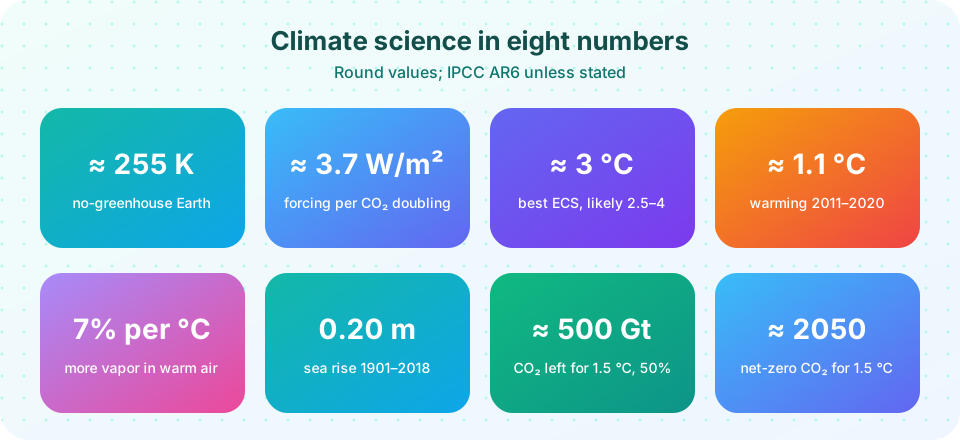
Effective temperature:   Tₑ = [ (S/4)(1 − α) / σ ]^¼ ≈ 255 K
Stefan–Boltzmann:        power per area = σ T⁴,  σ = 5.670e-8 W m⁻² K⁻⁴
CO₂ forcing:             F = 5.35 ln(C / C₀)  W/m²    → 3.7 W/m² per doubling
Energy balance model:    C dT/dt = F − λ T            → T_eq = F / λ,  τ = C / λ
Sensitivity:             ECS = F₂ₓ / λ                → λ = 1.2 gives ≈ 3.1 K
Two-box model:           C dT/dt = F − λT − γ(T − T_d),  C_d dT_d/dt = γ(T − T_d)
Kaya identity:           CO₂ = P × (GDP/P) × (E/GDP) × (CO₂/E)
Warming from emissions:  ΔT ≈ TCRE × cumulative CO₂  (0.45 °C per 1000 Gt)
Budget timing:           constant: B/E₀;  linear to zero: 2B/E₀;  exponential: rate = E₀/B
CO₂-equivalent:          mass × GWP  (CH₄ ≈ 30, N₂O ≈ 273 over 100 years)
Sea level from ice:      361 Gt of land ice = 1 mm of sea level
Water vapor:             ≈ 7% more per °C  (Clausius–Clapeyron)
Acidity:                 pH = −log₁₀[H⁺];  −0.1 pH ≈ +26% H⁺
Discounting:             PV = D / (1 + r)^t
Key numbers
| Quantity | Value | Source or note |
|---|---|---|
| Solar constant | 1361 W/m² | at Earth's distance |
| Earth's albedo | about 0.30 | satellite measurements |
| Natural greenhouse effect | about 33 K | 288 K vs 255 K |
| CO₂ now vs preindustrial | about 420 vs 280 ppm | rising about 2.5 ppm a year recently |
| Observed warming 2011-2020 | about 1.1 °C | AR6, relative to 1850-1900 |
| ECS | 3 °C best, likely 2.5 to 4 | AR6 |
| TCR | 1.8 °C, likely 1.4 to 2.2 | AR6 |
| TCRE | 0.45 °C per 1000 Gt CO₂ | AR6, likely 0.27 to 0.63 |
| Remaining budget from 2020 | 500 Gt (1.5 °C, 50%); 1,350 Gt (2 °C, 50%) | AR6 |
| Emissions 2019 | about 59 Gt CO₂-eq | AR6 WGIII |
| Fossil CO₂ now | about 37 Gt per year | recent annual estimates |
| Sea level rise 1901-2018 | about 0.20 m | AR6 |
| Rate of sea level rise | 1.3 then 1.9 then 3.7 mm per year | 1901-71, 1971-2006, 2006-18 |
| SSP warming 2081-2100 | 1.4, 1.8, 2.7, 3.6, 4.4 °C | SSP1-1.9 to SSP5-8.5 |
| Net zero CO₂ timing | about 2050 (1.5 °C), about 2070 (2 °C) | AR6 pathways |
| Coral reefs lost | 70 to 90% at 1.5 °C; about 99% at 2 °C | IPCC SR1.5 |
| Solar cost fall 2010-2019 | about 85% | AR6 WGIII |
Rules of thumb
- Factor of four: a sphere's area is four times its shadow, so average sunlight is a quarter of the solar constant.
- Forcing per doubling: about 3.7 W/m². Each doubling adds the same, so 280 to 560 to 1120 ppm adds equal steps.
- Warming per 1000 Gt: about 0.45 °C; every tonne of CO₂ counts about the same wherever it is emitted.
- Grid cost: halving horizontal spacing costs about eight times more computing.
- Extremes: a small shift in the mean multiplies the frequency of rare hot days.
- Time to cut: with 500 Gt and 40 Gt a year, a straight line to zero takes 25 years; waiting makes it steeper.
- Heat pumps: deliver about three units of heat per unit of electricity.
- Learning: a 20% learning rate leaves about 11% of the cost after ten doublings.
- Cumulative beats annual: what matters for temperature is the total emitted.
Checks before you trust a claim
- Units and size. Are the units right? Is the number plausible (1.7 × 10¹⁷ W, not 10⁷)?
- Baseline and window. Which reference period? How many years?
- Source. Is it a published dataset or assessment, or a single study? Is uncertainty shown?
- Scenario. Is the number conditional on an emission path?
- What it measures. Hazard, exposure or risk? Cause or impact? Fact or value judgment?
If a number from this sheet matters to a decision, check the latest IPCC report and national statistics. Round values here are for orientation, not for engineering.
How to use the sheet
Use the formulas to estimate before you calculate. If someone says that a measure will "cut 10 Gt a year," compare it with 40 Gt of emissions: that is a quarter of the total, a very large claim. If someone says that sea level will rise "several meters by 2100," compare with the AR6 likely ranges of 0.3 to 1 m and note that higher values are low-likelihood outcomes. If a chart shows a short hot or cold spell, remember that climate is defined over decades. Chaining the formulas is powerful: from a concentration you get a forcing, from a forcing and a sensitivity you get an equilibrium warming, from cumulative emissions you get a transient warming, and from warming you can estimate sea level or heat extremes qualitatively. For example, a rise from 420 to 560 ppm gives 5.35 ln(560/420) = 1.5 W/m², and at ECS 3 °C that is about 1.2 °C more warming at equilibrium. Practice such chains until they feel natural.
Try it
This script bundles the formulas as functions, so you can answer quick questions in one place.
Press Run (or Ctrl + Enter) to see the result here.
Program input · what you'd type while the program runs
Type the answers before you press Run, one per line. Each time the program reads a line (with input()), it gets the next line from this box.
Next, a unit converter for numbers you meet in climate news.
Press Run (or Ctrl + Enter) to see the console output here.
No output.
Check your understanding
Quick check · 5 questions
of 5 answered You scored / 5 · perfect!
-
1. What is the CO₂ forcing for a doubling of concentration?
5.35 ln 2 is about 3.7 W/m². -
2. A 500 Gt budget and 40 Gt per year emissions give how many years at constant emissions?
500 / 40 = 12.5 years. -
3. Which number is the AR6 best estimate for equilibrium climate sensitivity?
AR6 gives 3 °C, likely range 2.5 to 4 °C. -
4. How many Gt of land ice raise sea level by 1 mm?
About 361 Gt. -
5. Which check helps catch a misleading trend claim?
Short windows and convenient starting points can reverse a trend.
Summary
- A handful of formulas (energy balance, CO₂ forcing, TCRE, Kaya, discounting) answer most quantitative questions.
- Round numbers (1.1 °C so far, ECS 3 °C, 500 Gt budget, 0.20 m of sea level) help you sanity-check claims.
- Always check units, size, baseline, window, source and scenario.
Next: Further study
Track your progress
Create a free account to tick off lessons and pick up where you left off on any device.
of Climate Science lessons completed