


















Lesson 42 of 48 · Policy and Communication
Chapter 8 review: policy and communication
Review the Paris cycle, the IPCC and UNFCCC, carbon pricing, the social cost of carbon and the basics of communicating climate science, with ten questions.
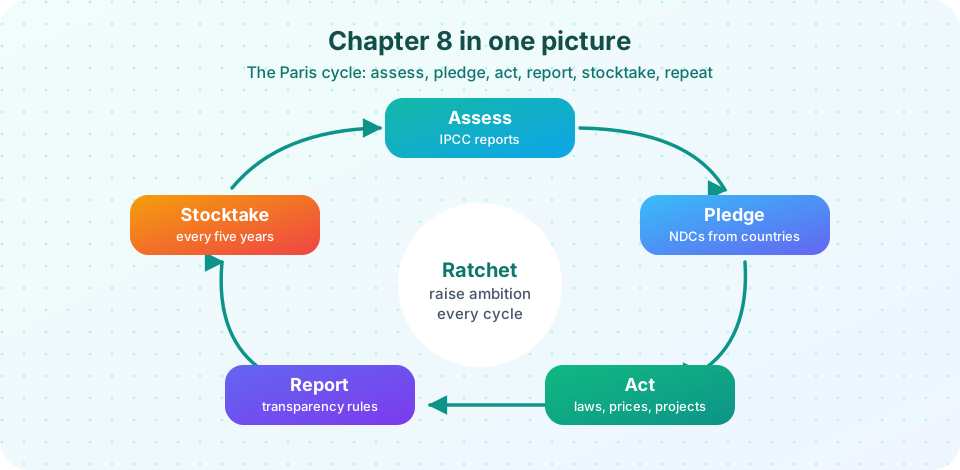
This chapter moved from physics to people: how societies decide, how rules and prices change behavior, and how knowledge travels. The picture below shows the cycle at the heart of the Paris Agreement, where science, pledges, action, reporting and review feed one another.
Recap table
| Topic | Key idea | Key facts |
|---|---|---|
| Collective action | Costs local and now, benefits shared and later | Free-rider problem; Ostrom's polycentric governance |
| IPCC | Assesses published science | Founded 1988; governments approve summaries |
| UNFCCC | Treaty framework | 1992 Rio; annual COPs; common but differentiated responsibilities |
| Kyoto Protocol | Binding targets for developed countries | 1997; about 5% below 1990 |
| Paris Agreement | Bottom-up NDCs, ratchet | 2015; well below 2 °C, pursue 1.5 °C; five-year cycles |
| Global stocktake | Five-yearly review | First concluded at COP28 (2023) |
| Carbon tax | Price fixed, quantity adjusts | Sweden 1991 |
| Cap and trade | Quantity fixed, price adjusts | EU ETS 2005; China ETS 2021 |
| Social cost of carbon | Damage per tonne | Highly sensitive to the discount rate |
| Policy mix | Prices plus standards and investment | Border adjustment to avoid leakage |
| Consensus | Expert agreement | 97% to over 99% in the studies |
| FLICC | Five misinformation techniques | Fake experts, Fallacies, Impossible expectations, Cherry-picking, Conspiracies |
| Inoculation | Warn first, explain the trick | Fact, myth, fallacy, fact |
Putting it together
Consider how a single country might act. The IPCC reports tell it what the science implies. Under Paris, it publishes an NDC, perhaps "cut emissions by 50% by 2030." To meet it, the government uses a mix: a carbon price covering power and industry, standards that phase out coal and set efficiency rules, public investment in grids and public transport, and support for affected workers. It reports progress under the transparency rules. After five years the global stocktake compares all countries' progress with the temperature goal, and the next round of NDCs should be stronger. Throughout, public support depends on communication: trusted messengers, honest handling of uncertainty, defenses against misinformation, and visible fairness.
Three points to carry away.
- Design for the problem. A global commons needs institutions that build trust and reciprocity, and policies that make clean choices easy.
- Tools complement each other. Prices are efficient, but standards, investment and information fill gaps that prices alone cannot.
- Communication is part of the system. Policy needs public understanding and consent, and misinformation can slow action by years.
When you evaluate a climate policy, ask: Which instrument does it use? Who pays and who benefits? Does it fit the carbon budget? How would we know whether it is working?
A worked synthesis question
A government proposes a carbon tax of 50 dollars per tonne on the 60% of its 300 Mt of emissions that are covered. It plans to return all the revenue to its 20 million residents as equal payments. Who gains, and what else is needed?
Covered emissions are 0.6 × 300 = 180 Mt, so the revenue is 180 × 10⁶ × 50 = 9 billion dollars a year if emissions do not change, and somewhat less as emissions fall. Per person that is 9 × 10⁹ / 20 × 10⁶ = 450 dollars, or 1,800 dollars for a household of four. Suppose a low-income household of four faces extra costs of about 600 dollars a year from higher energy prices, and a high-income household faces 2,400 dollars. The first gains 1,200 dollars, the second loses 600, so the policy is progressive even though the price is the same for all. Emissions fall because the price changes choices at the margin, and the dividend keeps public support. Other tools are still needed: standards and investment where prices work poorly, help for workers in affected regions, and a border adjustment so that trade-exposed firms are not undercut. Finally, the plan must be communicated clearly. A visible dividend, honest statements about costs, and a trusted messenger matter as much as the economics.
Try it
This calculator recomputes three pieces of arithmetic from the chapter.
Press Run (or Ctrl + Enter) to see the result here.
Program input · what you'd type while the program runs
Type the answers before you press Run, one per line. Each time the program reads a line (with input()), it gets the next line from this box.
Now a flashcard run.
Press Run (or Ctrl + Enter) to see the console output here.
No output.
Check your understanding
Quick check · 10 questions
of 10 answered You scored / 10 · perfect!
-
1. Which best describes the free-rider problem?
Because the atmosphere is shared, each actor is tempted to let others pay for the cuts. -
2. What is the role of the IPCC?
It is policy-relevant, not policy-prescriptive. -
3. Which feature makes the Paris Agreement a 'ratchet'?
NDCs are renewed every five years and the global stocktake reviews collective progress. -
4. In cap and trade, what adjusts?
The cap fixes the quantity, and the permit price emerges from trading. -
5. A higher discount rate generally makes the social cost of carbon
Future damages are weighted less, so the present value per tonne falls. -
6. Which is a reason for combining a carbon price with standards and investment?
Different barriers need different tools. -
7. What does a carbon border adjustment aim to prevent?
It prevents production from moving to places without carbon pricing. -
8. Which is an example of cherry-picking?
Choosing the start date to produce the desired slope is cherry-picking. -
9. What is the best structure for correcting misinformation?
It leads and ends with the correct information. -
10. The consensus studies found agreement among publishing climate scientists that recent warming is human-caused of about
Results range from about 97% to above 99%, depending on method and sample.
Summary
- Climate policy must solve a collective-action problem across scales.
- The IPCC assesses, the UNFCCC frames, Paris ratchets national pledges every five years.
- Carbon prices are efficient; a mix of standards, investment and fairness measures makes them work.
- Good communication admits uncertainty, uses trusted messengers and inoculates against misinformation.
Track your progress
Create a free account to tick off lessons and pick up where you left off on any device.
of Climate Science lessons completed