


















Lesson 13 of 48 · Energy Balance and Greenhouse Effect
Radiation and blackbody curves
Understand thermal radiation: why every object glows, how Planck curves explain sunlight and Earth's heat, and how to use the Stefan-Boltzmann and Wien laws with worked numbers.
Hold your hand near a hot stove and you feel warmth without touching anything. Heat has crossed the air as electromagnetic radiation. In fact, every object with a temperature above absolute zero constantly emits radiation: a stove, a person, the ground, the Sun. The hotter the object, the more power it emits and the shorter the wavelengths it favors. A piece of iron glows dull red at about 800 K, yellow-white at 1,500 K, and the Sun's surface, at about 5,800 K, shines white.
Climate science is built on this fact. Earth gains energy as sunlight and loses it as invisible infrared radiation, and the balance between these two sets the climate. In this lesson you learn the two laws that govern thermal radiation, calculate the glow of the Sun and Earth, and see why the two radiations differ so much in wavelength that we can treat them separately.
What you will learn
- Describe the electromagnetic spectrum and the connection between wavelength, frequency and photon energy.
- Explain what a blackbody is and state the Stefan-Boltzmann and Wien laws.
- Compute the emitted power and peak wavelength for the Sun and Earth.
- Explain why Earth's radiation is called longwave and sunlight shortwave.
- Explain, in one paragraph, why some gases absorb infrared radiation and others do not.
Key terms
Wavelength (λ): distance between successive wave crests, in meters or micrometers (µm). Blackbody: an ideal object that absorbs all radiation falling on it and emits the maximum possible at its temperature. Stefan-Boltzmann law: emitted power per unit area equals σT⁴. Wien's law: the wavelength of the peak emission equals b / T. Emissivity (ε): how close a real surface is to a blackbody, from 0 to 1.
Light, heat and the spectrum
Visible light, radio waves, X-rays and infrared are the same kind of wave, electromagnetic radiation, differing only in wavelength. All of them travel at the speed of light, c = 3.00 × 10⁸ m/s, and wavelength λ and frequency f are tied by c = λ f. The radiation also comes in packets, photons, each carrying energy E = hc / λ, where h = 6.626 × 10⁻³⁴ J·s is Planck's constant. Short wavelengths carry more energy per photon.
Visible light spans roughly 0.4 µm (violet) to 0.7 µm (red); a micrometer is one millionth of a meter. Just beyond red lies the infrared (about 0.7 to 1,000 µm), which includes the thermal radiation emitted by objects at everyday temperatures, and ultraviolet lies beyond violet (shorter than 0.4 µm). Climate scientists call the Sun's radiation, mostly 0.2 to 4 µm, shortwave, and Earth's, mostly 4 to 100 µm, longwave.
What is a blackbody?
A blackbody is the idealized emitter: it absorbs every bit of radiation that hits it, and when it is in thermal balance it emits radiation with a spectrum that depends only on temperature. Real objects are close to this: the Sun, the oceans, soil, snow and vegetation are all good blackbody approximations in the infrared, with emissivity around 0.95 to 0.99. Max Planck worked out the exact spectrum in 1900, a derivation that launched quantum theory. Planck's law gives the emitted power per unit area and wavelength:
B(λ, T) ∝ λ⁻⁵ / (e^(hc / λkT) − 1)
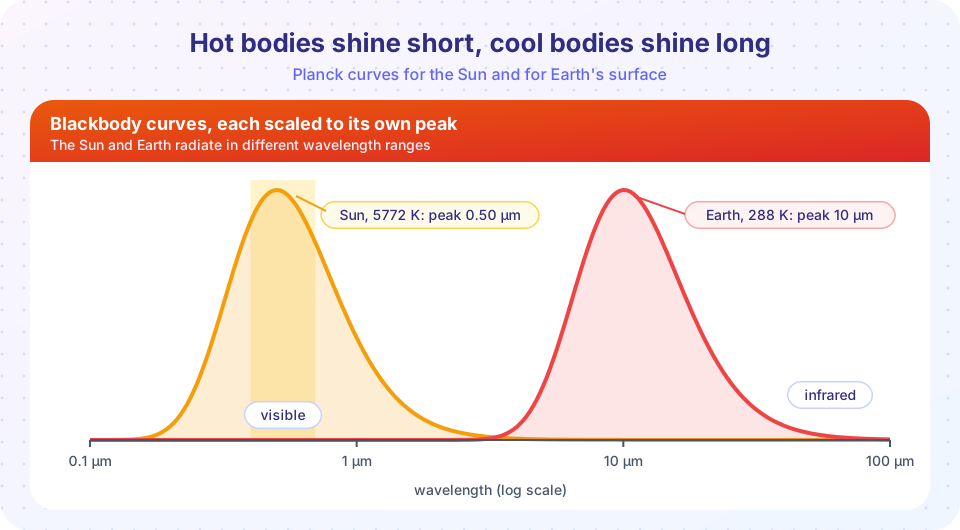
where k = 1.381 × 10⁻²³ J/K is Boltzmann's constant. You do not need to compute with this formula by hand, but it has a very recognizable shape: a smooth hump that rises quickly on the short side, peaks, and trails off slowly on the long side. The picture at the top of the lesson shows two such humps.
Two simple laws
Integrating Planck's law over all wavelengths gives the Stefan-Boltzmann law, discovered experimentally by Josef Stefan in 1879 and derived by Ludwig Boltzmann in 1884:
E = σ T⁴
Here E is the power emitted per square meter of surface, T is the absolute temperature in kelvin and σ = 5.670 × 10⁻⁸ W m⁻² K⁻⁴. The fourth power makes emission extremely sensitive to temperature: doubling the temperature raises the emitted power by 2⁴ = 16 times. A real surface with emissivity ε emits ε σ T⁴.
The wavelength at which the curve peaks is given by Wien's displacement law:
λmax = b / T, with b = 2.898 × 10⁻³ m·K.
Double the temperature and the peak shifts to half the wavelength.
Worked example: the Sun
The Sun's visible surface (the photosphere) has an effective temperature of 5,772 K. Then E = 5.670×10⁻⁸ × 5772⁴ = 6.29 × 10⁷ W/m², more than 60 million watts from every square meter. Its peak wavelength is λmax = 2.898×10⁻³ / 5772 = 5.02×10⁻⁷ m = 0.50 µm, in the green part of the visible spectrum. We evolved to see just the wavelengths that the Sun emits most.
Worked example: Earth
Take a global mean surface temperature of 288 K. Then E = 5.670×10⁻⁸ × 288⁴ = 390 W/m², and λmax = 2.898×10⁻³ / 288 = 1.01×10⁻⁵ m = 10 µm, deep in the infrared. Our eyes see nothing from this radiation, but infrared cameras do. Notice the ratio: the Sun's surface radiates 6.29×10⁷ / 390 ≈ 160,000 times more power per square meter than the Earth's.
A temperature sensitivity
How much more does the surface emit if it warms by one kelvin? Differentiating the law gives dE/dT = 4σT³ = 4E/T. At 288 K this is 4 × 390 / 288 ≈ 5.4 W/m² per kelvin. This number, the "Planck response", means that a warmer Earth sheds heat more effectively, which is the basic stabilizing mechanism of the climate. Lesson 5 returns to it.
Why separating the two radiations works
The Sun and Earth emit at temperatures differing by a factor of 20, so their peak wavelengths differ by a factor of 20 as well: 0.5 µm against 10 µm. As the picture shows, the two Planck curves hardly overlap; less than a few percent of sunlight has a wavelength longer than 4 µm, and almost none of Earth's radiation is shorter than 4 µm. This allows scientists to treat Earth's energy budget in two separate bookkeeping columns: shortwave (sunlight, absorbed or reflected) and longwave (infrared emitted by the surface and atmosphere). Greenhouse gases are almost transparent to the first column and strongly interact with the second.
Why gases absorb infrared selectively
A molecule absorbs radiation when the photon's energy matches a transition between its internal energy levels, such as a change of vibration or rotation. This only works if the change shifts the molecule's electric charge distribution so that the oscillating field can couple to it. Nitrogen (N₂) and oxygen (O₂) are symmetric, two-atom molecules; stretching them does not create an oscillating dipole, so they are almost transparent to infrared. Carbon dioxide is linear (O=C=O), and when it bends (a vibration with wavelength about 15 µm) the charge distribution changes, so it absorbs strongly near 15 µm, which lies on the long-wavelength side of Earth's emission peak. Water vapor absorbs in many bands, both in the far infrared and near 6.3 µm. Ozone absorbs near 9.6 µm, and methane near 7.7 µm. Between roughly 8 and 12 µm lies the "atmospheric window", where the clear air is fairly transparent and surface radiation escapes to space. Lesson 4 returns to these bands and the greenhouse effect.
Common misconceptions
"Only hot things radiate." All objects above absolute zero radiate. Your body, a block of ice and the night sky each emit infrared. Cooler objects simply emit less and at longer wavelengths.
"Infrared is heat itself." Infrared is just radiation. It carries heat from one place to another when absorbed, but any radiation that is absorbed (including sunlight) warms the absorber.
"The Stefan-Boltzmann law uses Celsius." It uses kelvin. Using °C produces nonsense, such as zero emission at 0 °C.
Try it
The first example is a calculator for the two laws. Edit the table to add any temperature you like.
Press Run (or Ctrl + Enter) to see the result here.
Program input · what you'd type while the program runs
Type the answers before you press Run, one per line. Each time the program reads a line (with input()), it gets the next line from this box.
The second example draws the Planck curves for the Sun, Earth and a warm object so you can see how the peak moves with temperature.
Press Run (or Ctrl + Enter) to see the result here.
Program input · what you'd type while the program runs
Type the answers before you press Run, one per line. Each time the program reads a line (with input()), it gets the next line from this box.
The third example lets you choose a temperature and see its glow color, peak wavelength and emitted power compared with Earth's surface. The color is an approximation.
Check your understanding
Quick check · 6 questions
of 6 answered You scored / 6 · perfect!
-
1. By what factor does the power emitted per square meter change if the absolute temperature doubles?
Power is proportional to T⁴, so doubling T multiplies power by 2⁴ = 16. -
2. The Sun's surface is at 5,772 K. According to Wien's law, its emission peaks at about:
λmax = 2.898×10⁻³ m K / 5772 K ≈ 5.0×10⁻⁷ m = 0.50 µm. -
3. Why can climate scientists treat sunlight and Earth's radiation as two separate streams?
The Sun peaks near 0.5 µm and Earth near 10 µm, so the two curves barely overlap. -
4. Which gas absorbs infrared strongly because it is a molecule whose vibration changes its charge distribution?
CO₂ bends and stretches in ways that create an oscillating dipole, unlike the symmetric N₂ and O₂ molecules. -
5. Which temperature must be used in the Stefan-Boltzmann law?
The law is built on absolute temperature. -
6. A surface at 288 K emits about how much power per square meter (blackbody)?
5.670×10⁻⁸ × 288⁴ ≈ 390 W/m².
Summary
- Every object above 0 K emits electromagnetic radiation; hotter objects emit more power and at shorter wavelengths.
- Stefan-Boltzmann:
E = σT⁴withσ = 5.67×10⁻⁸ W m⁻² K⁻⁴. Wien:λmax = b/Twithb = 2.898×10⁻³ m K. - The Sun (5,772 K) peaks near 0.5 µm; Earth (about 288 K) near 10 µm and emits about 390 W/m².
- Shortwave (sunlight) and longwave (Earth) radiation barely overlap, so they can be budgeted separately.
- Asymmetric or bending molecules such as CO₂, H₂O, CH₄ and O₃ absorb infrared; N₂ and O₂ do not.
Track your progress
Create a free account to tick off lessons and pick up where you left off on any device.
of Climate Science lessons completed