


















Lesson 39 of 48 · Policy and Communication
Chapter 8 overview: climate policy and communication
Understand why climate action is a collective-action problem and trace the milestones from the IPCC and Kyoto to the Paris Agreement and recent COP summits.
Science tells us what is happening and what choices would change it. Policy is how societies make those choices. Climate policy is unusual because the problem is global: a tonne of CO₂ has the same effect whoever emits it and wherever it is emitted, while the costs of cutting emissions fall on whoever does the cutting. That mismatch is the heart of the challenge, and it explains the shape of the international system built over four decades.
This chapter explains how that system works, what tools governments use at home, and how the science reaches the public, including how misinformation spreads and how to counter it.
What you will learn in this chapter
- Why climate change is a collective-action problem.
- How the IPCC, UNFCCC, Kyoto Protocol and Paris Agreement fit together.
- How the Paris ratchet is meant to raise ambition.
- How carbon pricing and other tools work, and how to communicate climate science well.
The collective-action problem
Imagine ten neighbors who share a lake. If each can dump waste cheaply into it, each gains a little, while the damage is shared by all. Economists call this a tragedy of the commons; the atmosphere is the ultimate shared resource. The logic is:
- Cutting emissions costs you now but benefits everyone later, so each actor is tempted to free-ride on others' cuts.
- The benefits come over decades while the costs come now.
- Countries differ enormously in how much they emitted historically, how much they emit per person, how rich they are and how exposed they are.
Yet the picture is not hopeless. Elinor Ostrom won the 2009 Nobel Prize in Economics for showing that communities often manage commons well when there are clear rules, monitoring, graduated penalties and trust. Climate governance today is a "polycentric" system, with action at the level of cities, firms, countries and treaties, not only at the global level.
Why climate policy is hard
The institutions
The tools
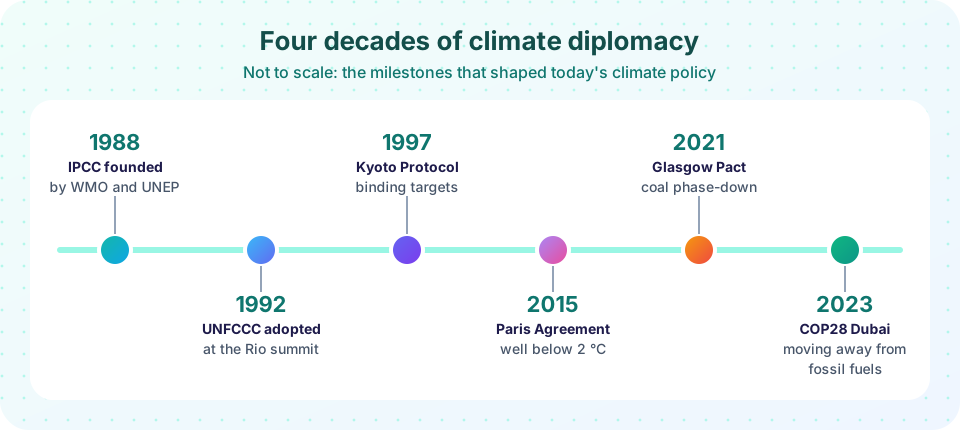
A short history
1988: the IPCC. The Intergovernmental Panel on Climate Change was set up by the World Meteorological Organization and the UN Environment Programme. It does not do its own research. Hundreds of scientists volunteer to assess the published literature, and governments approve the line-by-line wording of each summary for policymakers. Its assessment reports (1990, 1995, 2001, 2007, 2013-14, 2021-23) are the shared factual basis for negotiations.
1992: the UNFCCC. At the Rio Earth Summit, countries adopted the United Nations Framework Convention on Climate Change. Its objective is to stabilize greenhouse gas concentrations at a level that prevents dangerous human interference with the climate system. It set out the principle of "common but differentiated responsibilities": all countries must act, but rich countries, which emitted most historically, should lead. Nearly every country has ratified it. It meets each year at a Conference of the Parties (COP).
1997: the Kyoto Protocol. It set legally binding emission targets for developed ("Annex I") countries, averaging about 5% below 1990 levels in 2008-2012, and created international carbon markets. The United States signed but did not ratify, large developing emitters had no binding targets, and Canada withdrew in 2011. Many participants did meet their targets, partly thanks to the collapse of Soviet-era industry, but global emissions kept rising.
2015: the Paris Agreement. Rather than top-down targets, Paris builds on nationally determined contributions (NDCs): each country proposes its own goals. It sets a collective aim of holding warming to "well below 2 °C" above preindustrial levels and pursuing efforts to limit it to 1.5 °C, aims for balance between emissions and removals in the second half of the century, and requires transparency reporting. Crucially, it is a ratchet: NDCs are updated every five years and must represent progression, and a global stocktake every five years (the first concluded at COP28 in 2023) compares collective progress with the goals. Developed countries agreed to mobilize climate finance for developing countries, and at COP29 in 2024 a new goal of at least 300 billion US dollars per year by 2035 was set.
2021 to 2023: Glasgow and Dubai. At COP26 in Glasgow, countries agreed on language about phasing down unabated coal power and on rules for carbon markets. At COP28 in Dubai (2023), the first global stocktake concluded and the decision called for "transitioning away from fossil fuels in energy systems" in a just, orderly and equitable manner, the first COP text to name fossil fuels as a whole.
A precedent worth knowing. The 1987 Montreal Protocol phased out ozone-depleting chemicals, was ratified by every country, and has put the ozone layer on a path to recovery. It succeeded in part because substitutes were available, trade measures encouraged participation, and a fund helped developing countries. It shows that global environmental treaties can work, though CO₂ is a harder case because fossil fuels underpin the whole economy.
Is the ratchet working?
Before Paris, projections for 2100 based on policies then in place were about 4 °C or more. UN Environment Programme emissions-gap assessments found that current policies lead to roughly 2.5 to 3 °C of warming by 2100, and that full implementation of the pledges made so far would lower that, but with a large "implementation gap" between pledges and what policy actually delivers. That means the system has bent the curve, not enough: the ratchet has turned but must turn faster.
What each lesson covers
- Policy tools: agreements and carbon pricing: taxes, cap and trade, social cost of carbon, subsidies, border adjustments.
- Communicating climate science: consensus, uncertainty language, misinformation and how to respond to it.
- Chapter review: the Paris cycle in one picture and ten questions.
Common misconceptions
"The Paris Agreement sets binding national targets." The process obligations (submitting and reporting NDCs) are binding; the contents of each NDC are national choices.
"If one country cuts emissions, it makes no difference." Every tonne adds to the cumulative total, and national policies also change technology costs worldwide, so leadership has spillover effects.
"The IPCC does its own research and sets policy." It assesses published science and is "policy-relevant but not policy-prescriptive."
Try it
First, a public goods game that shows the free-rider problem. Each of 4 players can contribute from an endowment to a shared pot, which is multiplied and divided equally. Compare behaviors.
Press Run (or Ctrl + Enter) to see the console output here.
No output.
Second, a toy ratchet. In each five-year cycle, countries raise their annual cut rate. The model computes cumulative emissions and warming (using 0.45 °C per 1000 Gt) so you can see how much extra ambition each round buys. It is a teaching model with made-up starting values.
Press Run (or Ctrl + Enter) to see the result here.
Program input · what you'd type while the program runs
Type the answers before you press Run, one per line. Each time the program reads a line (with input()), it gets the next line from this box.
Check your understanding
Quick check · 5 questions
of 5 answered You scored / 5 · perfect!
-
1. Why is climate change called a collective-action problem?
That mismatch creates a temptation to free-ride on others' efforts. -
2. What does the IPCC do?
The IPCC assesses science; governments approve the summaries. -
3. What distinguishes the Paris Agreement from the Kyoto Protocol?
Paris is bottom-up and universal, with a ratchet mechanism. -
4. How often is the global stocktake under the Paris Agreement?
The stocktake is every five years; the first concluded at COP28 in 2023. -
5. The Montreal Protocol is important to climate policy because
It phased out ozone-depleting substances and is widely cited as a success.
Summary
- Climate change is a global collective-action problem: costs are local and now, benefits are shared and later.
- The IPCC assesses the science, the UNFCCC provides the framework, Kyoto set binding targets for some, and Paris uses national pledges reviewed every five years.
- COP28 (2023) concluded the first global stocktake and called for a transition away from fossil fuels.
- The pledges made so far reduce projected warming but a large implementation gap remains.
Track your progress
Create a free account to tick off lessons and pick up where you left off on any device.
of Climate Science lessons completed