


















Lesson 11 of 48 · The Climate System
Chapter review: the climate system
Review chapter 2 with a one-page picture of response times, a recap table, flashcards and a ten-question quiz on the atmosphere, oceans, ice, life and the carbon cycle.
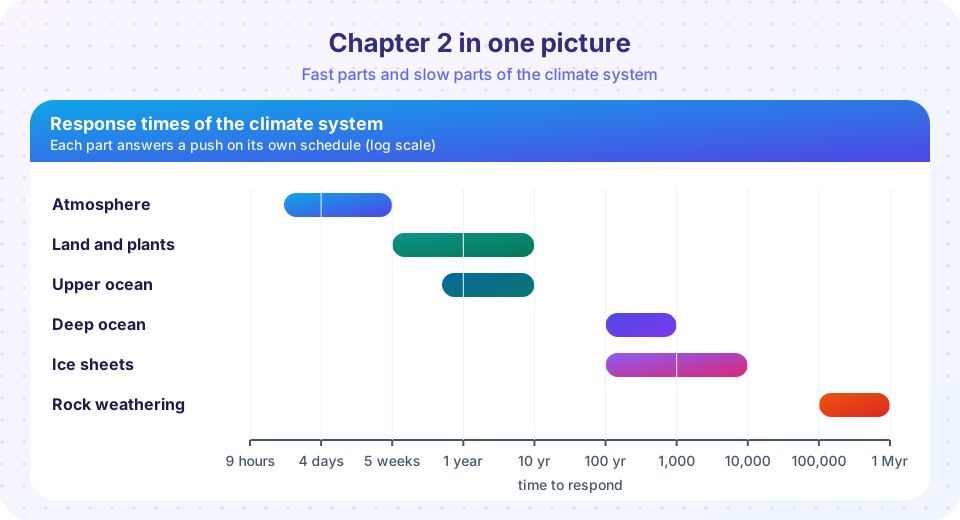
Chapter 2 introduced the machinery that produces climate. You met five interacting components, saw how fast or slow each one responds, and followed carbon through the whole system. Before moving to the physics of energy balance in chapter 3, this review pulls the main ideas into one picture, one table and a set of flashcards, and ends with a longer quiz.
What you should be able to do now
- Name the five components and give one job each plays in the climate.
- Explain why the ocean slows climate change, and what the thermocline, gyres and overturning circulation are.
- Use albedo values to say which surfaces warm or cool a region.
- Convert between GtC, GtCO₂ and ppm, and describe where emitted CO₂ goes.
- Say which responses are fast and which are slow.
The chapter in a table
| Component | Main role | Typical response time | Key number |
|---|---|---|---|
| Atmosphere | Moves heat and water; greenhouse gases act here | Days to weeks | 78 % N₂, 21 % O₂, CO₂ about 0.042 %; lapse rate 6.5 °C/km |
| Ocean | Stores heat and carbon; moves heat poleward | Years (surface) to millennia (deep) | 71 % of the surface; over 90 % of added heat; pH 8.2 to 8.1 |
| Ice (cryosphere) | Reflects sunlight; stores water | Years (sea ice) to millennia (ice sheets) | Snow albedo 0.8 to 0.9; Greenland 7 m, Antarctica 58 m of sea level |
| Life (biosphere) | Exchanges CO₂ with the air; shapes land albedo and evaporation | Months to centuries | Photosynthesis about 120 GtC per year |
| Land and rocks | Weathering, volcanoes, tectonics | Millennia to millions of years | Volcanic CO₂ under 1 % of human emissions |
Connecting the lessons
Lesson 2 showed that sunlight drives the atmosphere and that pressure falls quickly with height, so the troposphere, with the weather and most of the water vapor, is a thin shell. Lesson 3 added the ocean: it carries heat, stores more than 90 % of the extra heat and takes up a quarter of the CO₂ we emit. Lesson 4 looked at the albedo of ice, land and life, and at carbon stored in permafrost, forests and soils. Lesson 5 tied the story together with the carbon cycle: large natural flows, small but persistent human additions, and the long tail of CO₂ in the air.
The recurring lesson is time scale. When someone says that the climate system "responds" to a change, ask: which part? The air adjusts in days, so weather responds to sea-surface temperature at once. The upper ocean adjusts over years, which is why El Niño matters. The deep ocean and ice sheets are slow. That is why warming and sea-level rise continue long after emissions are cut, and why the lag between cause and effect is a characteristic of climate, not a sign that the cause is wrong.
Looking ahead
Chapter 3 will take the components you have just met and put numbers on the energy that flows between them. When you read about the energy balance, keep the cast of characters in mind: the atmosphere will carry the greenhouse gases and the clouds, the ocean will take up most of the extra energy, the ice and the land will decide how much sunlight is reflected, and the carbon cycle will determine how much of our emissions stay in the air to change the balance in the first place. The better you know who does what, the easier the physics will be to follow, because most of the equations in chapter 3 are just ways of keeping accounts for those same components.
Quick review: flashcards
Click a card to flip it. Try to answer before flipping.
Worked review problems
Problem 1: pressure and air. At the summit of a 4,000 m mountain, what is the air pressure compared with sea level? With a scale height of 7.6 km, p/p₀ = e^(-4 / 7.6) = e^(-0.526) = 0.59, so about 59 %. The oxygen fraction is still 20.95 %, but each breath contains only about 59 % as many oxygen molecules, which is why the mountain climber feels breathless.
Problem 2: heat in the ocean. A layer of the ocean 100 m deep warms by 0.5 °C. How much heat does 1 square meter of it absorb? The mass of the water column is 1025 kg/m³ × 100 m = 1.025 × 10⁵ kg, and the heat required is 1.025×10⁵ × 3990 × 0.5 ≈ 2.0 × 10⁸ J. If this happens over 20 years (6.3 × 10⁸ s), the average power absorbed is about 0.32 W/m². Compare that with the whole planet's present imbalance of about 0.8 W/m² (chapter 3) and you can see that a modest warming of the upper ocean accounts for a large share of the extra energy in the system.
Problem 3: carbon bookkeeping. In a year, fossil fuel emissions are 10.0 GtC and land-use emissions 1.0 GtC. The ocean takes up 2.8 GtC and the land 3.2 GtC. What is the airborne fraction and the rise in CO₂? The remainder in the air is 11.0 - 2.8 - 3.2 = 5.0 GtC, so the airborne fraction is 5.0 / 11.0 = 0.45, and the concentration rises by 5.0 / 2.13 ≈ 2.3 ppm. If instead the land took up 0.5 GtC less because of drought and fires, the air would receive 0.5 GtC more, and the rise would be about 0.23 ppm higher. This is why scientists watch the land sink closely.
Common confusions to watch for
Two confusions come up often in this chapter. The first is stock versus flow. A reservoir (the atmosphere holds about 890 GtC) is a stock, while a flux (10 GtC per year from fossil fuels) is a flow. A large flow can pass through a small stock without changing it, and a small net flow into a stock accumulates over time. Many arguments about carbon, such as "natural emissions are many times bigger than human emissions", become clear once you separate gross flows (both directions) from net flows (the difference).
The second is fast versus slow. A statement such as "the ocean absorbs heat" is true on any time scale, but "the ocean has reached equilibrium" is false on human time scales. When you meet a claim about the climate system, ask which components are involved and how long they take to respond. If you can answer that, you can usually tell whether the claim is plausible.
Check your understanding
Quick check · 10 questions
of 10 answered You scored / 10 · perfect!
-
1. Which component of the climate system holds more than 90 % of the extra heat trapped by greenhouse gases?
Observations of ocean heat content show it has absorbed over 90 % of the extra energy. -
2. In the troposphere, temperature on average falls with height at about:
The mean tropospheric lapse rate is about 6.5 °C per kilometer. -
3. Why does the stratosphere warm with height?
UV absorption by ozone heats the stratosphere from within. -
4. Which has the highest albedo?
Fresh snow reflects 80 to 90 % of sunlight; forest and open ocean reflect much less. -
5. Where does the North Atlantic Deep Water form?
Cooling makes northward-flowing Atlantic water dense so it sinks and flows south. -
6. An atmospheric CO₂ concentration of 420 ppm corresponds to about how much carbon in the air?
420 ppm × 2.13 GtC per ppm ≈ 895 GtC. -
7. Which is the main reason the carbon in fossil fuels matters for climate?
The fast return of slow-cycle carbon overwhelms the natural balance of the fast cycle. -
8. Roughly how large are volcanic CO₂ emissions compared with human emissions?
Human emissions are roughly 100 times as large. -
9. Which component takes the longest to respond fully to a forcing?
They respond over centuries to millennia, so changes continue long after a forcing stops growing. -
10. During an El Niño the tropical Pacific trade winds are:
Weak trade winds allow the warm pool to spread eastward, changing rainfall and raising global temperature slightly.
Summary
- The climate system has five connected components that respond on very different time scales, from days to millions of years.
- The ocean's heat capacity delays warming; its currents and El Niño move heat; its chemistry takes up CO₂ and acidifies.
- Albedo decides how much sunlight surfaces absorb; permafrost, forests and soils store carbon.
- Fossil carbon from the slow cycle enters the fast cycle in a century or two; about 45 % of emitted CO₂ stays in the air.
- Chapter 3 now explains the physics of energy balance and the greenhouse effect.
Next: Chapter overview: energy balance and the greenhouse effect
Track your progress
Create a free account to tick off lessons and pick up where you left off on any device.
of Climate Science lessons completed