


















Lesson 32 of 48 · Impacts and Risks
Ecosystems, health and tipping points
Explore how warming affects coral reefs, species ranges, crops and human health, and what scientists mean by climate tipping points and hysteresis.
Living things are tuned to the climate they evolved in. Corals have narrow temperature limits, trees time their leaf-out to spring warmth, wheat needs cool nights to fill its grains, and mosquitoes breed where it is warm and wet enough. When the climate shifts, each of these responds in its own way, and the human systems that depend on them, farming, fisheries and health, respond too.
In this lesson you will tour the main living-system impacts and then tackle the idea that worries many scientists most: tipping points, thresholds beyond which a part of the climate system changes state, abruptly or irreversibly.
What you will learn
- Describe impacts on species, coral reefs, crops, fisheries and human health.
- Explain ocean acidification with the pH scale.
- Define a tipping point, positive feedback and hysteresis.
- Name the main climate tipping elements and what is uncertain about them.
Key terms
Phenology: the timing of seasonal events such as flowering or migration. Bleaching: corals expelling their symbiotic algae under heat stress. Ocean acidification: the fall in seawater pH as the ocean absorbs CO₂. Tipping point: a threshold beyond which a small change triggers a large, often self-reinforcing shift. Hysteresis: a system that does not retrace its path when the driver is reversed.
Species on the move
Warming forces organisms to adapt, move or die. Syntheses of observations suggest that, on average, species have been shifting their ranges poleward at about 17 km per decade on land and upslope at about 11 m per decade, though the pace varies greatly between groups. Marine species often move faster than land species. Spring events in the Northern Hemisphere, such as leaf-out and bird migration, have moved earlier by days or weeks.
Moving is not always possible. A mountain-top species has nowhere higher to go. A tree species may need centuries to disperse. Habitat fragmentation by farms and cities blocks routes. A second problem is mismatch: if a caterpillar peak moves earlier than the arrival of the birds that feed their chicks on it, the birds suffer. Climate change adds to existing pressures (habitat loss, pollution, overexploitation), and scientists emphasize that these combined stresses raise extinction risk.
The ocean: heat, acid, and less oxygen
Coral reefs
Reef-building corals live in a partnership with algae that supply most of their food and color. Under heat stress, they expel the algae and turn white: bleaching. If the stress passes quickly the coral can recover; if it persists, the coral starves. Heat stress is measured in "degree heating weeks," the accumulation of temperatures above the local seasonal maximum. Mass bleaching events once rare have recurred in 1998, 2010, 2016 and 2023-2024 across multiple oceans. The IPCC assessed that 70 to 90% of warm-water reefs would be lost at 1.5 °C and about 99% at 2 °C. Reefs shelter a quarter of marine species and protect coasts and fisheries for hundreds of millions of people.
Acidification
The ocean takes up roughly a quarter of human CO₂ emissions. In seawater, CO₂ forms carbonic acid, which releases hydrogen ions and lowers the pH. Average surface-ocean pH has fallen from about 8.2 before the industrial era to about 8.1 today. pH is logarithmic: pH = −log₁₀[H⁺], so a drop of 0.1 means the hydrogen ion concentration has risen by a factor 10^0.1 ≈ 1.26, about 26% (often quoted as roughly 30%). The extra acidity reduces the carbonate ions that shell-forming animals such as oysters, sea urchins and pteropods use to build shells and skeletons.
Deoxygenation and fisheries
Warm water holds less dissolved oxygen, and stronger stratification reduces mixing of oxygen into deeper layers, so oxygen-minimum zones expand. Combined with warming and acidification, fish stocks shift toward the poles. Many tropical fisheries are projected to lose catch potential, with consequences for food security.
Food and farming
Crops are sensitive to both the average and the extremes. Heat during flowering reduces grain set in wheat and rice, and drought cuts yields. The IPCC assessed that climate change has already slowed growth of global agricultural productivity since about 1961, with the largest negative effects in lower latitudes. Higher CO₂ boosts photosynthesis in many crops (the CO₂ fertilization effect), but the nutritional quality of staples such as wheat and rice can fall (lower protein, zinc and iron) and the benefit is cancelled by heat, water stress and pests in many regions. Some high-latitude areas see longer growing seasons. Overall the balance shifts toward risk as warming increases, and the risk of simultaneous crop failures in several major producing regions is a concern.
Human health
Health impacts come through several routes.
- Heat: more heat-related deaths and illness, with elderly people, outdoor workers and urban poor most affected.
- Disease patterns: expanded ranges for mosquitoes that carry dengue and malaria in some regions, and for waterborne infections after floods.
- Air quality: higher ozone in hotter weather and wildfire smoke.
- Food and water: undernutrition when harvests fail, water shortages.
- Mental health: trauma and anxiety after disasters or displacement.
- Displacement: storms, floods and drought can move people, usually within their own countries.
Health systems can adapt, with heat-health warnings, mosquito control, and resilient hospitals. The WHO describes climate change as the single biggest health threat facing humanity in the long run, but also emphasizes that tackling it (cleaner air, active transport, healthier diets) has large health benefits.
Tipping points
A system has a tipping point when a gradual push eventually causes a rapid change into a different state that is hard to reverse. A rolling marble at the top of a hill is a good picture: a nudge decides which side it falls to. The ingredients are usually a positive (self-reinforcing) feedback strong enough that, once a threshold is crossed, the change feeds itself. Examples:
- Ice sheets: a melting surface lowers in altitude and warms (a "melt-elevation" feedback), and retreating ice sheets expose darker ground.
- Permafrost: thawing frozen soils release CO₂ and methane, which warms the air and thaws more.
- Amazon rainforest: the forest recycles rainfall, so losing trees can dry the region and kill more trees.
- Atlantic Meridional Overturning Circulation (AMOC): freshwater from melting ice can weaken the circulation, which affects heat transport.
What the science says
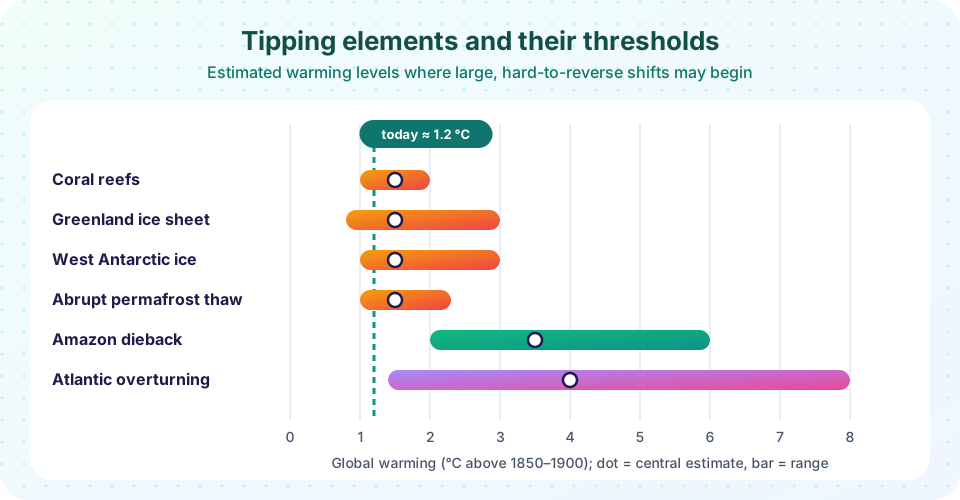
The IPCC assessed that many tipping points have low to moderate probability at modest warming and become more likely as warming rises. A 2022 synthesis by David Armstrong McKay and colleagues estimated threshold ranges (see the chart): for example, about 1.5 °C (range 0.8 to 3 °C) for the Greenland ice sheet, about 1.5 °C (1 to 3 °C) for the West Antarctic ice sheet, about 1.5 °C (1 to 2 °C) for low-latitude coral reefs, and about 1.5 °C (1 to 2.3 °C) for abrupt permafrost thaw, with the Amazon and AMOC at higher levels. These numbers carry large uncertainty, and the timescales matter: ice sheets could take centuries to millennia to respond fully, so crossing the threshold does not mean immediate collapse. The IPCC AR6 reported medium confidence that the AMOC will not abruptly collapse before 2100 but very likely weaken over the 21st century.
Hysteresis and irreversibility
Many tipping systems show hysteresis: once tipped, the driver must be lowered far below the tipping value to return. If an ice sheet has retreated, restoring the old climate may not be enough to regrow it, because the ice surface is now lower and warmer. This means that overshoot (temporarily exceeding a temperature target) may cause irreversible loss, even if temperature later returns.
Cascades
Tipping elements can interact: ice-sheet melt could weaken the AMOC; AMOC changes could shift rainfall over the Amazon. Researchers study whether crossing one tipping point raises the chance of others. This is why some assessments urge caution, not certainty: the uncertainties are large, but the potential consequences are very large too.
Common misconceptions
"Higher CO₂ is good for plants, so warming helps ecosystems." CO₂ fertilization is real but limited by nutrients and water, and it is outweighed by heat, drought, fire and pests in many regions.
"Ocean acidification means the ocean is acidic." Seawater is still alkaline (pH about 8.1). It is becoming less alkaline, and that change is enough to harm shell-forming organisms.
"A tipping point means the world ends immediately." Tipping elements respond over years to millennia. The concern is commitment to large, irreversible changes, not instant collapse.
Try it
First, the pH arithmetic of acidification: convert a pH change into a change in hydrogen ion concentration.
Press Run (or Ctrl + Enter) to see the result here.
Program input · what you'd type while the program runs
Type the answers before you press Run, one per line. Each time the program reads a line (with input()), it gets the next line from this box.
Second, a model of a tipping point. The equation dx/dt = r + x − x³ has two stable states for small r. Slowly raise r (the driver) and the system jumps; lower it again and it jumps back at a different value: hysteresis.
Press Run (or Ctrl + Enter) to see the result here.
Program input · what you'd type while the program runs
Type the answers before you press Run, one per line. Each time the program reads a line (with input()), it gets the next line from this box.
Third, a climate-velocity calculation. If the spatial temperature gradient is g (°C per km) and warming is w (°C per decade), species must move w / g per decade just to keep the same temperature. The gradient here is an assumed value, so this is an illustration of the idea.
Press Run (or Ctrl + Enter) to see the result here.
Program input · what you'd type while the program runs
Type the answers before you press Run, one per line. Each time the program reads a line (with input()), it gets the next line from this box.
Check your understanding
Quick check · 5 questions
of 5 answered You scored / 5 · perfect!
-
1. What does a drop in ocean pH from 8.2 to 8.1 mean for hydrogen ion concentration?
pH is logarithmic: 10^0.1 is about 1.26, so hydrogen ions rise by roughly 26%. -
2. What is coral bleaching?
Heat stress makes corals expel their algae, losing color and most of their food supply. -
3. Which is a characteristic of a tipping point?
Positive feedback makes change self-sustaining once the threshold is passed. -
4. What is hysteresis?
Hysteresis means the path back differs from the path forward, so recovery needs more than reversing to the tipping value. -
5. Why is CO₂ fertilization not a simple benefit for farming?
Extra CO₂ raises growth in some crops, but heat and water stress and lower grain nutrition can outweigh it.
Summary
- Species are moving poleward and upslope, and timing mismatches threaten some food webs.
- Corals bleach under heat stress; the ocean is acidifying (pH 8.2 to about 8.1, hydrogen ions up about 26%) and losing oxygen.
- Crops face heat, drought and nutritional trade-offs; CO₂ fertilization is real but limited.
- Health risks include heat, disease range shifts, air pollution, food insecurity and displacement.
- Tipping points are thresholds with self-reinforcing feedbacks and hysteresis; several have estimated thresholds near 1.5 °C or higher, with large uncertainty.
Next: Chapter review
Track your progress
Create a free account to tick off lessons and pick up where you left off on any device.
of Climate Science lessons completed