


















Lesson 37 of 48 · Mitigation and Adaptation
Adaptation and resilience
Learn how communities adapt to climate change with structures, nature and institutions, how to weigh costs and benefits, and where adaptation reaches its limits.
On 12 November 1970 the Bhola cyclone hit what is now Bangladesh and killed an estimated 300,000 people or more, one of the deadliest storms ever recorded. In November 2007 Cyclone Sidr, a similarly powerful storm, made landfall in the same country and killed several thousand. The storms were comparable; the difference was preparation. Bangladesh built thousands of cyclone shelters, improved forecasts, trained a large volunteer network and organized evacuations. That is adaptation: changing how we live so that the same hazard does less harm.
Climate adaptation is not a single technology. It ranges from sea walls to insurance schemes, from planting new crop varieties to rewriting building codes. This lesson shows the main types, explains how to decide which measures are worth their cost, and describes where adaptation runs into limits, including the danger of "maladaptation."
What you will learn
- Define adaptation, resilience and maladaptation.
- Distinguish structural, nature-based, and social or institutional measures.
- Weigh costs and benefits, including uncertainty about the future.
- Explain limits to adaptation and why equity matters.
Key terms
Adaptation: adjusting to actual or expected climate and its effects to reduce harm or exploit benefits. Resilience: the capacity of a system to absorb disturbance and recover. Maladaptation: actions that increase vulnerability or risk elsewhere or later. Transformational adaptation: changes that alter the fundamental nature of a system, such as relocating a community. Loss and damage: harm that cannot be avoided by mitigation or adaptation.
Three families of measures
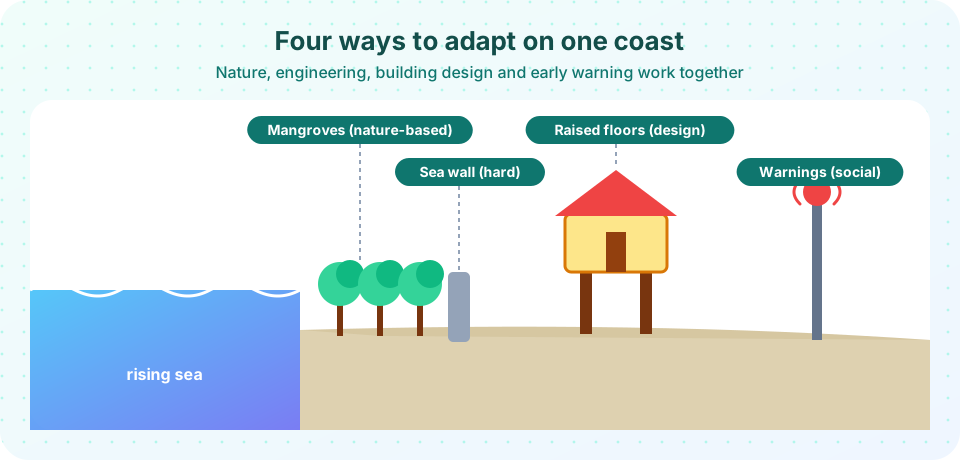
Structural and physical measures build or change physical things: sea walls and flood barriers, improved drainage, raised roads, cooling shelters, reservoirs and irrigation, buildings designed for heat and wind. They can be very effective but expensive and sometimes hard to modify.
Nature-based solutions use ecosystems: mangroves and salt marshes that absorb wave energy and trap sediment, dunes, restored wetlands and floodplains that hold floodwater, urban trees and parks that cool streets, forests that protect slopes. They often bring co-benefits (fisheries, carbon storage, recreation) and can grow with sea level if sediment is available, but they need space and take time.
Social, institutional and behavioral measures change rules, knowledge and practice: early-warning systems and evacuation plans, heat action plans that open cooling centers when forecasts exceed a threshold, crop insurance, land-use zoning that keeps new building out of flood zones, health system preparedness, water-use rules, social safety nets, and community-led planning. These are frequently the cheapest and the fastest to start.
Adaptation has many forms
Good adaptation is
Watch out for limits
Examples that worked
- Early warning. The World Meteorological Organization and others estimate that a warning issued 24 hours before a hazardous event can cut the damage by roughly 30%, and that early warning systems cost little compared with the damage they avoid. The UN's "Early Warnings for All" initiative aims to cover everyone on Earth.
- Heat action plans. After a deadly heat wave in 2010, Ahmedabad in India launched a plan with alerts, public awareness, cooling centers and coordination with hospitals. A later analysis estimated that it helped save on the order of a thousand lives per year, though attributing the change precisely is difficult.
- The Netherlands. Large parts of the Dutch land lie below sea level. The country built its Delta Works after the 1953 flood, and now runs an adaptive Delta Programme that plans for sea level rise with decision points, not a single fixed design.
Costs and benefits under uncertainty
The classic question is how high should the wall be? A higher wall costs more but lowers the chance of overtopping. A famous analysis by the Dutch mathematician David van Dantzig after the 1953 flood minimized the sum of the construction cost and the expected flood damage. The same logic applies today: pick the level that minimizes the total of annualized cost and expected annual loss, where the loss comes from the probability of an extreme event times the damage.
Climate change adds two difficulties. First, extreme events shift over time, so the optimal level changes as sea level rises. Second, the future is uncertain, so planners use robust strategies: options that perform acceptably across many futures, flexible designs that can be upgraded (such as foundations built to carry extra wall height later), and adaptive pathways with explicit triggers for the next step. A widely cited 2019 report of the Global Commission on Adaptation estimated that investing in early warning, resilient infrastructure, dryland farming, mangrove protection and water management could yield benefit-cost ratios from about 2:1 to 10:1.
Limits, maladaptation and fairness
Limits to adaptation. The IPCC distinguishes soft limits, which can be overcome with more money, better governance or new technology, from hard limits, which cannot: warm-water reefs cannot be shifted to cooler seas, a small low atoll cannot be raised enough, and human bodies cannot cope with sustained extreme wet-bulb heat without cooling. Adaptation limits are reached sooner at higher warming levels, which is a strong argument for mitigation.
Maladaptation. Some measures backfire. Air conditioning without clean power raises emissions and the urban heat island; a sea wall can give a false sense of security and encourage building in flood zones; irrigation can deplete aquifers; a levee can push floods downstream. Good practice asks who benefits, who bears costs, and what happens over the long term.
Fairness. Those most at risk often have the fewest resources. The UN Environment Programme's Adaptation Gap reports find that the money flowing to developing countries for adaptation is several times lower than their estimated needs. Under the UN climate process, rich countries have pledged adaptation finance, and a Loss and Damage fund was agreed in 2022-2023 to help countries with harm that cannot be prevented. Participation matters too: adaptation that uses local and indigenous knowledge and involves affected people tends to work better.
Common misconceptions
"We can simply adapt to anything." Adaptation has limits, and its costs and difficulty rise with warming. Some losses (species, cultures, places) cannot be replaced.
"Adaptation is a rich-country luxury." Many effective measures are cheap and local: warnings, mangrove restoration, drought-tolerant seeds, flood-proof housing design.
"A big engineering solution is always best." Hard infrastructure is useful but expensive and can lock in risk. A mix of hard, nature-based and social measures is usually more robust.
Try it
First, a van Dantzig-style calculation: choose a flood wall height that minimizes the sum of the wall's annual cost and expected annual flood damage. The numbers are invented for illustration. Rerun with a sea level rise of 0.5 m to see how the optimum shifts.
Press Run (or Ctrl + Enter) to see the result here.
Program input · what you'd type while the program runs
Type the answers before you press Run, one per line. Each time the program reads a line (with input()), it gets the next line from this box.
Second, a small classifier that sorts adaptation measures into the three families and counts them.
Press Run (or Ctrl + Enter) to see the console output here.
No output.
Check your understanding
Quick check · 5 questions
of 5 answered You scored / 5 · perfect!
-
1. Which is an example of a nature-based adaptation measure?
Mangroves are ecosystems that reduce wave energy and trap sediment. -
2. What is maladaptation?
Maladaptation backfires, for example by encouraging building in flood-prone areas or by increasing emissions. -
3. A 'hard limit' to adaptation is best illustrated by
Hard limits are physical or ecological boundaries that cannot be crossed by effort or money. -
4. Why do planners prefer flexible or adaptive designs?
Adaptive pathways with triggers and upgradable designs perform well across many futures. -
5. What made the difference between the 1970 Bhola and 2007 Sidr cyclone death tolls in Bangladesh?
Investment in warnings, shelters and volunteer networks cut deaths from hundreds of thousands to thousands.
Summary
- Adaptation reduces harm from climate effects through structural, nature-based and social measures.
- Early warning, heat plans and planned flexibility show that adaptation works and often pays off.
- Optimal design depends on cost, expected loss and a changing climate, so robust and adaptive approaches are preferred.
- Hard limits (reefs, small islands, extreme heat) and maladaptation show adaptation is not a substitute for mitigation.
- Fairness matters: adaptation finance and loss and damage support the most vulnerable.
Next: Chapter review
Track your progress
Create a free account to tick off lessons and pick up where you left off on any device.
of Climate Science lessons completed