


















Lesson 16 of 48 · Energy Balance and Greenhouse Effect
Feedbacks and climate sensitivity
Learn how feedbacks amplify or damp warming, how the Planck, water vapor, lapse rate, albedo and cloud feedbacks add up, and what equilibrium climate sensitivity of about 3 °C means.
Suppose carbon dioxide doubles. The extra greenhouse effect creates an imbalance of about 3.7 W/m². If nothing else changed, the planet would warm by only about 1.2 °C to cool itself back into balance. But other things do change. A warmer atmosphere holds more water vapor, which is itself a greenhouse gas. Melting ice exposes darker ground and sea. Clouds shift in height, thickness and extent. Each of these responses modifies how much warming is needed, and together they set the climate sensitivity, the most-discussed number in climate science.
This lesson explains the vocabulary (forcing, response, feedback), walks through each of the main feedbacks with numbers, shows how they add up to about 3 °C per doubling and describes why that number is uncertain by a factor of two but not by a factor of ten.
What you will learn
- Distinguish forcing, response and feedback, and positive from negative feedback.
- Describe the Planck, water vapor, lapse rate, surface albedo and cloud feedbacks and their typical strengths.
- Calculate the no-feedback warming and the amplification caused by feedbacks.
- Define equilibrium climate sensitivity (ECS) and transient climate response (TCR), and quote their IPCC ranges.
- Explain why the uncertainty in sensitivity is skewed toward high values.
Key terms
Feedback: a process in which a change in temperature causes a change in the energy balance that further alters the temperature. Positive feedback: amplifies the original change. Negative feedback: reduces it. Feedback parameter (λ): the change in net energy flow per kelvin of warming, in W/m² per K. ECS: equilibrium climate sensitivity, the long-term warming for doubled CO₂. TCR: transient climate response, the warming at the time CO₂ doubles when it increases by 1 % per year.
Forcing, response, feedback
A forcing is a push from outside: more CO₂, a volcanic eruption, a change in sunlight. It shifts the energy balance by ΔF watts per square meter. The response is the temperature change that follows. A feedback is a part of the response that itself changes the balance: warming alters the water vapor, the ice cover or the clouds, which in turn alter the energy flows.
It is useful to keep track of this with one equation. Let ΔN be the imbalance at the top of the atmosphere (energy in minus energy out) and ΔT the surface warming. Then
ΔN = ΔF + λ ΔT
where λ is the net feedback parameter. Because the planet loses more heat as it warms, λ is negative: it is a restoring term. At equilibrium ΔN = 0, so ΔT = ΔF / (-λ). With the forcing for doubled CO₂, ΔF₂ₓ ≈ 3.7 W/m², the equilibrium climate sensitivity is ECS = ΔF₂ₓ / (-λ). Everything in this lesson is about the value of λ.
The Planck response: the basic stabilizer
When the planet warms, it radiates more energy (σT⁴), which is a negative feedback. For the surface alone at 288 K the increase is 5.4 W/m² per kelvin (lesson 2). Taking into account that the atmosphere is colder and radiates at lower temperatures, the effective value for the whole planet comes to about -3.2 W/m² per K. This is the baseline. If this was the only response, doubled CO₂ would yield
ΔT₀ = 3.7 / 3.2 ≈ 1.2 °C
the no-feedback sensitivity. The rest of the story is how much further the other feedbacks push it.
The main feedbacks
Water vapor (strongly positive, about +1.8 W/m² per K)
Warm air holds roughly 7 % more water vapor for each degree. Water vapor is a powerful greenhouse gas, so the extra amount increases the greenhouse effect and warms the planet further. Observations show that atmospheric water vapor has increased as the climate has warmed, at about the rate expected, so this feedback is among the best constrained. By itself the water vapor feedback roughly doubles the warming from a given forcing.
Lapse rate (negative, about -0.5 W/m² per K)
In the tropics, warming at the surface tends to be amplified at upper levels because rising moist air releases heat as it condenses. That makes the radiating level warmer than before, which sends more heat to space, a negative feedback. In the polar regions the effect goes the other way. Because the water vapor and lapse rate feedbacks are physically linked, scientists often combine them: the pair is about +1.3 W/m² per K, with less uncertainty than either separately.
Surface albedo (positive, about +0.35 W/m² per K)
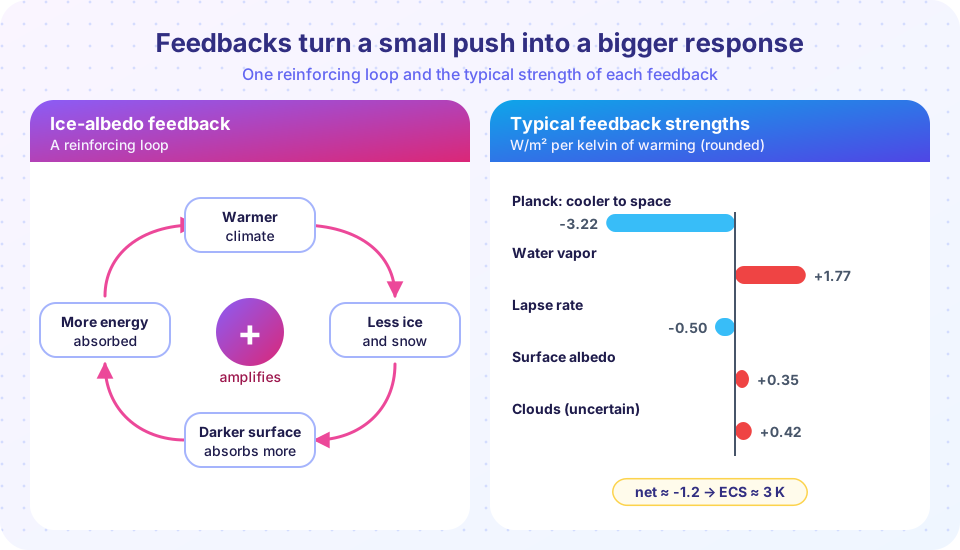
When snow and ice melt, they reveal darker land or water that absorbs more sunlight (lesson 4 of chapter 2). The surface warms more, melting still more ice, which makes this a classic reinforcing loop. It is strong regionally, especially in the Arctic, where warming is more than twice the global average ("Arctic amplification"), but is small in the global average because ice covers a small share of the globe.
Clouds (positive on average, about +0.4 W/m² per K, very uncertain)
Clouds both reflect sunlight (cooling) and trap infrared (warming), so they affect the energy balance in both directions. Which effect wins depends on the height and type of cloud. High, thin cirrus clouds warm. Low, thick stratocumulus clouds cool. In a warmer climate high clouds tend to rise (a warming feedback) and the area of low clouds in some regions is expected to decrease (also warming). The cloud feedback is the largest source of uncertainty in climate models, but recent assessments find it is likely positive, and a strongly negative cloud feedback is very unlikely.
Adding up and amplification
Typical central values from recent assessments are summarized below. They are rounded and each has an uncertainty range.
| Feedback | Strength (W/m² per K) | Effect |
|---|---|---|
| Planck | -3.2 | Stabilizing |
| Water vapor | +1.8 | Amplifying |
| Lapse rate | -0.5 | Stabilizing |
| Surface albedo | +0.35 | Amplifying |
| Clouds | +0.4 | Amplifying, uncertain |
| Net | about -1.2 | Still stabilizing |
The net value is still negative, which means the climate is stable: warming has a finite limit. But the restoring force is only about a third as strong as the Planck term alone, so the equilibrium warming is about three times larger: ECS ≈ 3.7 / 1.2 ≈ 3 °C. A convenient way to see the amplification is the ratio ΔT / ΔT₀ = 3.1 / 1.15 ≈ 2.7: feedbacks as a group multiply the basic effect by roughly 2.5 to 3.
Climate sensitivity in numbers
The IPCC Sixth Assessment Report (2021) combined several independent lines of evidence: physical understanding of the feedbacks, the warming observed since the 19th century, the climate of the last ice age (about 21,000 years ago, when the climate was about 6 °C cooler and CO₂ was 180 ppm), and other past climates. It concluded that ECS is likely between 2.5 and 4 °C per doubling of CO₂, very likely between 2 and 5 °C, with a best estimate of 3 °C. This is a narrower range than the 1.5 to 4.5 °C given from 1979 to 2013.
The transient climate response is lower, with a best estimate near 1.8 °C (likely 1.4 to 2.2 °C). It is lower because the ocean takes up heat and slows the surface warming during the 70 years it takes to double CO₂ at 1 % per year, as chapter 2 explained. ECS is what the planet would reach after hundreds of years of adjustment.
Why the uncertainty is skewed
Because ECS = ΔF/(-λ), uncertainty in λ becomes uncertainty in ECS through a division. If the net feedback were as weak as -0.8, the sensitivity would jump to 4.6 °C; if it were -1.6, it would be 2.3 °C. Equal-size errors in λ produce a longer tail on the high side. This skewness is why the "very likely" range extends further above the best estimate than below it, and why scientists take the high end seriously, even if it is less probable.
Beyond the ordinary feedbacks
Some feedbacks work on the carbon cycle (warming ocean absorbs less CO₂; thawing permafrost releases it) and others on ice sheets, vegetation and aerosols. These are usually part of "Earth system" sensitivity and play out over centuries. They are important but harder to quantify, and the IPCC treats them separately from the fast feedbacks above.
Common misconceptions
"Feedbacks mean runaway warming." A runaway occurs only if the net feedback becomes positive. All central estimates are strongly negative on net (about -1.2 W/m² per K), so warming approaches a limit. Venus-style runaway greenhouse warming is not plausible on Earth in the next centuries.
"Climate sensitivity is just a model assumption." It is an output: it comes from observations and physical understanding. Models, observed warming and paleoclimate records give consistent ranges.
"If the sensitivity is uncertain, we cannot say anything." The range of 2.5 to 4 °C per doubling already supports most of the key conclusions: even the low end implies substantial warming for the doubling that is plausible this century.
Try it
The first example calculates the no-feedback warming and the amplification from the feedbacks in the table.
Press Run (or Ctrl + Enter) to see the result here.
Program input · what you'd type while the program runs
Type the answers before you press Run, one per line. Each time the program reads a line (with input()), it gets the next line from this box.
The second example shows why the uncertainty in sensitivity is skewed. It draws many possible values of the net feedback and converts each into a sensitivity. The uncertainty chosen is illustrative, not an assessment result.
Press Run (or Ctrl + Enter) to see the result here.
Program input · what you'd type while the program runs
Type the answers before you press Run, one per line. Each time the program reads a line (with input()), it gets the next line from this box.
The third example is an interactive feedback mixer. Move the sliders, and the model computes the net feedback and the sensitivity. If the net becomes positive the system would be unstable.
Check your understanding
Quick check · 6 questions
of 6 answered You scored / 6 · perfect!
-
1. Which feedback is the basic stabilizer that makes the planet radiate more as it warms?
A warmer planet radiates more infrared (σT⁴), which is a negative feedback of about -3.2 W/m² per K. -
2. What warming would doubled CO₂ cause with only the Planck response (no other feedbacks)?
3.7 W/m² divided by 3.2 W/m² per K is about 1.2 K. -
3. Which feedback is the largest source of uncertainty in climate sensitivity?
Cloud responses vary by type, height and region, making this feedback the least certain. -
4. The IPCC AR6 best estimate for ECS is:
AR6 gives 3 °C as the best estimate with a likely range of 2.5 to 4 °C. -
5. Why is the transient climate response smaller than the ECS?
TCR is measured at the time of doubling, when the climate has not yet reached equilibrium. -
6. A net feedback of -1.2 W/m² per K and a forcing of 3.7 W/m² gives an equilibrium warming of about:
3.7 / 1.2 ≈ 3.1 K.
Summary
- Forcing pushes the energy balance, feedbacks modify the response, and
ΔT = ΔF / (-λ)at equilibrium. - The Planck response (-3.2 W/m² per K) gives a no-feedback warming of about 1.2 °C per doubling.
- Water vapor (+1.8), surface albedo (+0.35) and clouds (+0.4) amplify; the lapse rate (-0.5) damps. Net about -1.2, so ECS ≈ 3 °C.
- AR6: ECS likely 2.5 to 4 °C, very likely 2 to 5 °C; TCR about 1.8 °C.
- The uncertainty is skewed toward high values because ECS is the inverse of the net feedback.
Next: Chapter review: energy balance and the greenhouse effect
Track your progress
Create a free account to tick off lessons and pick up where you left off on any device.
of Climate Science lessons completed