


















Lesson 15 of 48 · Energy Balance and Greenhouse Effect
The greenhouse effect
Understand how greenhouse gases warm the planet using a layer model and the emission-height idea, why CO₂ forcing is logarithmic, and what the 33 K natural greenhouse effect means.
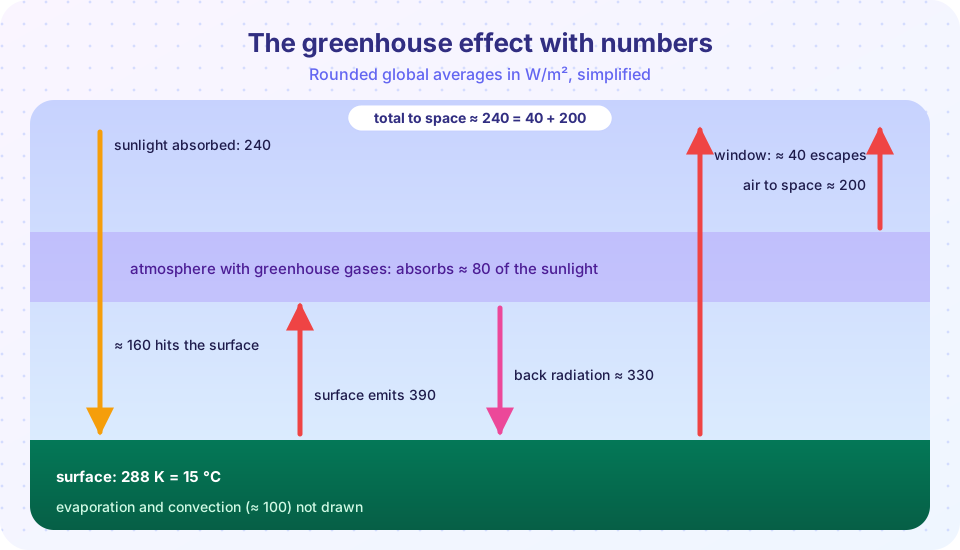
Without any atmosphere Earth's surface would settle at about 255 K, a frozen -18 °C. The real surface averages about 288 K. The 33 K difference is the natural greenhouse effect, and it exists because certain gases in the atmosphere absorb infrared radiation and re-emit it in all directions, including back toward the ground. The result is that the surface receives energy not just from the Sun but also from the sky.
The word "greenhouse" is a historical accident, and it misleads a little: a garden greenhouse warms mainly because its glass stops warm air from escaping by convection, while the atmosphere works through radiation. This lesson builds the real mechanism step by step, from a one-layer model to the picture of an effective emission height, and ends with the formula for how much extra warming comes from extra carbon dioxide.
What you will learn
- Explain the greenhouse effect with the one-layer model and calculate its prediction.
- Describe the emission-height picture and why more greenhouse gas warms the surface.
- Name the main greenhouse gases and their relative contribution.
- Use
ΔF = 5.35 ln(C/C₀)to calculate the forcing from CO₂. - Recognize and correct common objections, such as "CO₂ is already saturated".
Key terms
Greenhouse gas: a gas that absorbs and emits infrared radiation, such as H₂O, CO₂, CH₄, N₂O and O₃. Back radiation: infrared emitted by the atmosphere toward the surface. Effective emission height: the altitude from which most of the infrared leaving Earth escapes to space. Radiative forcing (ΔF): the change in net energy flow at the top of the atmosphere caused by an agent, in W/m². Atmospheric window: the wavelength range (about 8 to 12 µm) where the clear atmosphere is largely transparent.
Step 1: the one-layer model
Imagine the atmosphere as a single sheet above the surface. It is transparent to sunlight, so all absorbed sunlight (238 W/m² on average) reaches the surface. The sheet absorbs a fraction f of the infrared the surface emits and re-emits the energy both up and down, half to space, half back to the surface.
For the whole system to be in balance, the energy leaving at the top must equal the 238 W/m² absorbed. Let the surface be at Ts and the atmosphere at Ta. The sheet is in balance when it emits twice what it absorbs per side: 2 σ Ta⁴ = σ Ts⁴, so σTa⁴ = σTs⁴ / 2. The outgoing flux at the top has two parts: surface radiation that slips through (the fraction 1 - f) and the sheet's own upward radiation (f σTa⁴):
OLR = (1 - f) σTs⁴ + f σTs⁴ / 2 = σTs⁴ (1 - f/2)
Set OLR = 238 W/m². If the sheet is perfectly absorbing (f = 1), σTs⁴ = 2 × 238, so Ts = 2^(1/4) × 255 = 303 K, too warm. With Ts = 288 K we need 1 - f/2 = 238.2 / 390.1 = 0.611, so f = 0.78. A one-layer atmosphere that absorbs 78 % of the infrared leaving the surface matches the observed temperature. Notice that 1 - f/2 = 0.61 is exactly the effective emissivity used in the temperature knob of the chapter overview.
This model is a cartoon (the real atmosphere has many layers, absorbs at selected wavelengths, and moves heat by convection and evaporation), but it captures the essence: a surface under an absorbing blanket must be warmer to push the same energy out.
Step 2: the emission-height picture
A more realistic idea is the effective emission height. At a wavelength where greenhouse gases absorb strongly, the air is opaque, so radiation escaping to space comes not from the ground but from a higher level where the air has become thin enough to let it through. Averaged over all wavelengths, that level is about 5 km above the surface, where the temperature is close to 255 K, the emission temperature we calculated in lesson 3. That is no coincidence: to radiate 238 W/m² the level that radiates to space must be at 255 K.
Now use the lapse rate from chapter 2, which tells us that the temperature increases by about 6.5 K for each kilometer we descend through the troposphere. From the emission height at 5 km down to the ground the temperature rises by 6.5 × 5 ≈ 32 K, so Ts ≈ 255 + 32 = 287 K. The greenhouse effect is the difference between the surface and the cold altitude from which Earth radiates to space.
This picture also explains why adding more greenhouse gas warms the surface. More gas makes the atmosphere opaque to a wider range of wavelengths and moves the level of escape higher, where it is colder. A colder emitting layer radiates less (σT⁴ goes down), so, at first, less energy leaves than arrives: the planet has an imbalance (a positive forcing). To restore the balance the whole column, including the surface, warms until the raised emission level is again at 255 K. If the emission height rises by Δz, the surface warms by about Γ Δz, where Γ ≈ 6.5 K/km. A rise of 200 m yields about 1.3 K, a number close to the no-feedback warming for doubled CO₂.
The greenhouse gases
By far the largest contributor is water vapor, followed by clouds (which also absorb infrared) and then carbon dioxide. Modeling studies by Gavin Schmidt and colleagues attributed about 50 % of the clear-sky greenhouse effect to water vapor, 25 % to clouds, 20 % to CO₂, and the remaining 5 % to methane, nitrous oxide, ozone and others. Why, then, is the focus on CO₂? Because water vapor is controlled by temperature: warm the air by a few degrees and it holds about 7 % more water vapor per degree; cool it and the excess condenses out as rain within days. Water vapor therefore responds to climate, which makes it a feedback (lesson 5). CO₂ and the other non-condensing gases stay in the air for decades to centuries, so their concentration is set by emissions, not by temperature, and they act as the controlling knob.
Other greenhouse gases have a stronger effect per molecule. On a 100-year basis a tonne of methane warms about 27 to 30 times as much as a tonne of CO₂, but it lasts only about a dozen years; nitrous oxide is about 270 times as strong with a lifetime near a century; some synthetic gases such as sulfur hexafluoride are thousands of times stronger. The ratio used to compare them is called global warming potential (GWP).
Why the CO₂ effect is logarithmic
Each additional molecule of CO₂ has a smaller effect than the one before. In the middle of the strong 15 µm band the gas absorbs almost completely, so adding more does little there; but the band's edges ("wings") are weaker and bring new absorption, and a larger concentration raises the emission height. The net result is that the forcing grows with the logarithm of concentration, which Gunnar Myhre and colleagues fitted in 1998 as:
ΔF = 5.35 × ln(C / C₀) W/m²
with C₀ the reference concentration. For a doubling, ΔF = 5.35 × ln 2 = 3.71 W/m², and this applies for every doubling: from 280 to 560 ppm, from 420 to 840 ppm and so on. From the pre-industrial 280 ppm to 420 ppm, ΔF = 5.35 × ln 1.5 = 2.17 W/m². The sixth IPCC assessment gives the effective radiative forcing from CO₂ since 1750 as about 2.2 W/m². The total from all human influences is about 2.7 W/m², smaller because cooling by aerosols (about -1.1 W/m²) partly offsets the other greenhouse gases and ozone.
Worked example
If CO₂ rises from 420 ppm to 500 ppm, ΔF = 5.35 × ln(500/420) = 5.35 × 0.174 = 0.93 W/m². The next 80 ppm, from 500 to 580 ppm, adds only 5.35 × ln(580/500) = 0.79 W/m²: slightly less each time, but never zero.
Common misconceptions
"CO₂ is already saturated, so more makes no difference." That was Ångström's 1900 objection (history lesson). It fails because radiation escapes to space from a high, cold layer; more CO₂ moves that layer up, so less energy escapes. Wings of the absorption band also keep absorbing. Satellite measurements of outgoing infrared have observed the extra absorption in the CO₂ band directly.
"A greenhouse works like the atmosphere." A glass greenhouse warms mainly by suppressing convection. The atmospheric effect is radiative: gases absorb and re-emit infrared. The name stuck, but the physics differs.
"Water vapor is the main greenhouse gas, so CO₂ doesn't matter." Water vapor responds to temperature, while CO₂ persists and sets the temperature to which water vapor then responds. Without the non-condensing gases, most of the water vapor would freeze or rain out.
"The greenhouse effect is bad." The natural effect is what makes the planet habitable. The concern is the enhancement caused by adding gases.
Try it
The first example solves the one-layer model for the absorbed fraction and shows the effect of changing it.
Press Run (or Ctrl + Enter) to see the result here.
Program input · what you'd type while the program runs
Type the answers before you press Run, one per line. Each time the program reads a line (with input()), it gets the next line from this box.
The second example compares the logarithmic law with a linear guess and prints the forcing for several concentrations.
Press Run (or Ctrl + Enter) to see the result here.
Program input · what you'd type while the program runs
Type the answers before you press Run, one per line. Each time the program reads a line (with input()), it gets the next line from this box.
The third example is the emission-height model with sliders. It is a toy: it assumes a fixed 255 K emission temperature and a constant lapse rate.
Check your understanding
Quick check · 6 questions
of 6 answered You scored / 6 · perfect!
-
1. In the one-layer model, an atmosphere that absorbs 78 % of surface infrared gives a surface temperature of about:
With f = 0.78, 1 - f/2 = 0.61 and Ts = (238/(σ × 0.61))^(1/4) ≈ 288 K. -
2. Why does adding greenhouse gas warm the surface in the emission-height picture?
A higher and colder emission level radiates less; the whole column warms until the raised level is again at about 255 K. -
3. What is the forcing from doubling CO₂, using ΔF = 5.35 ln(C/C₀)?
5.35 × ln 2 = 3.71 W/m². -
4. Why is water vapor treated as a feedback rather than a forcing?
Water vapor concentration responds to temperature within days; CO₂ stays, setting the temperature. -
5. Which statement refutes the claim that CO₂ absorption is already saturated?
More CO₂ raises the emission level and absorbs in the wings of the band, so the forcing keeps growing, logarithmically. -
6. The natural greenhouse effect is about:
288 K minus 255 K is about 33 K.
Summary
- Greenhouse gases absorb infrared and re-emit it up and down; the surface receives energy from both the Sun and the sky and sits about 33 K warmer than the emission temperature of 255 K.
- A one-layer model absorbing 78 % of surface infrared reproduces 288 K; the emission-height picture says
Ts ≈ 255 K + Γ zwithz ≈ 5 km. - Water vapor (about half of the effect) and clouds respond to temperature; CO₂ and other long-lived gases act as the controlling knob.
- CO₂ forcing is logarithmic:
ΔF = 5.35 ln(C/C₀), 3.7 W/m² per doubling. - Total effective forcing since 1750 is about 2.7 W/m², with CO₂ alone near 2.2 W/m².
Track your progress
Create a free account to tick off lessons and pick up where you left off on any device.
of Climate Science lessons completed