


















Lesson 6 of 48 · The Climate System
Chapter overview: the climate system
Meet the five interacting parts of the climate system, see how fast each one responds, and get a guide to the lessons on air, oceans, ice, life and the carbon cycle.
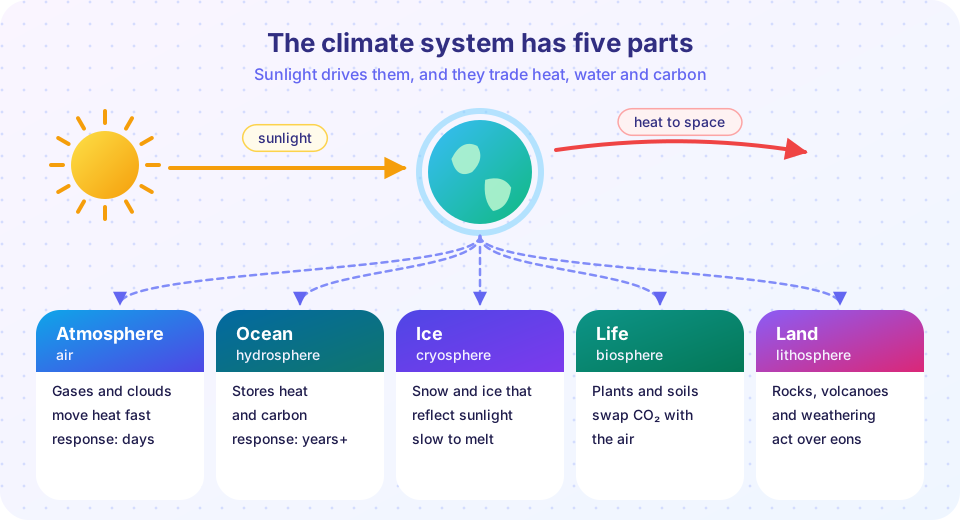
When people say "the climate" they often picture the air: temperature, wind and rain. But air is only the quickest-moving part of a larger machine. Climate emerges from the interaction of five components, driven by sunlight and connected by flows of heat, water and carbon. Change one component and the others respond, sometimes within days, sometimes over thousands of years. Understanding which part moves fast and which part moves slowly is the key to reading nearly every climate story.
This chapter introduces the parts one by one. Here you get the big picture, a quick tour in slides, and a first calculation showing why the ocean is the climate system's flywheel.
What you will learn
- Name the five components of the climate system and what each does.
- Describe the main ways the components exchange energy, water and carbon.
- Compare how fast each component responds to a change.
- Know what each lesson in this chapter covers.
Key terms
Atmosphere: the envelope of gases around Earth. Hydrosphere: all liquid water, mostly oceans. Cryosphere: snow, sea ice, glaciers and ice sheets. Biosphere: living things and the soils they shape. Lithosphere: the solid Earth, including rocks and volcanoes. Forcing: an external push on the system (more sunlight, a volcanic eruption, added CO₂). Feedback: a response inside the system that amplifies or reduces the effect of a push.
The five components
Five parts, one system
What connects them
Fast and slow
The atmosphere is a thin shell: most of its mass lies within about 16 km of the surface, about a quarter of one percent of Earth's radius. It is the component through which we feel weather, and it carries heat from the tropics toward the poles. The hydrosphere, mostly ocean, covers 71 % of the planet and holds almost all of the Earth's liquid water. The cryosphere includes the Greenland and Antarctic ice sheets, mountain glaciers, floating sea ice and seasonal snow. The biosphere (forests, grasslands, plankton) exchanges carbon with the air and changes how much sunlight the land reflects. The lithosphere supplies minerals that weather and bury carbon, and volcanoes that return it to the air.
Forcing and response
A climate system in balance receives as much energy as it radiates. A forcing disturbs that balance: a change in sunlight, a large volcanic eruption that fills the stratosphere with reflective particles, or more greenhouse gases that slow the escape of heat. Natural forcings have changed the climate throughout Earth's history. Today the largest forcing is the added CO₂ and other greenhouse gases from human activities.
The climate responds in two stages. A fast response happens in the atmosphere, land surface and upper ocean over years. A slow response follows as the deep ocean and the great ice sheets gradually adjust over centuries to millennia. This is why warming continues for a long time after a forcing stops growing, and why melting of ice sheets and rising of the sea are effectively locked in for centuries.
Why the ocean is the flywheel
Heat capacity is the amount of energy needed to raise the temperature of something by one degree. Water is exceptional: about 4.2 kJ per kilogram per degree, compared with roughly 1.0 for air. The ocean is also immensely more massive than the atmosphere, so the ocean holds the vast majority of the heat that is added to the climate system. A flywheel stores energy and resists sudden changes in speed; the ocean does the same for temperature. It slows the warming of the land and air, which is both a relief and a delay: it means warming continues after emissions fall. The first TryIt turns this idea into a number.
Press Run (or Ctrl + Enter) to see the result here.
Program input · what you'd type while the program runs
Type the answers before you press Run, one per line. Each time the program reads a line (with input()), it gets the next line from this box.
The second example is a quick explorer: choose a process and see which components take part.
What is coming in this chapter
| Lesson | What it covers |
|---|---|
| Atmosphere: layers, composition and circulation | Layers, gases, pressure, the Hadley cell and the winds |
| Oceans and currents | Heat storage, surface currents, overturning circulation, El Niño |
| Ice, land and life | Albedo, sea ice and ice sheets, vegetation and soils |
| The carbon cycle | Reservoirs, flows, sinks and the added fossil carbon |
| Chapter review | One-page recap and a mixed quiz |
Three stories of interaction
The best way to see how the components of the climate system connect is to follow one disturbance through them. Here are three, each told in order.
A volcanic eruption. A large tropical volcano erupts and injects sulfur dioxide into the stratosphere (atmosphere and solid Earth). Within weeks the gas turns into sulfate droplets that spread around the world and reflect a small fraction of sunlight, so the surface cools. Over the following year or two the upper ocean cools a little and the Northern Hemisphere winter circulation can shift. The aerosols fall out within about two years, sunlight returns to normal, and the cooled ocean slowly warms again. The disturbance was short, so the slow components (deep ocean, ice sheets) barely noticed. This is why a single eruption has a visible but temporary effect on global temperature, as in 1991 after Mount Pinatubo.
The loss of Arctic sea ice. As the air and the water warm, summer sea ice shrinks (cryosphere, atmosphere and ocean). The dark open water absorbs more sunlight and releases extra heat to the air in autumn, which in turn warms the Arctic faster than the rest of the planet (the ice-albedo feedback, studied in chapter 3). Warmer Arctic air over the permafrost lands starts to thaw frozen soil, and microbes release carbon dioxide and methane (biosphere and carbon cycle), which adds to the greenhouse effect. One change in one component has therefore reached three others.
An El Niño. The trade winds in the tropical Pacific weaken (atmosphere), warm surface water spreads east (ocean), rainfall shifts across the Pacific and the heat released from the ocean to the air rises for about a year. Globally averaged temperature rises by a few tenths of a degree, droughts and floods appear in many parts of the world, and the land biosphere changes: in some years, tropical forests absorb less carbon because they are hotter and drier. The event passes in a year or two and the system returns to a different state.
Why time scales matter
Each story involves components with different response times, and that is the key to the logic of the whole chapter. Components with short time scales (atmosphere, land surface) move first and fastest, and their behavior is what we call weather. Components with intermediate time scales (upper ocean, vegetation, sea ice) set the variability from year to year and decade to decade. The slow components (deep ocean, ice sheets, rocks) set the long-term trajectory. When people ask whether the climate has "responded yet" to the carbon dioxide already emitted, the answer depends on which component they have in mind: the air has, the deep ocean has barely started.
This also explains two common features of climate science that can seem puzzling. First, committed change: the planet continues to warm and the sea continues to rise after concentrations stop increasing, because the slow components keep adjusting. Second, irreversibility: processes such as the loss of an ice sheet or the acidification of the deep ocean take centuries to millennia to reverse even when the cause is removed. Both follow directly from the response times in this chapter, and both are reasons why the carbon dioxide emitted this decade matters for centuries.
Check your understanding
Quick check · 4 questions
of 4 answered You scored / 4 · perfect!
-
1. Which component of the climate system responds the fastest to a change?
Air has a small heat capacity and mixes quickly, so its state changes within days. -
2. Why does the ocean dominate the climate system's heat storage?
Both properties together mean the ocean holds far more heat for each degree of warming than the atmosphere. -
3. In the TryIt, the whole atmosphere has the same heat capacity as about how much ocean depth?
10,329 kg/m² of air times 1,004 J/(kg K) equals the heat capacity of roughly 2.5 m of seawater. -
4. What is a forcing?
A forcing changes the energy balance from outside; a feedback is the system's internal response.
Summary
- The climate system has five components (atmosphere, ocean, ice, life and land) that exchange energy, water and carbon.
- Some respond in days (air), some in years (upper ocean, vegetation), and some in centuries or longer (deep ocean, ice sheets, rocks).
- A forcing disturbs the energy balance; feedbacks inside the system amplify or reduce the result.
- The ocean, with its huge heat capacity, is the system's flywheel.
Track your progress
Create a free account to tick off lessons and pick up where you left off on any device.
of Climate Science lessons completed