


















Lesson 1 of 48 · Getting Started
Course map: how this climate science course works
See the whole climate science course at a glance: who it is for, what you need to know first, how to study it, and what each of the nine chapters covers.
Climate science asks a deceptively simple question: why is Earth's climate the way it is, and why does it change? To answer it you need a little physics (how heat and light move), a little chemistry (what gases do to radiation), some Earth science (oceans, ice, rocks and air) and some honest statistics (how to tell a trend from noise). You also need to know what the evidence looks like, because climate science is, above all, an evidence-based subject. This course puts those pieces together in a sensible order.
You do not need to be a scientist to follow it. Each idea starts from everyday experience, such as why a parked car gets hot or why a coastal city has milder winters, and then adds numbers, equations and runnable examples. By the end you should be able to read a climate headline, a chart or a report and know what questions to ask of it.
What you will learn
- Who this course is written for and what background it assumes.
- How the nine chapters build on one another, from basic ideas to policy.
- How each lesson is organized, and how to get the most out of the interactive examples.
- A first quantitative teaser: the temperature of a planet without an atmosphere.
Key terms
Climate: the statistics of weather (averages, spread and extremes) over decades. Climate system: the atmosphere, oceans, ice, land surface and living things, plus the energy that connects them. Greenhouse effect: the natural warming caused by gases that absorb heat radiation. Proxy: a natural material that records past climate indirectly. Model: a set of equations, solved on a computer, that imitates part of the climate system.
Who this course is for
The course is aimed at curious learners from about age 14 upward and at adults who want a solid, balanced foundation. Typical readers include school students taking physics, geography, environmental science or Earth science, first-year university students in any field, teachers looking for explanations and worked examples, and professionals (in policy, finance, engineering or journalism) who need to understand the science behind the discussion.
The language is plain and the math is gentle: arithmetic, powers and roots, and simple formulas. When a calculation needs more, it is built up step by step and checked by code you can run. Nothing here asks you to take a conclusion on trust. Where a number comes from a measurement, you will see how it was measured; where it comes from a model, you will see what the model assumes.
The course is educational. It explains how the science works; it does not tell you what to believe about politics or how to vote. Where science meets policy (chapters 7 and 8) the lessons separate three things carefully: what the evidence shows, what the options are, and which choices depend on values rather than on measurements.
Prerequisites
You need very little to start.
- Arithmetic and powers of ten. Reading
1.4 × 10⁻²³should not frighten you. A quick refresher on scientific notation is in the Earth science track on this site. - Basic physics ideas. Energy, temperature and the idea that hot things glow. Chapter 3 rebuilds these from scratch, so you can start with a rough understanding.
- Reading simple graphs. Axes, units, lines and bars. Chapter 1 has a lesson on anomalies that makes graphs of temperature easy to read.
Nothing else is assumed. Python is used in the interactive examples, but you never have to write code: each example runs in your browser, and changing a number and pressing Run is enough.
How the nine chapters fit together
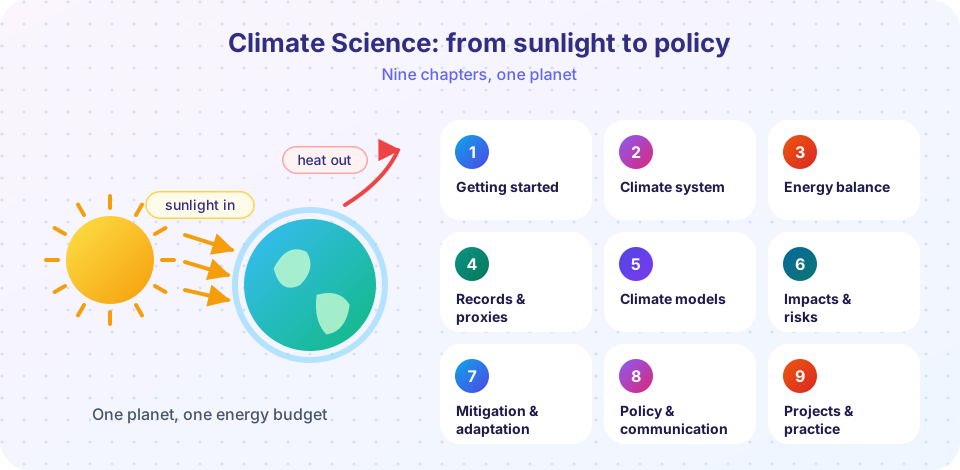
The chapters follow the logic of the science. You first learn what climate is (chapter 1), then what the climate system is made of (chapter 2). Chapter 3 explains the physics that sets Earth's temperature, including the greenhouse effect. Chapter 4 shows how scientists know what the climate did in the past. Chapter 5 shows how computer models use all of this to project the future. Chapters 6 to 8 move from science to consequences: impacts and risks, mitigation and adaptation, then policy and communication. Chapter 9 gathers projects and practice sets.
Part 1: Foundations
- Getting started
- Climate system
- Energy balance
Part 2: Evidence and tools
- Records and proxies
- Climate models
- Impacts and risks
Part 3: Action
- Mitigation, adaptation
- Policy, communication
- Projects, practice
How each lesson works
Every content lesson has the same shape, so you always know where you are. What you will learn lists the outcomes. Key terms collects the new vocabulary. The body explains the idea with a picture near the top, a worked example with real numbers and, where useful, the names of the scientists who found it out. Common misconceptions lists wrong beliefs that people often hold and the correction. Try it has two or three interactive examples. Check your understanding is a short quiz, and Summary gives you the take-home points.
Chapter overviews open each chapter with a big picture and a deck of slides. Chapter reviews close it with a one-page picture and a longer quiz. The final chapter contains a glossary, a cheat sheet and suggestions for further study.
Study tips
- Predict before you run. Before you press Run on an example, write down what you expect. Being wrong is useful: it shows exactly where your intuition and the physics part ways.
- Change one number at a time. Double the albedo, halve the carbon dioxide, lengthen the averaging window. Climate science is mostly about how a result responds to a change.
- Keep units in view. Watts per square meter, kelvin, parts per million and gigatonnes of carbon each mean something specific. Most confusion comes from mixing them.
- Separate observation from inference. A thermometer reading is an observation. "The climate is warming" is an inference from many readings. Both matter, and the difference matters too.
- Use the quizzes honestly. Each question has an explanation. Read the explanation even when you get the answer right.
Common misconceptions
"Climate science is just opinion." It is not. Its core ideas rest on physics that was tested in laboratories long before anyone worried about warming, such as how gases absorb infrared radiation. Disagreements exist at the frontier (exactly how clouds respond to warming, for example) and the course points them out, but the basic picture is built from measurements.
"You need advanced math to understand it." The central ideas need only arithmetic and powers. Advanced models need advanced math, but you can understand what they do, and why they can be trusted for some questions and not others, without writing a line of the code.
A first teaser: a planet with no atmosphere
Here is a small calculation that previews chapter 3. Sunlight delivers about 1,361 W/m² at the top of the atmosphere on a surface facing the Sun. Earth reflects about 30 % of it (the albedo is 0.30). Averaged over the whole sphere the absorbed power is a quarter of the rest. If the planet radiated like an ideal blackbody and had no atmosphere, what temperature would balance the books? The first TryIt works it out. You do not need to understand every step yet; the point is that a few lines of arithmetic give a number you can compare with reality.
Press Run (or Ctrl + Enter) to see the result here.
Program input · what you'd type while the program runs
Type the answers before you press Run, one per line. Each time the program reads a line (with input()), it gets the next line from this box.
The result, near 255 K, is about 33 K colder than the real average surface temperature. That gap is the natural greenhouse effect, and chapter 3 explains it. The second example is a small guide to the course. Choose what interests you and it suggests where to begin.
Check your understanding
Quick check · 4 questions
of 4 answered You scored / 4 · perfect!
-
1. Which description best fits climate?
Climate describes long-run weather statistics. A single day is weather, and a forecast is a prediction of weather. -
2. What is a proxy in climate science?
Proxies such as tree rings, corals and ice cores hold physical or chemical clues that can be calibrated against temperature or rainfall. -
3. In the first TryIt, why is the calculated temperature (about 255 K) lower than the real surface temperature (about 288 K)?
The model planet has no atmosphere to absorb and re-emit infrared radiation, so it is about 33 K colder than the real Earth. -
4. Which habit helps most when you use the interactive examples?
Making a prediction and changing a single value shows exactly how the result responds, which is the core skill of climate science.
Summary
- Climate science combines physics, chemistry, Earth science and statistics, and it is built on evidence.
- The course runs from foundations (chapters 1 to 3) through evidence and models (4 and 5) to consequences and action (6 to 8), then projects (9).
- Every lesson has outcomes, key terms, a worked example, common misconceptions, interactive examples and a quiz.
- A planet with no atmosphere would sit near 255 K; the real Earth is about 33 K warmer.
Next: Weather versus climate
Track your progress
Create a free account to tick off lessons and pick up where you left off on any device.
of Climate Science lessons completed