


















Lesson 9 of 48 · The Climate System
Ice, land and life
Learn how ice, snow, vegetation, soils and volcanoes shape climate: albedo, sea ice and ice sheets, permafrost carbon, forests and the volcanic influence on temperature.
The air and the ocean get most of the attention, but three other parts of the climate system decide how much sunlight Earth absorbs and where carbon is stored. Ice and snow are bright mirrors. Land surfaces, covered with forest, grass, desert or city, control how much heat the ground gives back to the air and how much water evaporates. Living things, from trees to ocean plankton, take up and release carbon dioxide. And the solid Earth supplies volcanoes and, over very long times, the minerals that regulate the carbon cycle.
This lesson covers each of these, with a special focus on albedo, because the way surfaces reflect sunlight is the basis of one of the most important feedbacks in climate.
What you will learn
- Define albedo and compare typical values for snow, ice, land and ocean.
- Describe the cryosphere (sea ice, glaciers, ice sheets, permafrost) and how its different parts affect climate and sea level.
- Explain how vegetation and soils influence the energy, water and carbon budgets.
- Describe how volcanoes cool the climate in the short term and affect carbon over long times.
Key terms
Albedo: the fraction of incoming sunlight that a surface reflects (0 to 1). Sea ice: frozen seawater floating on the ocean. Ice sheet: a continental-scale mass of land ice, on Greenland and Antarctica. Permafrost: ground that stays frozen for at least two years. Evapotranspiration: water moved to the air by evaporation from soil and by transpiration from plants. Aerosol: tiny solid or liquid particles suspended in the air.
Albedo: the climate's mirror
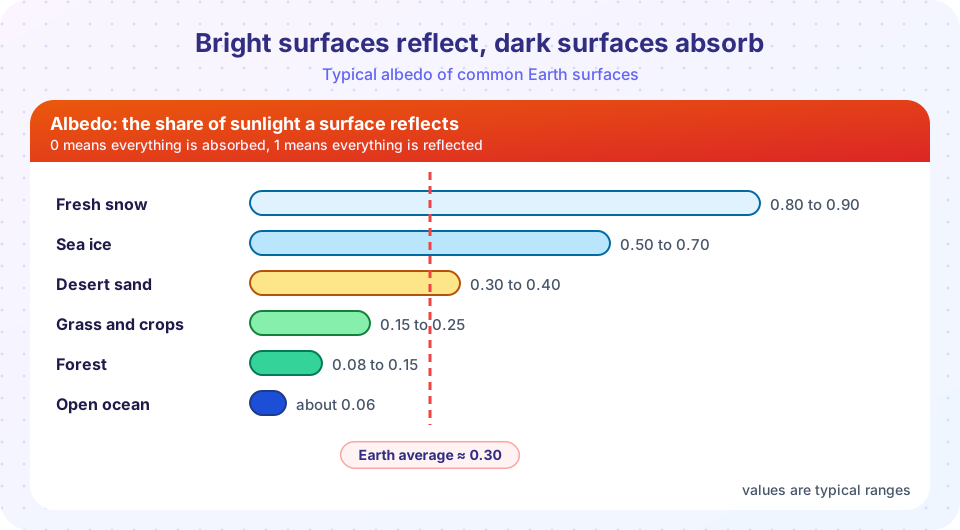
When sunlight strikes a surface, some is reflected and some is absorbed as heat. The reflected fraction is the albedo, a number between 0 (a perfectly black surface) and 1 (a perfect mirror). Fresh snow reflects 80 to 90 % of the light, sea ice 50 to 70 %, desert sand 30 to 40 %, grass 15 to 25 %, forest 8 to 15 % and the open ocean only about 6 %. Averaged over the planet, with clouds and the atmosphere included, Earth reflects about 30 % of the incoming sunlight (planetary albedo 0.30). About two-thirds of that reflection comes from clouds and the atmosphere, and one-third from the surface.
Look at what this means. A square meter of Arctic sea ice that melts and is replaced by dark water can absorb two to five times as much sunlight as before (reflectivity of 0.6 to 0.8 falls to about 0.06). Albedo differences are why a white roof stays cooler than a black one, why snow cover can keep a cold spell going and why the loss of ice amplifies warming, the ice-albedo feedback covered in chapter 3.
The cryosphere
The cryosphere includes everything frozen, and its different parts matter in different ways.
- Sea ice floats on the ocean, covering about 15 million square km of the Arctic at its winter maximum and, in recent years, about 4 to 4.5 million km² at the September minimum, down from around 7 million km² around 1980. Because the ice is already floating, its melting adds almost nothing to sea level (like a melting ice cube in a full glass), but its loss exposes dark water and changes the Arctic's heat budget and ecosystems.
- Ice sheets and glaciers rest on land. The Greenland ice sheet holds enough water to raise sea level by about 7 m, and the Antarctic ice sheet about 58 m (the figure is lower than the volume suggests because much of its ice already sits below sea level). Mountain glaciers hold only about 0.3 m of sea-level equivalent, but they supply water to hundreds of millions of people. Land ice flows slowly and responds over centuries.
- Snow cover is seasonal. It strongly changes albedo in spring across the northern continents.
- Permafrost underlies about a quarter of the land of the Northern Hemisphere. It contains organic matter frozen for thousands of years, with an estimated 1,400 to 1,600 billion tonnes of carbon, roughly twice the amount in the atmosphere. As permafrost thaws, microbes decompose that matter and release CO₂ and methane, a carbon feedback that is one of the major uncertainties of future climate.
Land surfaces
The land affects climate through three channels: it reflects sunlight, it uses solar energy to evaporate water, and it exchanges carbon with the air.
Energy and water. Sunlight absorbed by a surface has to go somewhere. Part warms the air directly (sensible heat); part evaporates water (latent heat). Forests, with deep roots and large leaf area, return large amounts of water to the air by transpiration, which cools the surface and feeds rain downwind; in the Amazon, a large share of the rain is recycled moisture. Deserts have little water to evaporate, so nearly all absorbed energy warms the air, and the ground becomes very hot. Cities, with dark surfaces and little vegetation, create an urban heat island that is several degrees warmer than nearby countryside on calm nights.
Albedo and deforestation. Forests are dark, so replacing forest by pasture raises albedo; that alone cools the surface, especially in snowy regions where trees mask bright snow. But clearing also removes the evaporation, and releases the stored carbon. The net effect depends on place: tropical deforestation tends to warm the planet, since the carbon and evaporation effects dominate, while the picture for boreal (northern) forests is more mixed.
Carbon. Forests, grasslands and wetlands hold carbon in biomass and soils: vegetation about 450 to 650 gigatonnes of carbon and soils roughly 1,500 to 2,400 (lesson 5). Land currently absorbs roughly a quarter to a third of annual human emissions through growth of vegetation, though droughts, fires and heat can turn regions into carbon sources.
Life in the ocean
Microscopic algae called phytoplankton drift in sunlit surface waters. Though their combined mass is a tiny fraction of the land's plants, they cycle through quickly and carry out about half of the planet's photosynthesis. When they die, some of the carbon sinks as particles into the deep sea, a transfer called the biological pump, which lowers the CO₂ at the surface and allows the ocean to absorb more from the air. Coral reefs, kelp and mangroves also matter for local ecology and coasts.
Volcanoes and the solid Earth
Big volcanic eruptions can cool the planet for a year or two. In June 1991 Mount Pinatubo in the Philippines injected about 20 million tonnes of sulfur dioxide into the stratosphere, where it formed a veil of sulfate droplets that reflected sunlight; global mean temperature dipped by roughly 0.5 °C for the following year or so, and the effect faded as the particles settled out. Volcanoes also emit carbon dioxide, but their yearly output is under 1 % of human emissions. Over millions of years, however, volcanic CO₂ balances the removal of CO₂ by the weathering of rocks, a thermostat that has kept Earth habitable (chapter 4 comes back to it when it explains climates of the deep past). Plate tectonics also reshape continents and ocean basins, which changes currents and winds over geological time.
Common misconceptions
"Melting sea ice raises sea level." Floating ice already displaces its own weight of water, so melting it changes sea level negligibly. It is the melting of land ice (ice sheets and glaciers) and the expansion of warming water that raise sea level.
"Volcanoes emit more CO₂ than humans." Human activities emit roughly 100 times more CO₂ each year than all volcanoes combined.
"Planting trees always cools the planet." Trees take up carbon, but they also darken the surface, especially where snow cover would otherwise reflect sunlight. The net benefit depends on location, type of forest and how long the carbon stays stored.
Try it
The first example estimates the extra power absorbed when a patch of Arctic sea ice is replaced by open water in summer. It is an upper bound because clouds block part of the sunlight.
Press Run (or Ctrl + Enter) to see the result here.
Program input · what you'd type while the program runs
Type the answers before you press Run, one per line. Each time the program reads a line (with input()), it gets the next line from this box.
The second example is a mixer: set the fractions of different surface types and see the area-weighted surface albedo. It ignores clouds and the atmosphere, so it is not the planetary albedo.
The third example converts ice volume to a sea-level equivalent and shows why the answer for Antarctica needs a correction.
Press Run (or Ctrl + Enter) to see the result here.
Program input · what you'd type while the program runs
Type the answers before you press Run, one per line. Each time the program reads a line (with input()), it gets the next line from this box.
Check your understanding
Quick check · 6 questions
of 6 answered You scored / 6 · perfect!
-
1. Roughly what albedo does fresh snow have?
Fresh snow reflects most of the sunlight that reaches it. -
2. Why does melting floating sea ice barely change sea level?
Like an ice cube in a glass, floating ice displaces about as much water as it adds when it melts. -
3. Which has the larger sea-level potential if it all melted?
Antarctica holds about eight times as much as Greenland and far more than mountain glaciers. -
4. How did the 1991 eruption of Mount Pinatubo affect global temperature?
Stratospheric sulfate aerosols reflected sunlight, causing a short-lived cooling. -
5. Why is thawing permafrost a climate concern?
Permafrost holds about twice as much carbon as the atmosphere, and thawing lets microbes release part of it. -
6. Roughly how large are volcanic CO₂ emissions compared with human emissions?
Humans emit roughly 100 times as much CO₂ per year as volcanoes.
Summary
- Albedo is the reflected fraction of sunlight: about 0.8 to 0.9 for fresh snow, 0.06 for open ocean, and 0.30 for Earth as a whole.
- Sea ice floats (its melt hardly changes sea level), while ice sheets and glaciers sit on land and raise it.
- Permafrost holds roughly twice as much carbon as the atmosphere; forests and soils store carbon and regulate water and heat.
- Large volcanic eruptions cool the planet briefly; volcanic CO₂ is a tiny share of human emissions.
- Phytoplankton make about half of photosynthesis and pump carbon to the deep sea.
Next: The carbon cycle
Track your progress
Create a free account to tick off lessons and pick up where you left off on any device.
of Climate Science lessons completed