


















Lesson 36 of 48 · Mitigation and Adaptation
The mitigation toolbox
Tour the main ways to cut greenhouse gases, from clean electricity and heat pumps to methane, industry and carbon removal, with the numbers that show what works.
There is no single "climate solution." Emissions arise from burning fuels in power stations, cars and furnaces; from cement and steel plants; from cattle, rice paddies and fertilized fields; and from cleared forests. Each source needs its own answer. The good news is that for many of them, the answer already exists and is cheap. The harder news is that a few, such as cement and aviation, still need new technology or new habits.
This lesson organizes the options into six families, shows the simple physics that makes several of them work (a heat pump delivers more heat than the electricity it uses; an electric car wastes much less energy than a petrol car), and explains why carbon removal is a supplement, not a substitute.
What you will learn
- Describe options for power, buildings, transport, industry, land and methane.
- Compare a heat pump or electric car with its fossil alternative.
- Explain learning curves and why costs fell.
- Understand carbon removal, its energy cost and its limits.
Key terms
Decarbonization: reducing the carbon intensity of an activity. Electrification: switching from burning fuel to electricity. COP (coefficient of performance): heat delivered divided by electricity used by a heat pump. Learning rate: the fall in cost for each doubling of cumulative production. CDR (carbon dioxide removal): taking CO₂ out of the air and storing it durably.
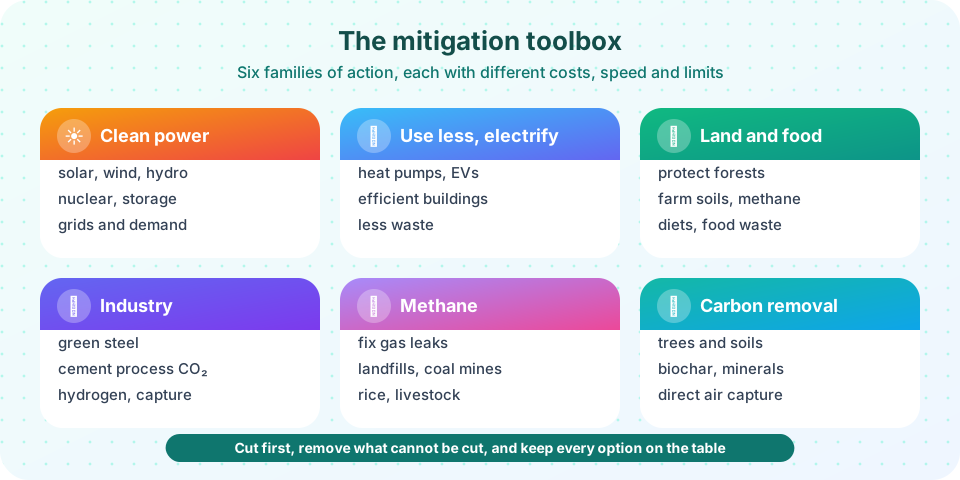
1. Clean power
Electricity and heat generation is the largest single emitting sector. Low-carbon sources include solar, wind, hydropower, geothermal, nuclear and bioenergy. Solar and wind dominate new capacity growth because their costs fell sharply. They are variable, so a clean grid also needs storage (batteries for hours, pumped hydro for longer), flexible demand, long-distance transmission, and sometimes firm low-carbon sources (hydro, nuclear, geothermal, or gas plants with CO₂ capture). A grid with a high share of wind and solar is a design problem, not an impossibility, and many regions already run on more than half renewable power for large parts of the year. Phasing out unabated coal is the most important single step in this sector because coal has the highest CO₂ per unit of electricity, about twice that of gas.
2. Use less and electrify
Efficiency is the cheapest "supply." Better insulation, efficient appliances, LED lighting and smarter design cut energy needs. Electrification lets electricity from a cleaner grid replace burning fuel at the point of use.
- Heat pumps move heat from outside air or ground into a building. A typical coefficient of performance is 3 to 4, meaning one unit of electricity delivers three or four units of heat. A gas boiler delivers at best about 0.9 units per unit of gas.
- Electric vehicles (EVs) convert about 70 to 90% of battery energy to motion, against about 20 to 30% for a petrol engine. Even on a fairly dirty grid, an EV usually emits less CO₂ per kilometer over its life than a petrol car, and it improves as the grid cleans up.
- Transport more broadly includes public transport, cycling, walkable cities, rail for freight, and cleaner fuels for aviation and shipping (sustainable fuels, hydrogen, ammonia), where electrification is harder.
3. Land and food
Land use contributes about a fifth of emissions but also holds the largest natural sinks. Options: protect forests and peatlands (stopping deforestation is among the most cost-effective measures), restore degraded land, plant trees where they suit the ecosystem, manage soils to hold carbon, cut methane from cattle and rice, cut nitrous oxide from fertilizers with precision application, and reduce food waste. Dietary shifts, such as less red meat in high-consumption countries, can cut both emissions and land use. Land measures have limits: forests burn, and carbon stored in trees is reversible, so land cannot replace fossil emission cuts.
4. Industry
Heavy industry is "hard to abate" because processes need very high temperatures or release CO₂ by chemistry. About 60% of cement's CO₂ comes not from fuel but from heating limestone (CaCO₃ → CaO + CO₂), which no change of fuel can avoid. Options include efficiency and material savings, electrification of lower-temperature heat, green hydrogen to make steel by direct reduction instead of coal in blast furnaces, new cement chemistries, and carbon capture and storage (CCS) to catch process CO₂ at the plant and pump it into deep geological formations. Industrial CCS is operating at only small scale compared with what scenarios need (tens of megatonnes per year, around 0.1% of global emissions).
5. Methane
Methane's short lifetime makes cutting it a fast brake on warming. Large, relatively cheap reductions are available in the fossil energy sector (leak detection and repair, ending routine venting and flaring) and in landfills and coal mines. Agriculture is harder: rice management and livestock feed additives help, but the biology limits what is possible.
6. Carbon dioxide removal
Even with ambitious cuts, some emissions (aviation, some industry, agriculture) are very hard to eliminate. Carbon dioxide removal (CDR) takes CO₂ out of the air and stores it. Methods differ in how durable the storage is:
- Afforestation, reforestation and soil carbon: cheap and land-hungry, but reversible.
- Biochar: heating biomass without oxygen makes a stable charcoal-like material.
- Bioenergy with CCS (BECCS): grow biomass, burn it for energy, capture the CO₂.
- Direct air capture with storage (DACCS): machines that chemically capture CO₂ from the air; high cost and high energy use.
- Enhanced rock weathering and ocean-based methods: speed natural reactions that bind carbon; still in research.
Most 1.5 °C pathways assessed by the IPCC include substantial removal in the second half of the century to compensate for residual emissions, and possibly to bring temperatures back down after overshoot. Scientists warn about moral hazard (using the promise of future removal to delay cuts), land competition and the need for permanence, measurement and verification.
Removal does not replace cutting. Capturing CO₂ from the air takes energy and money for every tonne, and the scale required to offset today's 40 Gt a year is far beyond anything operating. Cut first, then remove what cannot be cut.
Why costs fell: learning curves
Many technologies get cheaper the more of them we make, because factories improve, designs mature and supply chains grow. Wright's law says the cost falls by a constant fraction with every doubling of cumulative output. For solar photovoltaics the learning rate has been about 20 to 25% per doubling over several decades. With a 20% rate, after 10 doublings the cost is 0.8¹⁰ ≈ 11% of the starting cost. This helps explain how the unit cost of solar fell about 85% between 2010 and 2019.
Common misconceptions
"Renewables cannot work because the sun does not always shine." Grids combine wind, solar, storage, hydro and demand flexibility, and costs of storage are falling.
"EVs are dirtier than petrol cars once you count the battery." Battery manufacture adds emissions up front, but lifecycle studies find EVs lower over their lifetimes in nearly all grids, and the gap grows as grids decarbonize.
"Tree planting alone can fix climate change." Trees are valuable but cannot offset continued fossil fuel use because the land area needed is huge and the stored carbon can be lost to fire or drought.
Try it
First, compare heating options and cars by CO₂ per unit of service across a range of grid carbon intensities. The input values are typical round numbers, so treat the output as an illustration.
Press Run (or Ctrl + Enter) to see the result here.
Program input · what you'd type while the program runs
Type the answers before you press Run, one per line. Each time the program reads a line (with input()), it gets the next line from this box.
Second, a learning-curve plot. Each doubling of cumulative capacity cuts the cost by 20%.
Press Run (or Ctrl + Enter) to see the result here.
Program input · what you'd type while the program runs
Type the answers before you press Run, one per line. Each time the program reads a line (with input()), it gets the next line from this box.
Third, a scale check for direct air capture. The energy per tonne is an assumed round number, and the result shows why the scale matters.
Press Run (or Ctrl + Enter) to see the result here.
Program input · what you'd type while the program runs
Type the answers before you press Run, one per line. Each time the program reads a line (with input()), it gets the next line from this box.
Check your understanding
Quick check · 5 questions
of 5 answered You scored / 5 · perfect!
-
1. What does a heat pump with COP 3 deliver?
It moves heat from outside, so it delivers more heat than the electricity it consumes. -
2. Why is cement hard to decarbonize?
Heating limestone releases CO₂ regardless of the fuel, so process emissions need capture or new chemistry. -
3. Which carbon removal method is reversible if the land burns?
Carbon stored in trees can be released again by fire, drought or logging. -
4. A 20% learning rate means
Wright's law: a fixed percentage cost drop per doubling of cumulative output. -
5. What is the main message about carbon removal?
Removal handles residual emissions and potential overshoot, but is limited by cost, energy and land.
Summary
- Mitigation has six families: clean power, efficiency and electrification, land and food, industry, methane and removal.
- Heat pumps (COP 3 to 4) and EVs use far less energy than fossil equivalents and win on most grids.
- Industrial process emissions (cement, steel) need new chemistry, hydrogen or CCS.
- Costs fall with learning, which is why solar, wind and batteries became cheap.
- Carbon removal supplements cuts for residual emissions; it cannot replace them.
Track your progress
Create a free account to tick off lessons and pick up where you left off on any device.
of Climate Science lessons completed