


















Lesson 14 of 48 · Energy Balance and Greenhouse Effect
Planetary energy balance and albedo
Derive Earth's emission temperature from sunlight, albedo and the Stefan-Boltzmann law, test it on Venus, Mars and the Moon, and see how small changes in albedo or sunlight shift temperature.
A planet is a ball in the middle of a beam of sunlight. It absorbs some of that light, and as it warms it radiates infrared in all directions. If it absorbs more than it emits it warms; if less, it cools. Only when the two are equal does the temperature hold steady. That single idea, applied carefully, predicts a number that you can compare with real measurements: the temperature of a planet. It is also the starting point for understanding what changes it.
In this lesson you derive the temperature of an airless Earth, learn why sunlight is divided by four, see how the formula performs on three other worlds, and meet Earth's actual average energy budget in watts per square meter.
What you will learn
- Explain why a sphere's average absorbed sunlight is
S(1 - α)/4. - Solve the balance equation for the emission temperature
Te. - Calculate how
Techanges with albedo and with the solar constant. - Apply the model to Venus, Mars and the Moon and say why it works better for some than for others.
- Quote the main numbers of Earth's global energy budget and the present energy imbalance.
Key terms
Solar constant (S): sunlight power per square meter at the top of the atmosphere facing the Sun, 1,361 W/m² for Earth. Bond albedo (α): the fraction of all incoming sunlight a planet reflects, in all directions. Emission temperature (Te): the temperature at which a blackbody planet would radiate as much power as it absorbs. Energy imbalance: absorbed minus emitted power, in W/m². Zero-dimensional model: a model that treats the whole planet as a single point with one temperature.
Setting up the balance
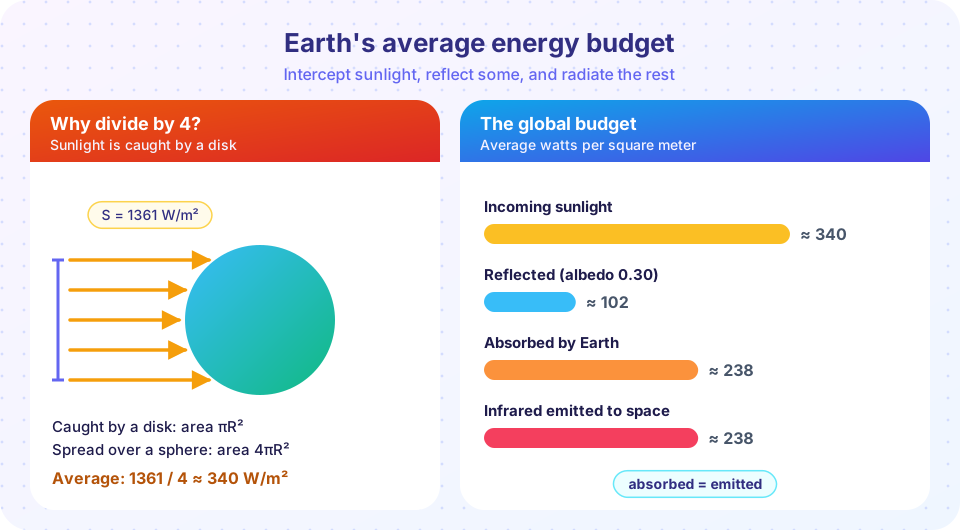
Picture Earth from the Sun. The planet presents a circular disk of radius R, with area πR². Sunlight of intensity S falls on that disk, so the total power intercepted is S · πR². Some fraction α is reflected, so the absorbed power is S(1 - α) πR².
Earth radiates from its entire surface, a sphere of area 4πR². If it radiates like a blackbody at temperature T, the emitted power is σT⁴ · 4πR². Setting absorbed equal to emitted:
S(1 - α) πR² = σ T⁴ · 4πR²
The πR² cancels, and the factor of 4 is the ratio of sphere area to disk area. Solving for T:
Te = [ S(1 - α) / (4σ) ]^(1/4)
Notice that the planet's size cancels out. A pebble in orbit would reach the same temperature as a planet at the same distance if it had the same albedo.
Worked example: Earth with no atmosphere
Use S = 1361 W/m², α = 0.30 and σ = 5.670×10⁻⁸. The average absorbed power is 1361 × 0.70 / 4 = 238.2 W/m². Then Te⁴ = 238.2 / 5.670×10⁻⁸ = 4.20×10⁹ K⁴, and taking the fourth root gives Te = 254.6 K, which is -18.6 °C. Earth's actual mean surface temperature is about 288 K, so the real planet is some 33 K warmer than the bare-planet prediction. The difference needs an explanation, and that is the greenhouse effect (lesson 4).
The picture shows the other side of the balance. The average incoming sunlight is 1361 / 4 ≈ 340 W/m²; about 102 W/m² is reflected by clouds, aerosols and bright surfaces, and about 238 W/m² is absorbed. The radiation that leaves the top of the atmosphere, measured by satellites, is almost the same: about 239 W/m² on average. The surface and atmosphere share the absorbed energy: roughly 160 W/m² at the surface and 78 W/m² in the atmosphere (lesson 4 follows those flows).
What changes the temperature?
Two things matter in this equation: the absorbed sunlight and the radiating surface.
Albedo
Raising the albedo reduces the absorbed energy. Differentiating Te with respect to α gives dTe/dα = -Te / (4(1 - α)). For Earth that is -254.6 / 2.8 ≈ -91 K per unit of albedo, or about -0.9 K for each 0.01. If clouds, ice or aerosols raised the planetary albedo from 0.30 to 0.31, the emission temperature would fall by about 0.9 K. This sensitivity is why the loss of reflective ice and snow matters, and why volcanic aerosols can cool the planet for a while.
Solar output
Similarly, a small change in the solar constant gives dTe / Te = (1/4) dS / S. A 1 % change in S changes Te by 0.25 %, which is 0.64 K. The Sun's output varies by only about 0.1 % over the 11-year sunspot cycle, which would change Te by about 0.06 K. Since 1750, the Sun's contribution to climate change has been tiny compared with that of greenhouse gases.
Time scales
Earth does not jump to a new equilibrium instantly. The oceans must warm first. A mixed layer 70 m deep has a heat capacity of 1025 × 3990 × 70 ≈ 2.9×10⁸ J/(m² K). With a restoring rate of a few W/m² per K, the time to approach a new balance is 2.9×10⁸ / 3 ≈ 10⁸ s, a few years for the mixed layer alone, and much longer once the deeper ocean takes part. This ties back to chapter 2: the ocean sets the pace.
Testing the formula on other worlds
A good physical model should work on other planets, and the test is a way to find what it leaves out.
| World | Distance (AU) | Solar flux S (W/m²) | Bond albedo | Predicted Te | Observed mean surface |
|---|---|---|---|---|---|
| Moon | 1.000 | 1,361 | 0.11 | about 270 K | about 250 K |
| Mars | 1.524 | 586 | 0.25 | about 210 K | about 210 K |
| Earth | 1.000 | 1,361 | 0.30 | 255 K | 288 K |
| Venus | 0.723 | 2,604 | 0.77 | about 227 K | about 737 K |
Venus gets almost twice the sunlight of Earth, yet its predicted emission temperature is lower than Earth's, because thick sulfuric-acid clouds reflect 77 % of the light. Its actual surface temperature, 737 K (about 464 °C), is hotter than the surface of Mercury, thanks to an extremely powerful greenhouse effect from an atmosphere that is mostly CO₂ at 90 times Earth's surface pressure. Mars has a very thin atmosphere, so it has almost no greenhouse warming, and its mean temperature matches the formula. The Moon misses for a different reason: the formula assumes a single uniform temperature, but a slowly rotating airless body has a very hot day side and a very cold night side. Because emission goes as T⁴, the hot side loses disproportionately more than the cold side, so the true average temperature is lower than the equal-temperature prediction.
Real Earth: details the zero-dimensional model skips
The simple balance treats the planet as one point. Actually the tropics absorb more than they radiate, and the poles radiate more than they absorb, with the difference carried poleward by air and ocean (lessons 2 and 3). The albedo is not uniform, the atmosphere absorbs part of the sunlight directly (about 78 W/m²), and the surface loses heat not only by radiation but also by evaporation and convection. Satellite measurements (the CERES instruments, since 2000) show that Earth is currently out of balance by about 0.8 W/m² on average: it absorbs more than it emits, and this surplus is what is heating the planet, largely the ocean. Though small compared with 240 W/m², a surplus of 0.8 W/m² over the whole planet amounts to about 400 trillion watts, around twenty times human primary energy use.
Common misconceptions
"The Earth's temperature is set by how close it is to the Sun." Distance sets the incoming flux, but albedo and the atmosphere matter just as much. Venus is hotter than Mercury, though it is farther away.
"Dividing by 4 means the Sun only shines on a quarter of the Earth." It is a geometric average. Half of the planet is lit at a time, but the light is concentrated near the subsolar point and spread out near the edges. Averaged over a whole sphere and a whole day, the factor is 4.
"If Earth were in balance, nothing would ever change." Balance means no net heating. The climate may still shift as forcings and feedbacks change; and the present imbalance of 0.8 W/m² shows it is not in balance.
Try it
The first example computes the emission temperature for planets with different albedos and distances, and shows the sensitivities.
Press Run (or Ctrl + Enter) to see the result here.
Program input · what you'd type while the program runs
Type the answers before you press Run, one per line. Each time the program reads a line (with input()), it gets the next line from this box.
The second example simulates how the temperature responds over time to a small change in albedo. It uses the zero-dimensional model with a mixed-layer ocean as the heat reservoir.
Press Run (or Ctrl + Enter) to see the result here.
Program input · what you'd type while the program runs
Type the answers before you press Run, one per line. Each time the program reads a line (with input()), it gets the next line from this box.
The third example is a planet chooser: pick a world and compare its predicted emission temperature with its observed surface temperature.
Check your understanding
Quick check · 6 questions
of 6 answered You scored / 6 · perfect!
-
1. Why does the planetary energy balance contain the factor 4?
The planet intercepts sunlight over πR² but radiates from 4πR². -
2. With S = 1361 W/m² and albedo 0.30, how much sunlight is absorbed on average per square meter of Earth's surface?
1361 × 0.70 / 4 = 238 W/m². -
3. If albedo rises from 0.30 to 0.31 and nothing else changes, Earth's emission temperature changes by about:
dTe/dα = -Te/(4(1-α)) ≈ -91 K per unit, so 0.01 gives about -0.9 K. -
4. Why is Venus's surface far hotter than its emission temperature?
Venus's atmosphere traps infrared so strongly that the surface is about 500 K warmer than the simple balance predicts. -
5. Satellites show Earth absorbs about 0.8 W/m² more than it emits. What does this mean?
A positive imbalance means net heating; more than 90 % of that energy ends up in the ocean. -
6. Which statement about the emission temperature is correct?
The radius cancels in the balance; the real surface is warmer on Earth because of the greenhouse effect.
Summary
- Absorbed sunlight per unit area of surface is
S(1 - α)/4; emitted power isσT⁴; balance givesTe = [S(1 - α)/(4σ)]^(1/4). - For Earth,
Te ≈ 255 K, which is 33 K below the real mean surface temperature of about 288 K. - A change of 0.01 in albedo shifts
Teby about 0.9 K; a 1 % change in S shifts it by about 0.6 K. - The model works for Mars, fails for Venus (huge greenhouse effect) and for the Moon (uneven temperatures).
- Earth currently absorbs about 0.8 W/m² more than it emits, which is what drives present warming.
Next: The greenhouse effect
Track your progress
Create a free account to tick off lessons and pick up where you left off on any device.
of Climate Science lessons completed