


















Lesson 8 of 48 · The Climate System
Oceans and currents
Learn why the ocean is the climate's heat reservoir, how winds and density drive currents and the overturning circulation, and how El Niño changes weather worldwide.
If you want to understand why climate changes slowly, look at the sea. The ocean covers 71 % of Earth's surface, reaches an average depth of about 3.7 km and holds about 97 % of all water. It absorbs sunlight, stores heat for decades to centuries, and carries it from the tropics toward the poles. It also dissolves carbon dioxide, which makes it one of Earth's two major carbon sinks, along with the land.
This lesson covers how the ocean stores heat, how it is layered, what drives surface currents and the deep overturning circulation, and how a swing in the tropical Pacific called El Niño reaches around the world.
What you will learn
- Explain why the ocean stores far more heat than the atmosphere and why this slows climate change.
- Describe the ocean's layers: mixed layer, thermocline and deep water.
- Distinguish wind-driven surface currents from the density-driven overturning circulation.
- Describe El Niño and La Niña and their effect on global temperature.
- Link ocean heat uptake to sea-level rise and ocean carbon uptake.
Key terms
Thermocline: the layer where temperature drops rapidly with depth, separating warm surface water from cold deep water. Gyre: a large, wind-driven circular current. Sverdrup (Sv): a unit of flow, one million cubic meters per second. AMOC: the Atlantic Meridional Overturning Circulation, the Atlantic part of the global overturning. ENSO: El Niño-Southern Oscillation, an irregular swing in the tropical Pacific.
Heat storage
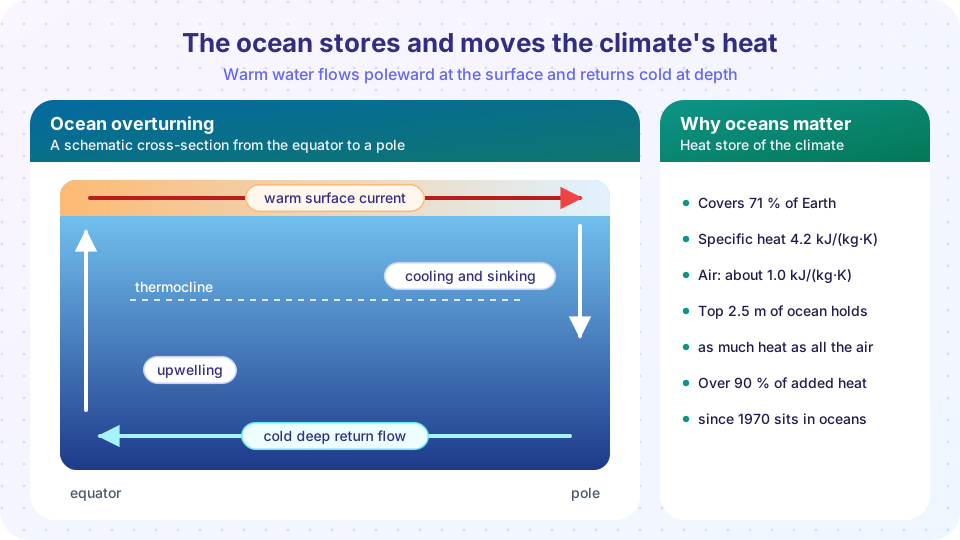
Water has a specific heat of about 4,000 J per kilogram per kelvin, roughly four times that of air, and the ocean's mass is some 270 times that of the atmosphere. Together these facts mean the whole atmosphere has the heat capacity of only the top 2.5 m of ocean. Measurements show that more than 90 % of the extra energy trapped by greenhouse gases since the 1970s has gone into the ocean: warming of the air accounts for only about 1 % of the total.
This stored heat has two consequences. First, the ocean moderates climate: coastal cities have milder winters and cooler summers than inland places at the same latitude, and the global surface warms more slowly than it would without the ocean. Second, it creates commitment: because the ocean continues to take up heat for decades, and releases it slowly, the surface keeps warming for a long time after greenhouse gas concentrations stop rising.
Layers of the ocean
Sunlight penetrates only the top 100 to 200 m, and waves and winds stir the upper layer so that its temperature is nearly uniform. This mixed layer is typically tens of meters to a couple of hundred meters deep and holds the sea-surface temperature you see on weather maps. Below it, the thermocline is a layer, several hundred meters thick, in which temperature falls steeply. Beneath, the deep ocean is cold (around 2 to 4 °C), dark and slowly moving. Salinity averages about 35 grams of salt per kilogram of seawater, and seawater freezes near -1.8 °C because the salt lowers its freezing point.
Both temperature and salinity set the density of seawater. Cold or salty water is denser and sinks; warm or fresh water is lighter and stays at the surface. Because the top layer is warm and light, the ocean is stably stratified, and mixing between surface and depth is slow.
Surface currents: wind-driven
The prevailing winds from lesson 2 push on the surface and set it moving. Because of Earth's rotation, the moving water turns (to the right in the Northern Hemisphere, to the left in the Southern), and large circular gyres form in each ocean basin. The currents on the western side of a basin are narrow, fast and warm: the Gulf Stream in the North Atlantic and the Kuroshio in the North Pacific carry tens of Sverdrups of warm water poleward (the Gulf Stream through the Florida Straits carries about 30 Sv, and farther downstream it carries much more). Eastern boundary currents, such as the California and Humboldt currents, are broad, slow and cool. Currents like these carry heat poleward and help explain why Western Europe is milder than Canada at the same latitude, although the prevailing westerly winds carrying marine air do much of that job too.
Winds also cause upwelling: when winds blow along a coast, the surface water is pushed away and cold, nutrient-rich water rises from below. The richest fishing grounds (off Peru, California and West Africa) lie in upwelling zones.
Deep currents: the overturning circulation
Below the wind-driven layer, a slower circulation is driven by density. In the North Atlantic, warm salty surface water flowing north from the tropics loses heat to the cold air, becomes dense and sinks, mainly in the Nordic and Labrador Seas. This North Atlantic Deep Water flows south at depths of 2 to 4 km. Around Antarctica, very cold, salty water produced as sea ice forms sinks to make Antarctic Bottom Water. These deep waters spread through the ocean basins and eventually rise to the surface again, a trip that can take hundreds to a thousand years or more.
The Atlantic part of this loop is the AMOC. Direct measurements by a line of instruments across the Atlantic at 26.5° N (the RAPID array, since 2004) show a flow averaging roughly 17 Sverdrups. The AMOC carries a large amount of heat northward, which helps keep the North Atlantic region warm. Climate models project that the AMOC will weaken during this century as the surface of the northern Atlantic warms and freshens from melting ice; scientists disagree about how fast and whether a collapse is plausible, and the IPCC rates a collapse before 2100 as unlikely but with considerable uncertainty and large consequences if it were to happen.
El Niño and La Niña
Every two to seven years the tropical Pacific swings between two states. Normally, trade winds push warm surface water westward, piling it up near Indonesia and allowing cold water to upwell off South America. During an El Niño, the trade winds weaken, warm water slides eastward, and the eastern Pacific warms by one or more degrees. Rainfall shifts east, droughts hit Indonesia and Australia, and heavy rain hits Peru. The opposite phase, La Niña, has stronger trade winds and a cooler eastern Pacific. Together they are called ENSO.
ENSO matters for climate because a warm tropical Pacific releases heat to the air: global mean temperature is typically a few tenths of a degree warmer in the year after a strong El Niño (2016 is a good example) and cooler after a strong La Niña. These swings are natural variability in the sense of lesson 2 of chapter 1; they ride on top of the long-term warming trend.
Heat, sea level and carbon
Warming water expands: the volume of seawater increases by about 0.02 % per kelvin in warm surface water (a coefficient near 2 × 10⁻⁴ K⁻¹, smaller in cold water). Together with melting land ice, this expansion has raised global mean sea level by about 20 cm since 1900, and thermal expansion accounts for roughly a third to a half of the rise in recent decades. The ocean also takes up around a quarter of the carbon dioxide emitted by human activities, which makes seawater less alkaline: its average surface pH has fallen from about 8.2 before the industrial era to about 8.1 today, which is an increase of roughly 26 % in hydrogen ion concentration. Chapter 6 returns to both impacts.
Common misconceptions
"The Gulf Stream alone makes Europe warm." It helps, but the winds, the sea's heat storage and the mild marine air also matter. If the AMOC weakened, Europe would cool somewhat relative to the future trend, but it would not enter an ice age.
"The ocean is just a passive container." It is an active participant: it stores heat, absorbs carbon, shapes weather patterns through ENSO and sets the pace of sea-level rise.
"A 0.1 pH change is tiny." The pH scale is logarithmic, so a decrease of 0.1 means about 26 % more hydrogen ions. This is already measurable in shell-forming organisms.
Try it
The first example estimates how long it takes to warm the entire ocean by a tenth of a degree, using Earth's energy imbalance. The numbers are round estimates.
Press Run (or Ctrl + Enter) to see the result here.
Program input · what you'd type while the program runs
Type the answers before you press Run, one per line. Each time the program reads a line (with input()), it gets the next line from this box.
The second example is an interactive model of the equatorial Pacific. Slide the trade winds from strong (La Niña) to weak (El Niño) and watch the warm pool and thermocline move. It is a simplified cartoon.
The third example estimates how much the sea level rises from thermal expansion and how much more acidic the sea becomes for a given pH drop.
Press Run (or Ctrl + Enter) to see the result here.
Program input · what you'd type while the program runs
Type the answers before you press Run, one per line. Each time the program reads a line (with input()), it gets the next line from this box.
Check your understanding
Quick check · 6 questions
of 6 answered You scored / 6 · perfect!
-
1. About what share of the extra heat trapped by greenhouse gases since the 1970s has gone into the ocean?
Observations of ocean heat content show that the ocean has absorbed over 90 % of the added energy. -
2. What drives the large surface gyres of the ocean?
The wind pushes on the surface, and rotation turns the flow, producing basin-scale circular gyres. -
3. Where does North Atlantic Deep Water mainly form?
Heat loss to cold air makes warm, salty northward-flowing water dense, so it sinks and flows south at depth. -
4. During an El Niño, the trade winds are:
Weaker trades let warm water spread east across the Pacific. -
5. A drop of 0.1 in pH corresponds to about what change in hydrogen ion concentration?
pH is logarithmic: 10^0.1 = 1.26, an increase of about 26 %. -
6. Why does warming continue for decades after greenhouse gas concentrations stop rising?
The ocean absorbs heat slowly and releases it slowly, which creates a lag between forcing and full surface response.
Summary
- The ocean covers 71 % of Earth, and holds more than 90 % of the added heat; its heat capacity delays climate response.
- It has a warm mixed layer, a thermocline and a cold deep layer; density depends on temperature and salinity.
- Winds drive gyres and upwelling; density differences drive the deep overturning circulation, including the AMOC.
- ENSO is a natural Pacific swing that alters weather and shifts global temperature by a few tenths of a degree.
- Ocean heat causes thermal expansion of seawater, and absorbed CO₂ acidifies it.
Next: Ice, land and life
Track your progress
Create a free account to tick off lessons and pick up where you left off on any device.
of Climate Science lessons completed