


















Lesson 45 of 48 · Projects and Practice
Practice problems: climate science
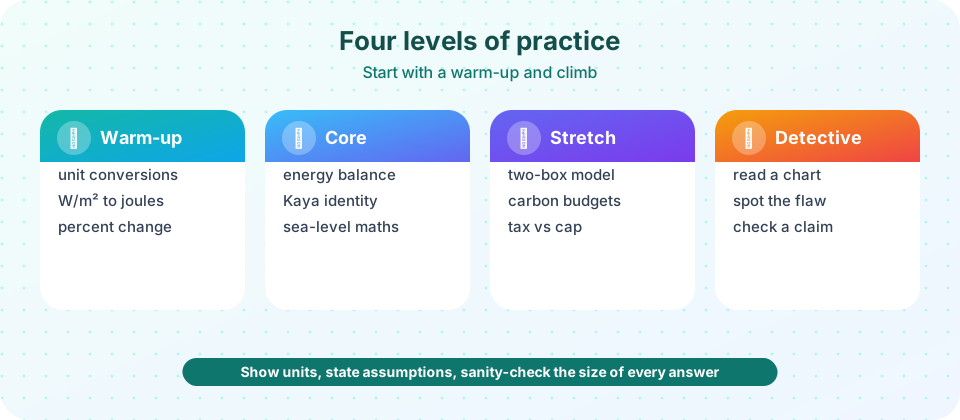
Fifteen climate science problems in four levels, from unit conversions to the two-box model and claim checking, with hints, a checker script and full worked answers.
The best way to learn quantitative science is to do the calculation yourself, get a number, and ask whether it makes sense. This set has fifteen problems in four levels, using the ideas of Chapters 5 to 8: energy balance, feedbacks, sea level, extremes, carbon budgets, policy arithmetic and the honest reading of claims.
Work each problem on paper first, with units. Use the hints if you are stuck, then compare with the worked answers at the end. A checker script lets you confirm the numbers.
What you will learn
- Apply the chapter's formulas to fresh numbers.
- Check results with orders of magnitude and units.
- Explain a claim's strengths and weaknesses in plain language.
Useful constants
Earth's surface area 5.10 × 10¹⁴ m²; ocean area 3.61 × 10¹⁴ m²; solar constant 1361 W/m²; σ = 5.670 × 10⁻⁸ W m⁻² K⁻⁴; CO₂ forcing F = 5.35 ln(C/C₀); TCRE 0.45 °C per 1000 Gt CO₂; 1 mm of sea level = 361 Gt of water; GWP-100 for fossil methane is 29.8; present warming about 1.2 °C.
Level 1: warm-up
Problem 1. The average sunlight on Earth is 340 W/m². What is the total power, in watts, received by the whole planet? (Use Earth's surface area.)
Problem 2. Earth's albedo rises from 0.30 to 0.31 because of extra cloud or ice. By how much does the effective temperature change?
Problem 3. CO₂ rises from 280 ppm to 420 ppm. What is the percentage increase, and what is the radiative forcing?
Level 2: core
Problem 4. In the model C dT/dt = F − λT with C = 8 W yr m⁻² K⁻¹ and λ = 1.2 W m⁻² K⁻¹, what fraction of the equilibrium response is reached 10 years after a sudden step in forcing?
Problem 5. Population grows 0.7% per year, GDP per person 2.2% per year, and energy intensity falls 1.5% per year. What annual change in carbon intensity makes total emissions fall 3% per year? (Add growth rates.)
Problem 6. In one year, ice sheets and glaciers lose a total of 540 Gt of ice. How many millimeters of sea level does this add?
Problem 7. Air holds about 7% more water vapor per °C. If a region warms by 3 °C, how much more water can the air hold, using compounding, not a simple sum?
Problem 8. A remaining carbon budget is 650 Gt and emissions are 40 Gt per year. What constant annual percentage cut (exponential decline) uses exactly the budget?
Level 3: stretch
Problem 9. In the two-box model with C = 8, γ = 0.7 and a feedback λ = 1.0, what is the equilibrium warming for a CO₂ doubling, and what is the fast time constant C / (λ + γ) of the upper box?
Problem 10. A damage of 500 million dollars is expected in 100 years. What is its present value at a 2% discount rate?
Problem 11. A heat pump with COP 3.2 runs on a grid with 350 g CO₂ per kWh. A gas boiler (90% efficient, gas 202 g CO₂ per kWh of fuel) delivers the same heat. By what percentage does the heat pump cut emissions per kWh of heat?
Problem 12. A pathway emits 800 Gt of CO₂ from now. Current warming is 1.2 °C. What warming does TCRE imply?
Level 4: detective
Problem 13. A chart titled "Global warming has stopped!" shows temperature from 1998 to 2012 with a flat line. List at least three things you would check before accepting the claim.
Problem 14. "CO₂ is only 0.04% of the atmosphere, so it cannot have a big effect." Respond in three or four sentences.
Problem 15. A news story says "97% of scientists agree on climate change." State precisely what the studies measured, and name one thing the figure does not tell you.
Hints
- Power = intensity × area.
- Recompute
Tₑ = (S(1−α)/4σ)^¼for both albedos and subtract. - Percent change = (new − old)/old; forcing from the log formula.
- The solution is
1 − e^(−t/τ)withτ = C/λ. - Required carbon-intensity change = target − (sum of the other three).
- Divide by 361 Gt per mm.
- Compound:
1.07³. - Exponential decline uses
E₀ / rof budget. ECS = F₂ₓ / λ;F₂ₓ = 5.35 ln 2.- Present value =
D / (1 + r)ᵗ. - Compare
350/3.2with202/0.9. - Warming = now + TCRE × cumulative.
- Think about start date, window length, uncertainty, other indicators, data source.
- Think about how gases absorb infrared, and what other trace gases do.
- Think about who was surveyed and what question was asked.
Try it
This script computes the numerical answers so you can check your work. Run it after attempting the problems.
Press Run (or Ctrl + Enter) to see the result here.
Program input · what you'd type while the program runs
Type the answers before you press Run, one per line. Each time the program reads a line (with input()), it gets the next line from this box.
Now a small practice generator in the console. It creates random versions of Problem 6 (ice to sea level) and Problem 10 (discounting) so you can drill the arithmetic and see the answers.
Press Run (or Ctrl + Enter) to see the console output here.
No output.
Worked answers
1. 340 × 5.10 × 10¹⁴ = 1.73 × 10¹⁷ W, about 173 petawatts. That is thousands of times larger than humanity's total power use of roughly 2 × 10¹³ W.
2. Tₑ at 0.30 is 254.6 K and at 0.31 it is 253.7 K, a fall of about 0.9 K. A one-percentage-point change in albedo is a big climate lever, which is why clouds and ice matter.
3. The increase is (420 − 280)/280 = 50%, and the forcing is 5.35 ln 1.5 = 2.17 W/m².
4. τ = 8/1.2 = 6.67 years; 1 − e^(−10/6.67) = 1 − 0.223 = 0.777, about 78%.
5. The other three factors sum to 0.7 + 2.2 − 1.5 = +1.4%, so carbon intensity must change by −3 − 1.4 = −4.4% per year. That is much faster than the historical trend of a few tenths of a percent a year.
6. 540 / 361 = 1.5 mm.
7. 1.07³ = 1.225, so about 22.5% more (a simple sum would give 21%).
8. r = E₀/B = 40/650 = 6.2% per year.
9. ECS = 3.71 / 1.0 = 3.7 °C. The fast time constant is 8/(1.0 + 0.7) = 4.7 years.
10. 500 / 1.02¹⁰⁰ = 500/7.24 = 69 million dollars.
11. The boiler emits 202/0.9 = 224 g per kWh of heat, the heat pump 350/3.2 = 109 g, a saving of about 51%.
12. 0.45 × 0.8 = 0.36 °C; total 1.2 + 0.36 = 1.56 °C.
13. Check the start date (1998 was an exceptionally warm El Niño year, so the window starts at a peak), the window length (15 years is short compared with the 30 years used for climate), whether the trend is statistically distinguishable from the long-term trend, whether other indicators (ocean heat, sea level, ice) agree, which data set was used, and whether the y-axis is stretched. Longer records and ocean heat content show continued warming.
14. The size of a concentration does not determine its effect. Nitrogen and oxygen make up 99% of air, but they barely absorb infrared radiation. CO₂ molecules absorb strongly at certain infrared wavelengths, so even small amounts block outgoing heat; by analogy, a few drops of dye color a glass of water, and ozone at a few parts per million shields us from ultraviolet. Laboratory measurements by John Tyndall in 1859 and satellite measurements today confirm the absorption.
15. The studies surveyed publishing climate scientists or classified the abstracts of scientific papers, and found that about 97% (up to over 99% in a later study) of those taking a position agreed that recent warming is mostly human-caused. The figure does not tell you how fast the climate will change, how severe the impacts will be, or which policies are best; those are separate questions with more uncertainty and with value judgments.
Check your understanding
Quick check · 5 questions
of 5 answered You scored / 5 · perfect!
-
1. A good first check of a numerical answer is
Units and sizes catch most slips, such as a misplaced exponent. -
2. If carbon intensity must fall 4.4% per year to cut emissions 3% per year, which statement is correct?
Historical carbon intensity declines have been a few tenths of a percent per year. -
3. Why is a 15-year window a weak basis for a climate trend claim?
Climate normals use 30 years because short windows are noisy. -
4. In Problem 11, the heat pump saves emissions mainly because
A COP above one means more heat out than electricity in. -
5. What does the 97% consensus figure not tell you?
It measures agreement on the cause of warming, not on impacts or policy choices.
Summary
- Quantitative practice means setting up the formula, keeping units and checking the size of the answer.
- Core relationships: energy balance, forcing, exponential approach, Kaya growth sums, ice-to-sea-level conversion, discounting and TCRE.
- Detective problems apply the same care to claims: examine window, baseline, source and what a statistic actually measures.
Next: Glossary
Track your progress
Create a free account to tick off lessons and pick up where you left off on any device.
of Climate Science lessons completed