


















Lesson 17 of 48 · Energy Balance and Greenhouse Effect
Chapter review: energy balance and the greenhouse effect
Review chapter 3: the Stefan-Boltzmann and Wien laws, the 255 K emission temperature, the greenhouse effect, CO₂ forcing and climate sensitivity, with a calculator and a ten-question quiz.
Chapter 3 is the physical heart of the course. It connected four ideas into one chain: hot bodies radiate, so a planet's temperature follows from balancing sunlight against infrared; greenhouse gases change that balance by making the atmosphere opaque to infrared; adding gas produces a forcing that grows with the logarithm of its concentration; and feedbacks amplify the response to give a sensitivity near 3 °C per doubling. This review collects the relations, gives you one calculator to apply them all, and finishes with a longer quiz.
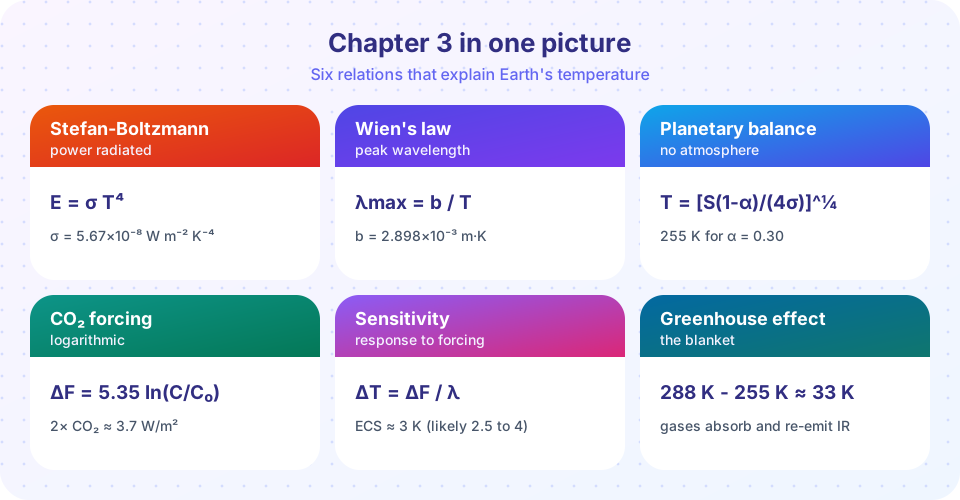
What you should be able to do now
- Use
E = σT⁴andλmax = b/Tto calculate power and peak wavelength for a body at a given temperature. - Derive the emission temperature
Te = [S(1 - α)/(4σ)]^(1/4)and compute it for Earth and other planets. - Explain the greenhouse effect with a layer model and the emission-height picture.
- Calculate the forcing from a given change in CO₂ with
ΔF = 5.35 ln(C/C₀). - Explain how feedbacks change
ΔT₀ ≈ 1.2 Kinto an ECS of about 3 K.
Formulas and constants at a glance
| Quantity | Relation | Value or example |
|---|---|---|
| Emitted power | E = εσT⁴ |
σ = 5.670×10⁻⁸ W m⁻² K⁻⁴; 288 K gives 390 W/m² |
| Peak wavelength | λmax = b / T |
b = 2.898×10⁻³ m·K; Sun 0.50 µm, Earth 10 µm |
| Solar constant | S = L / (4πd²) |
1,361 W/m² at Earth |
| Absorbed sunlight | S(1 - α)/4 |
238 W/m² for α = 0.30 |
| Emission temperature | Te = [S(1 - α)/(4σ)]^(1/4) |
255 K (-18 °C) |
| Albedo sensitivity | dTe/dα = -Te / (4(1 - α)) |
about -0.9 K per 0.01 |
| One-layer greenhouse | OLR = σTs⁴(1 - f/2) |
f = 0.78 gives 288 K |
| Emission height | Ts ≈ Te + Γ z |
255 K + 6.5 K/km × 5 km |
| CO₂ forcing | ΔF = 5.35 ln(C/C₀) |
3.7 W/m² per doubling |
| Equilibrium warming | ΔT = ΔF / (-λ) |
3.7 / 1.2 ≈ 3 K |
The chain of reasoning
Read the chapter as a story in five sentences. Hot objects radiate, and the Sun and Earth radiate at such different wavelengths that sunlight and Earth's heat can be accounted for separately (lesson 2). The Earth absorbs about 238 W/m² and must radiate the same, which would happen at 255 K if the planet had no atmosphere (lesson 3). Greenhouse gases absorb infrared, so the radiation escapes from a higher, colder layer and the surface warms to 288 K (lesson 4). Adding CO₂ raises the escape layer further, creating a forcing of 3.7 W/m² per doubling (lesson 4). Feedbacks, mainly from water vapor, ice and clouds, increase the resulting warming about threefold, giving an equilibrium sensitivity near 3 °C (lesson 5).
Notice what is not in the story. It does not depend on computer models, on temperature records or on any argument about the past. The core ideas, radiation laws, absorption by gases and energy balance, could be tested in a laboratory and have been tested for more than a century. Models (chapter 5) and records (chapter 4) are independent checks on them.
A calculator for the whole chapter
The TryIt below chains the whole chapter in one place. Edit the inputs (albedo, CO₂ concentration, feedback strength) and see the emission temperature, the forcing, the equilibrium warming and a short commentary.
Press Run (or Ctrl + Enter) to see the result here.
Program input · what you'd type while the program runs
Type the answers before you press Run, one per line. Each time the program reads a line (with input()), it gets the next line from this box.
Common misconceptions to leave behind
"The greenhouse effect is a theory some scientists doubt." The existence of the natural greenhouse effect is verified by basic physics and by satellite measurements of infrared leaving Earth. What remains uncertain is the exact size of feedbacks, not whether the effect exists.
"CO₂ is only 0.04 % of the air, so it cannot matter." Concentration is not the issue; what matters is how strongly the gas absorbs infrared. A trace of an absorbing gas can have a large effect, just as a few drops of dye color a glass of water.
"A larger sensitivity means more things will go wrong." Sensitivity is a physical quantity: it describes how strongly the climate responds to a push. What follows from it (impacts, risk) is the subject of chapter 6.
Worked review problems
Problem 1: a different planet. A planet orbits at 1.5 AU from a star identical to the Sun and has a Bond albedo of 0.25. What is its emission temperature? The solar flux is 1361 / 1.5² = 605 W/m². The absorbed power per square meter of the surface is 605 × 0.75 / 4 = 113.4 W/m². Then Te = (113.4 / 5.670×10⁻⁸)^(1/4) = (2.0×10⁹)^(1/4) ≈ 211 K, which is very close to the case of Mars. If the planet had an atmosphere that absorbed 78 % of the infrared as in the one-layer model of Earth, the surface would be warmer by a factor (1 / (1 - 0.78/2))^(1/4) = 1.17, which is about 247 K.
Problem 2: forcing and warming. Suppose CO₂ rose from 420 ppm to 630 ppm (a factor of 1.5). What is the forcing, and what equilibrium warming follows with a net feedback of -1.2 W/m² per K? ΔF = 5.35 ln 1.5 = 5.35 × 0.405 = 2.17 W/m². The equilibrium warming is 2.17 / 1.2 = 1.8 °C. Notice that going from 420 ppm to 630 ppm gives exactly the same forcing as going from 280 ppm to 420 ppm, because both are a factor of 1.5. This is the logarithmic law at work: each fixed percentage increase adds the same forcing.
Problem 3: how bright is the Sun? If the Sun's output rose by 1 % with no other change, how much would the emission temperature change? ΔTe / Te = (1/4)(ΔS / S) = 0.0025, so ΔTe = 0.0025 × 254.6 = 0.64 K. Climate scientists compare this with the actual variation in the Sun over the 11-year cycle, about 0.1 %, which would change Te by about 0.06 K: much less than the effect of greenhouse gases over the same period.
Putting the pieces together
The ability to move between these formulas without a calculator is a mark of understanding. A good exercise is to take any one of the problems above and change one assumption: the albedo, the distance, the absorbed fraction, the CO₂ ratio. Predict the direction of change before you compute it. If you can do this reliably, you have the physical intuition on which climate models and policy numbers are built. The next chapter shows how scientists check these ideas against the evidence in records of the past.
Check your understanding
Quick check · 10 questions
of 10 answered You scored / 10 · perfect!
-
1. A body's absolute temperature rises from 300 K to 600 K. By what factor does the power it emits per square meter increase?
Power scales with T⁴, so doubling T gives 2⁴ = 16. -
2. Which law tells you the wavelength at which a hot body's emission peaks?
λmax = b/T. -
3. Earth's emission temperature (no greenhouse effect) is about:
Te = [1361 × 0.70 / (4σ)]^(1/4) ≈ 255 K. -
4. Doubling the solar constant while keeping the albedo fixed would multiply the emission temperature by about:
Te scales with S^(1/4) and 2^(1/4) = 1.19. -
5. Which describes the emission-height picture of the greenhouse effect?
The surface is warmer than the emission layer by about Γ × z ≈ 6.5 K/km × 5 km. -
6. Which is the controlling knob of the greenhouse effect on long time scales?
Water vapor condenses out within days; CO₂ persists, so it controls the system. -
7. CO₂ rises from 280 ppm to 560 ppm. The forcing is about:
5.35 × ln 2 = 3.71 W/m². -
8. Which feedback is strongly positive and well constrained by observations of atmospheric humidity?
Observed increases in humidity match expectations, and the water vapor feedback roughly doubles the response. -
9. The no-feedback warming from doubled CO₂ is about 1.2 K. The IPCC best-estimate ECS is about 3 K. What explains the difference?
Positive feedbacks outweigh the lapse rate feedback, so the net response is about 2.5 times larger than the Planck-only response. -
10. A net feedback of -1.5 W/m² per K with a forcing of 3.7 W/m² gives an ECS of about:
3.7 / 1.5 = 2.5 K.
Summary
- Radiation:
E = σT⁴andλmax = b/Texplain why the Sun shines in visible light and Earth in infrared. - Balance: absorbed sunlight
S(1 - α)/4 = 238 W/m²fixes an emission temperature of 255 K. - Greenhouse effect: absorbing gases lift the emission layer, warming the surface by 33 K to 288 K.
- Forcing and sensitivity:
ΔF = 5.35 ln(C/C₀), 3.7 W/m² per doubling; feedbacks give ECS ≈ 3 °C (likely 2.5 to 4 °C). - Chapter 4 now looks at the evidence: what thermometers and natural archives show.
Track your progress
Create a free account to tick off lessons and pick up where you left off on any device.
of Climate Science lessons completed