


















Lesson 24 of 48 · Climate Models
Chapter 5 overview: how climate models work
Meet the family of climate models, from a one-equation energy balance to Earth system models, and learn why scientists trust them to project the future.
You cannot run an experiment on the real Earth. There is only one planet, nobody can rewind it, and the experiment you most want to try, "what happens if we double the carbon dioxide in the air?", is the one nobody should run for real. Climate scientists solve this problem the same way engineers test a bridge before they build it: they build a model and run the experiment there.
This chapter opens the black box. You will learn what a climate model actually contains, how a few lines of physics grow into programs that run for weeks on supercomputers, how the future is described through emission scenarios, and how scientists judge how far to trust the answers.
What you will learn in this chapter
- What a climate model is and what it is not.
- How the simplest model fits on one line and why it is still useful.
- How a general circulation model divides the planet into grid cells.
- How emission scenarios, shared socioeconomic pathways and uncertainty fit together.
The big idea: laws, not guesses
A climate model is a computer program that applies physical laws to a representation of the Earth. The laws are familiar from school science: energy is conserved, mass is conserved, momentum changes when forces act (Newton's second law), and warm air and water expand and rise. Add the way gases absorb and emit infrared radiation, and you have the core of every model.
Models are therefore not curve fits to past temperatures. The 1960s model of Syukuro Manabe and Richard Wetherald, which found that doubling CO₂ would warm the surface by about 2 °C, did not use observed warming at all. It used the physics of radiation and convection. Observations are used afterwards to test the model, which is what makes the agreement between the two meaningful. In 2021 the Nobel Prize in Physics honored Manabe and Klaus Hasselmann (together with Giorgio Parisi) for this work on modeling the climate and quantifying its variability.
A family of models
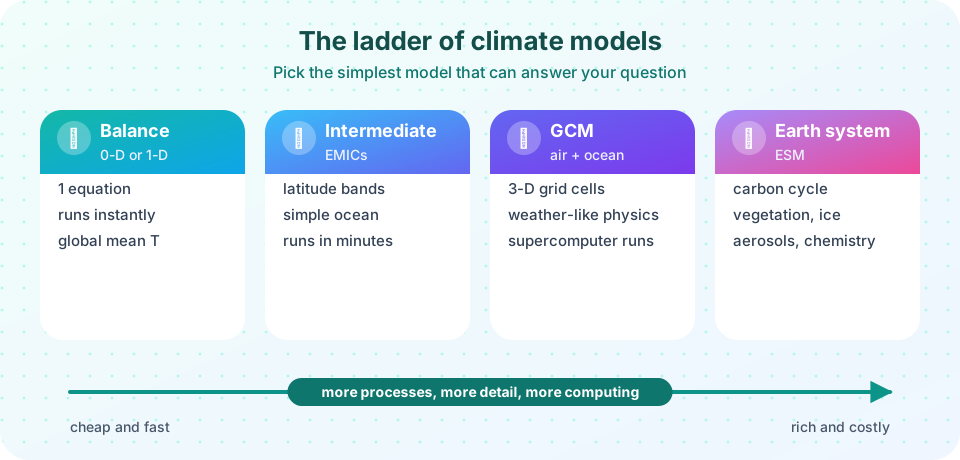
Scientists keep a whole hierarchy of models because different questions need different tools.
The model ladder
Simple to complex
Why not always the biggest?
Where the chapter goes
At the bottom of the ladder sits the energy balance model: Earth as a single number, its average temperature. At the top are Earth system models, which add the carbon cycle, vegetation, ice sheets, atmospheric chemistry and ocean life. Between them are intermediate-complexity models, which resolve latitude bands or simplified ocean basins and run quickly enough to explore thousands of "what if" cases.
Climate science needs the whole ladder. A simple model shows why something happens and can be understood by a student with a calculator. A full model shows where and when it happens, with regional detail. Good scientists move between the two, checking that the big model's behavior makes sense in terms of the small one.
Weather forecasts versus climate projections
A weather model and a climate model share most of their equations. The difference is the question. A weather forecast asks: what will the atmosphere be doing next Thursday? That depends sensitively on today's exact state, so forecasts lose skill after roughly two weeks (the "butterfly effect" described by Edward Lorenz).
A climate projection asks: how will the long-term average and the spread of weather change if the energy balance changes? That is a question about statistics and boundary conditions, not about one particular day. A good analogy is a loaded die. You cannot predict the next roll, but you can say with confidence how the average of a thousand rolls changes if the die is loaded.
A model is judged by whether it gets the right physics and reproduces observed climate statistics (seasons, storm tracks, El Niño, the response to past volcanic eruptions), not by whether it predicts the weather on a particular date a century from now.
What each lesson covers
- The energy balance model: sunlight in, infrared out, and why Earth would be about 33 K colder without greenhouse gases.
- General circulation models and Earth system models: grid cells, time steps, parameterization and how models are tested.
- Scenarios and uncertainty: shared socioeconomic pathways, ensembles and the three kinds of uncertainty.
- Chapter review: a picture, a recap table and ten questions.
Common misconceptions
"Models just extrapolate recent warming." They do not. They calculate the temperature from energy balance and fluid motion. Warming emerges from the physics; it is not drawn into the program.
"If models cannot predict next month's weather, they cannot predict 2100." Weather depends on fine details of the starting state. Climate depends on the long-term energy budget. These are different problems with different predictability.
"A model is only as good as its biggest flaw." Every model is imperfect, which is why scientists use many models, compare them with observations, and report ranges.
Try it
The first demonstration shows why computing cost matters. Halving the grid spacing quadruples the number of columns, and a smaller grid also needs smaller time steps. The code estimates the cost of running the same model at finer resolution.
Press Run (or Ctrl + Enter) to see the result here.
Program input · what you'd type while the program runs
Type the answers before you press Run, one per line. Each time the program reads a line (with input()), it gets the next line from this box.
The second demonstration is an interactive widget. Drag the slider to change the grid spacing and watch the number of columns and relative cost update.
Check your understanding
Quick check · 5 questions
of 5 answered You scored / 5 · perfect!
-
1. What is the main reason scientists use climate models?
Models let scientists test what happens when forcing changes, which cannot be tried on the single real planet. -
2. Which model type contains the fewest processes?
An energy balance model tracks only the average temperature, balancing energy in against energy out. -
3. Why does halving the grid spacing cost roughly eight times more?
Halving the spacing gives four times as many columns (area scaling) and a shorter time step, about twice as many steps. -
4. How is a climate projection different from a weather forecast?
Both rest on similar physics, but climate asks how the average and spread of weather change when the energy balance changes. -
5. Which is the best description of how a climate model gets its warming?
The physics of radiation, convection and circulation produces the temperature response; it is not an input.
Summary
- Climate models apply conservation laws and radiation physics to a representation of Earth.
- A hierarchy runs from one-equation energy balance models to full Earth system models.
- Simple models give insight; complex models give regional detail; scientists use both.
- Weather forecasting is about a specific day; climate projection is about long-term statistics.
- Finer resolution is expensive: cost grows roughly with the cube of the resolution increase.
Next: The energy balance model
Track your progress
Create a free account to tick off lessons and pick up where you left off on any device.
of Climate Science lessons completed