


















Lesson 7 of 48 · The Climate System
The atmosphere: layers, composition and circulation
Learn what the atmosphere is made of, why it has four layers, how pressure falls with height, and how uneven heating drives the Hadley cell, trade winds and jet streams.
The atmosphere is the part of the climate system you live in. Its gases keep the planet warm, its winds move heat around, and its water vapor and clouds shape both weather and climate. Yet it is astonishingly thin. If Earth were a basketball, nearly all of the air would fit in a coat of paint a fraction of a millimeter thick.
In this lesson you will learn what air is made of, why temperature rises and falls with altitude to create four layers, why pressure drops so quickly as you climb, and how the uneven heating of the planet drives the large-scale pattern of winds.
What you will learn
- List the main gases in dry air and identify the greenhouse gases among them.
- Describe the four layers of the atmosphere and what sets the temperature in each.
- Use the exponential law for pressure and the lapse rate for temperature.
- Explain the Hadley circulation, trade winds, westerlies and jet streams in terms of heating and rotation.
Key terms
Troposphere: the lowest layer, where weather happens and temperature falls with height. Stratosphere: the layer above it, where ozone warms the air. Lapse rate: the rate at which temperature falls with altitude (about 6.5 °C per km on average). Scale height: the altitude gain over which pressure falls by a factor e ≈ 2.718 (about 7 to 8 km). Coriolis effect: the apparent sideways deflection of moving air caused by Earth's rotation.
What the air is made of
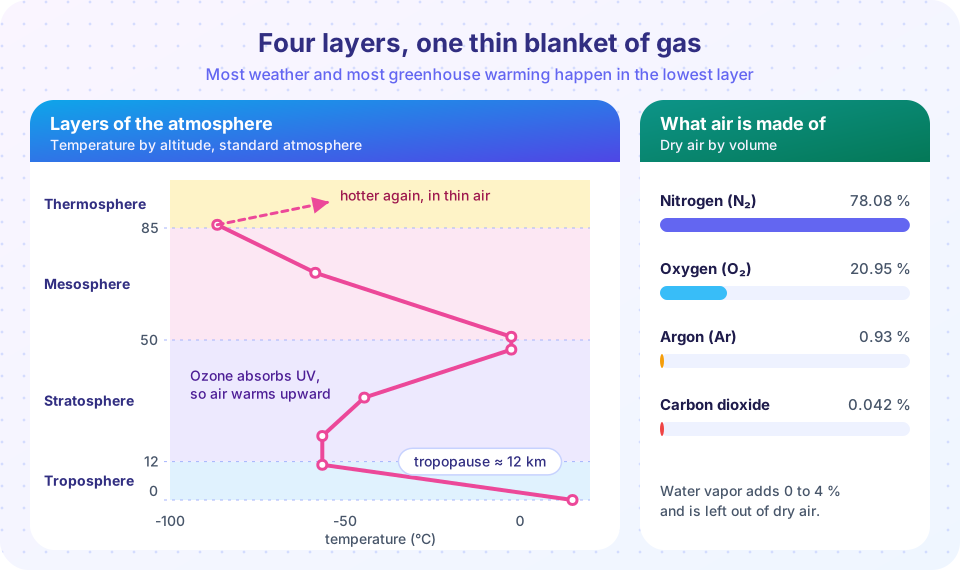
Dry air by volume is 78.08 % nitrogen (N₂), 20.95 % oxygen (O₂) and 0.93 % argon. Everything else together makes up about a twentieth of one percent. Yet that "everything else" matters enormously for climate. Carbon dioxide stands near 0.042 % (420 parts per million), methane near 1.9 parts per million, and nitrous oxide about 0.34 parts per million. The two biggest gases, N₂ and O₂, barely interact with infrared radiation; it is the trace gases (and water vapor, which varies between nearly 0 and about 4 % of air) that create the greenhouse effect.
Water vapor deserves special mention. Warm air can hold much more of it than cold air: the capacity rises by roughly 7 % for each degree Celsius of warming, a result called the Clausius-Clapeyron relation. This is why the tropics are humid and polar air is dry, and why a warmer atmosphere carries more moisture and tends to produce heavier downpours.
Pressure and the thin blanket
Air has weight, so the pressure at any level equals the weight of the air above it per unit area. At sea level this is about 101,325 pascals (1,013 hPa), the weight of roughly ten tonnes on each square meter. As you climb, less air remains above you, and the pressure falls approximately exponentially:
p(z) = p₀ · e^(-z / H)
where H is the scale height, near 7.6 km on average. Half the atmosphere's mass lies below about 5.3 km (H ln 2), so on a mountain such as Everest, 8.8 km high, the pressure is only about a third of the value at sea level. About 90 % of the atmosphere's mass is below 16 km. This is why such a thin layer can still matter: it contains almost all of the air but is tiny compared with Earth's radius of 6,371 km.
Worked example
A hiker reaches 3,000 m. The pressure is 1013 · e^(-3 / 7.6) = 1013 · 0.674 ≈ 683 hPa, about two-thirds of the sea-level value. So each breath contains about a third less oxygen, even though the oxygen is still 20.95 % of the air.
The four layers
The layers are defined by the way temperature changes with height.
- Troposphere (0 to about 12 km). The Sun heats the ground, and the ground heats the air above it. Warm air rises, so convection mixes the layer, and temperature falls on average by about 6.5 °C per km from roughly 15 °C at the surface to about -56 °C at the top. The troposphere holds about 80 % of the atmosphere's mass and nearly all of its water vapor, so weather happens here. Its top, the tropopause, is high (16 to 18 km) over the tropics and low (8 to 9 km) over the poles.
- Stratosphere (about 12 to 50 km). Temperature now rises with height because the ozone layer absorbs ultraviolet radiation from the Sun and warms the air. This stable layer, with warm air above cold, resists vertical mixing; it is why volcanic ash and aerosols stay for a year or more once they reach it.
- Mesosphere (about 50 to 85 km). Little ozone is left, and temperature again falls, reaching about -90 °C, the coldest place in the atmosphere. Most meteors burn up here.
- Thermosphere (above about 85 km). The air is extremely thin, and absorption of solar X-rays and extreme ultraviolet light makes individual molecules very energetic, so the "temperature" can reach well over 1,000 °C, though a thermometer would feel almost nothing because so few molecules touch it.
Why temperature falls with height in the troposphere
A rising parcel of air expands because the pressure around it drops. Expansion does work, so the parcel cools. For dry air this adiabatic cooling is g / cp = 9.81 / 1004 ≈ 9.8 °C per km. Real air is moist; as it cools and water vapor condenses, latent heat is released and slows the cooling to roughly 4 to 7 °C per km. The observed average of 6.5 °C per km lies between the two. The lapse rate controls how easily air convects, and thus how storms and clouds form. It will matter again in chapter 3, because it sets the effective altitude from which Earth radiates heat to space.
Global circulation
Sunlight is concentrated in the tropics, where the Sun is nearly overhead, and spread thinly near the poles. This uneven heating creates a pole-to-equator temperature difference that the atmosphere (and oceans) work to reduce by carrying heat poleward. If Earth did not rotate, a single loop would form in each hemisphere: air rising at the equator, moving to the poles at high altitude, sinking and returning at the surface. Rotation breaks this single loop into three cells in each hemisphere.
- Hadley cell (0° to about 30°). Warm, moist air rises near the equator in a belt of towering clouds and heavy rainfall called the Intertropical Convergence Zone. Aloft it moves poleward, cools and sinks near 30° latitude as dry air. Where the air descends, clouds are scarce, and the great subtropical deserts (the Sahara, the Arabian and Australian deserts) lie there.
- Ferrel cell (about 30° to 60°) and polar cell (60° to 90°). These are weaker cells driven partly by the mid-latitude storm tracks.
Rotation also bends the winds. Because Earth spins eastward, air that moves toward the equator along the surface is deflected westward, producing the trade winds, steady easterlies in the tropics that sailors used for centuries. Air moving poleward is deflected eastward, creating the westerlies of the mid-latitudes. At the boundaries of the cells, narrow bands of strong winds at about 10 km altitude, the jet streams, follow the sharp temperature contrasts; they steer storms. The atmosphere carries the larger share of poleward heat at mid-latitudes, while the ocean carries a significant share in the tropics (lesson 3).
Common misconceptions
"The atmosphere is mostly carbon dioxide and the ozone layer is what keeps Earth warm." The air is 99 % nitrogen and oxygen, and carbon dioxide is only about 0.04 %. Ozone high in the stratosphere absorbs ultraviolet light, but the greenhouse effect is created mainly by water vapor, carbon dioxide and other trace gases in the troposphere.
"It is colder on mountains because they are closer to the Sun." Mountains are barely closer. They are colder because the pressure is lower, air there expands and cools, and the thin air above holds less heat. The ground is also not warmed from below by a thick layer of dense air.
"Hot air rises, so the top of the atmosphere should be hottest." Rising air cools as it expands. The troposphere cools with height, and heat is released back to space from the cold upper layers.
Try it
The first example plots pressure and the share of atmospheric mass beneath each altitude. Change H and notice how the curve moves.
Press Run (or Ctrl + Enter) to see the result here.
Program input · what you'd type while the program runs
Type the answers before you press Run, one per line. Each time the program reads a line (with input()), it gets the next line from this box.
The second example is an altitude explorer. Drag the slider from the surface to the edge of space; it reports the standard-atmosphere temperature and pressure at that height and the layer you are in.
The third example compares what a rising parcel does in dry air with what the real atmosphere does. It shows why air that is lifted is usually warmer than its surroundings only if the surroundings cool fast enough.
Press Run (or Ctrl + Enter) to see the result here.
Program input · what you'd type while the program runs
Type the answers before you press Run, one per line. Each time the program reads a line (with input()), it gets the next line from this box.
Check your understanding
Quick check · 6 questions
of 6 answered You scored / 6 · perfect!
-
1. Which two gases make up about 99 % of dry air?
Nitrogen (78.08 %) and oxygen (20.95 %) together make about 99 % of dry air. -
2. Why does temperature rise with height in the stratosphere?
Ozone in the stratosphere absorbs UV light, heating that layer from within. -
3. At about what altitude does atmospheric pressure fall to roughly half its sea-level value?
With a scale height of about 7.6 km, half the pressure is reached at 7.6 × ln 2 ≈ 5.3 km, close to 5 km. -
4. Where do the great subtropical deserts form, and why?
The Hadley cell's descending branch near 30° produces clear, dry conditions. -
5. What causes the trade winds to blow from east to west near the equator?
The Coriolis effect turns equatorward-moving surface air toward the west. -
6. The average tropospheric lapse rate is about:
Temperature in the troposphere falls on average by about 6.5 °C for each kilometer of height.
Summary
- Dry air is 78 % nitrogen, 21 % oxygen and 0.93 % argon; the trace gases (CO₂, CH₄, N₂O) and water vapor create the greenhouse effect.
- Pressure falls exponentially with height with a scale height near 7.6 km; about 90 % of the atmosphere's mass is below 16 km.
- The four layers (troposphere, stratosphere, mesosphere, thermosphere) are defined by how temperature changes with altitude.
- Uneven heating and Earth's rotation produce the Hadley, Ferrel and polar cells, trade winds, westerlies and jet streams.
Next: Oceans and currents
Track your progress
Create a free account to tick off lessons and pick up where you left off on any device.
of Climate Science lessons completed