


















Lesson 10 of 48 · The Climate System
The carbon cycle
Learn the carbon cycle: the reservoirs of carbon, yearly flows between air, ocean and land, where human CO₂ goes, how long it lingers, and how to convert GtC, GtCO₂ and ppm.
Carbon is the element of life and the central actor in climate change. It is in every living cell, in the limestone of mountains, in coal and oil, in the sea and, as carbon dioxide, in the air. Carbon never disappears; it moves among reservoirs, sometimes in days (a leaf takes up CO₂ and returns it), sometimes over millions of years (a seashell becomes limestone and later returns CO₂ through a volcano). The climate cares about the carbon cycle because carbon dioxide and methane are greenhouse gases, and any change in how much carbon sits in the air changes the energy balance.
This lesson maps the reservoirs and flows, follows the extra carbon from fossil fuels through the system and gives you the units and conversions needed to read any carbon number you will meet.
What you will learn
- Name the major carbon reservoirs and compare their sizes.
- Distinguish the fast (biological and ocean) carbon cycle from the slow (geological) cycle.
- Describe where the carbon emitted by humans ends up and calculate the airborne fraction.
- Convert between GtC, GtCO₂ and ppm.
- Explain why CO₂ stays in the atmosphere for a very long time.
Key terms
Reservoir (pool): a place where carbon is stored (air, ocean, plants, soils, rocks). Flux: a flow of carbon between reservoirs, in GtC per year. Sink and source: a reservoir that takes up (sink) or releases (source) carbon on balance. Airborne fraction: the share of emitted CO₂ that stays in the air. GtC: gigatonne (billion tonnes) of carbon. Weathering: slow chemical breakdown of rock that removes CO₂ from the air.
Reservoirs
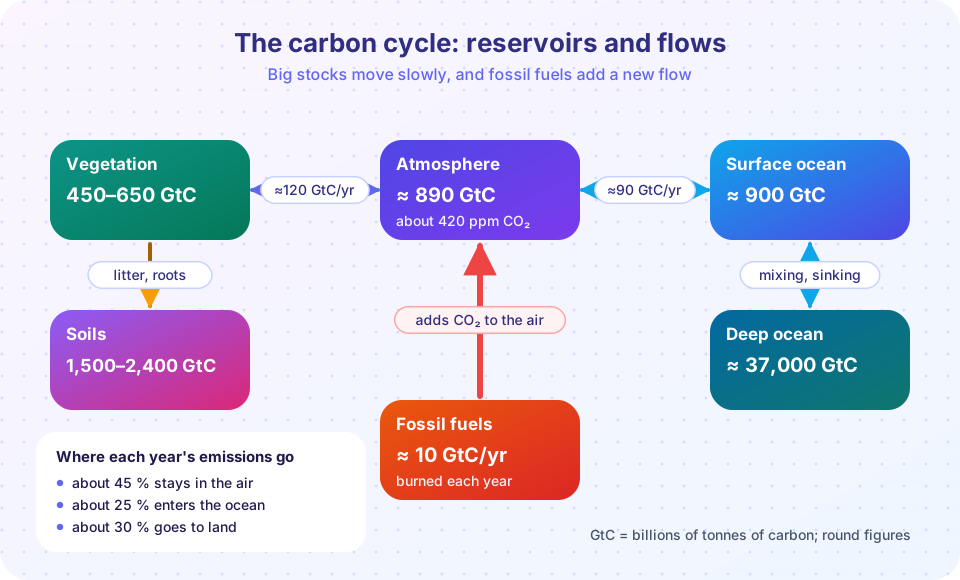
The figures below are round numbers in gigatonnes of carbon (GtC), and they come from large compilations such as the Global Carbon Project and the IPCC. Different assessments vary by tens of percent for the soil and vegetation pools, so treat them as estimates.
| Reservoir | Carbon stored (GtC) | Note |
|---|---|---|
| Atmosphere | about 890 | about 420 ppm of CO₂ (about 590 before industrialization) |
| Vegetation | 450 to 650 | forests hold most of it |
| Soils (top 2 m or so) | 1,500 to 2,400 | roughly 3 times the vegetation |
| Permafrost soils | about 1,500 | frozen carbon, overlapping the soil estimate |
| Surface ocean | about 900 | in exchange with the air within years |
| Deep ocean | about 37,000 | the largest active pool |
| Fossil fuel reserves and resources | thousands | coal, oil and gas formed over hundreds of millions of years |
| Sedimentary rocks (limestone and others) | tens of millions | the slow cycle's store |
Two facts stand out. First, the ocean holds about 40 times as much carbon as the air. Second, the amount of carbon burned as fossil fuel in one year (about 10 GtC) equals roughly one percent of what is stored in the air, a small number that adds up quickly.
The fast cycle: yearly exchange
Each year, plants on land remove about 120 GtC from the air by photosynthesis, CO₂ + H₂O + light → sugar + O₂, and return nearly the same amount by respiration and decay. The ocean surface exchanges roughly 90 GtC each way with the atmosphere. These flows are enormous compared with the 10 GtC from fossil fuels, but they are nearly in balance, like a bathtub with a large inflow and an almost equal outflow. A small imbalance of a few GtC per year, accumulating for decades, is what changes the water level.
The Keeling curve's seasonal wiggle is the fast cycle made visible. In the Northern Hemisphere, where most of Earth's land is, plants grow in spring and summer and take CO₂ out of the air, and in autumn and winter decay returns it. As a result atmospheric CO₂ falls by about 6 ppm between May and October and rises again afterwards, while the long-term trend continues upward.
The slow cycle: rocks
Over tens of thousands to millions of years, the cycle is governed by geology. Rain absorbs CO₂ and becomes slightly acidic; it dissolves silicate rocks and carries calcium and bicarbonate to the sea, where organisms build shells of calcium carbonate that sink and form limestone. Volcanoes and metamorphism return CO₂ to the atmosphere (a few tenths of a gigatonne of CO₂ per year). This silicate weathering loop is a natural thermostat: when the world is warmer and wetter, weathering speeds up, removes more CO₂ and cools the planet; when it is colder, weathering slows and volcanic CO₂ builds up. It works on time scales of hundreds of thousands of years, much too slowly to help with today's emissions.
Fossil fuels are carbon from the slow cycle: ancient plankton and plants buried and transformed over hundreds of millions of years. Burning them returns that carbon to the fast cycle in a century or two, thousands of times faster than nature stored it.
Where the emitted carbon goes
Human emissions come mainly from burning coal, oil and natural gas (about 10 GtC per year in recent years, or 37 GtCO₂) and from deforestation and other land-use change (about 1 GtC per year). Careful accounting by the Global Carbon Project shows that the emitted carbon is divided roughly this way: about 45 % remains in the atmosphere, about 25 % dissolves into the ocean and about 30 % is taken up by land vegetation and soils. The 45 % is the airborne fraction, which has stayed remarkably constant over six decades even as emissions have grown.
The ocean's uptake is limited by chemistry. Dissolved CO₂ forms carbonic acid, which reacts with carbonate ions; once that buffer is used up locally, further uptake slows. This is why the ocean takes up less CO₂ than a simple comparison of reservoir sizes would suggest: the "Revelle factor" is about 10, meaning that a 10 % rise in atmospheric CO₂ raises the carbon stored in surface water by only about 1 %. Land uptake responds to higher CO₂ (a fertilization effect), longer growing seasons and regrowth of forests, but it is vulnerable to drought, heat and fire.
Units and conversions
Three units appear everywhere.
- GtC counts only the mass of carbon. GtCO₂ counts the whole CO₂ molecule, and one tonne of carbon becomes
44/12 ≈ 3.664tonnes of CO₂. So 10 GtC is 36.6 GtCO₂. - ppm (parts per million by volume) is a concentration. Adding about 2.13 GtC to the atmosphere raises CO₂ by 1 ppm, so 1 ppm is roughly 7.8 GtCO₂.
Worked example
Annual fossil emissions of 10 GtC with an airborne fraction of 0.45 mean 4.5 GtC remain in the air each year. Dividing by 2.13 GtC per ppm gives about 2.1 ppm per year, which is close to the observed recent growth of about 2.3 ppm per year (a slightly higher airborne fraction and land-use emissions account for the difference).
How long does CO₂ stay?
Unlike a gas that decays chemically, CO₂ is never destroyed; it only moves among reservoirs. After an emission, the air quickly shares the excess with the surface ocean and land plants, so within a few decades roughly half of the pulse has left the air, but the slower uptake into the deep ocean takes centuries. A substantial share, very roughly a fifth to a third, is still in the air after a thousand years, and the rest of the adjustment depends on rock weathering over tens to hundreds of thousands of years. For this reason it is best to think of CO₂ not as having a single lifetime, but as lingering in a long tail, which is why cumulative emissions matter more than annual emissions in setting long-term warming.
Common misconceptions
"Natural flows are much bigger than human emissions, so humans don't matter." Natural flows, such as 120 GtC per year from photosynthesis, are nearly balanced by equal return flows. Human emissions are a net addition and about half remains in the air, as the rising Keeling curve shows. The isotopic signature of the carbon in the air, which shifts toward the pattern of fossil carbon, confirms where the extra carbon comes from.
"The ocean will absorb all the CO₂." The ocean takes up about a quarter, and its uptake is limited by its chemistry and slow mixing with the deep.
"Carbon in the air disappears after about 5 to 10 years." An individual molecule may be swapped with the ocean or plants within years, but swapping is not removal. The net excess persists for centuries.
Try it
The first example converts units and checks the carbon budget with round numbers.
Press Run (or Ctrl + Enter) to see the result here.
Program input · what you'd type while the program runs
Type the answers before you press Run, one per line. Each time the program reads a line (with input()), it gets the next line from this box.
The second example is a simple bathtub model of the atmosphere: emissions pour in, and the ocean and land take out an amount that grows with the excess above 280 ppm. It is a one-box teaching model, not a climate-model result. It shows that the concentration is set by the balance between emissions and sinks. Its flaw is important: it has a single time constant (about 55 years), so it removes CO₂ much faster after emissions stop than the real Earth, where deep-ocean mixing and rock weathering add much slower steps and a long tail.
Press Run (or Ctrl + Enter) to see the result here.
Program input · what you'd type while the program runs
Type the answers before you press Run, one per line. Each time the program reads a line (with input()), it gets the next line from this box.
The third example is a slider version of the same model. Choose how much emissions change by 2100 and see the CO₂ curve respond.
Check your understanding
Quick check · 6 questions
of 6 answered You scored / 6 · perfect!
-
1. How many tonnes of CO₂ correspond to one tonne of carbon?
The molar mass of CO₂ is 44 and carbon is 12, so the ratio is 44/12 ≈ 3.66. -
2. Which reservoir holds the most carbon of those that exchange with the air on human time scales?
The deep ocean holds about 37,000 GtC, far more than the atmosphere (about 890 GtC) or vegetation. -
3. Roughly what share of human CO₂ emissions stays in the atmosphere?
The airborne fraction is near 45 %. The rest is taken up by the ocean (about a quarter) and land (about 30 %). -
4. Why do natural carbon flows (such as 120 GtC per year from photosynthesis) not cancel the importance of human emissions?
A large flow that is matched by an equal return flow changes nothing. Human emissions add a net amount, and about half stays in the air. -
5. What process slowly removes CO₂ over hundreds of thousands of years and acts as a climate thermostat?
Rock weathering takes CO₂ from the air and, with sea shells, stores it as limestone. -
6. Annual emissions of 10 GtC raise CO₂ by about how much per year if 45 % stays airborne?
4.5 GtC divided by 2.13 GtC per ppm is about 2.1 ppm.
Summary
- Carbon moves among the atmosphere (about 890 GtC), vegetation, soils, the ocean (about 37,900 GtC in total) and rocks.
- The fast cycle swaps roughly 120 GtC per year with land plants and 90 GtC with the ocean; these flows nearly balance. The slow cycle works through weathering and volcanoes over geological time.
- Burning fossil fuels adds about 10 GtC per year; roughly 45 % stays in the air, 25 % enters the ocean, 30 % goes to land.
- 1 GtC equals 3.66 GtCO₂ and about 0.47 ppm; CO₂ lingers for centuries to millennia because there is no chemical destruction.
Track your progress
Create a free account to tick off lessons and pick up where you left off on any device.
of Climate Science lessons completed