


















Lesson 34 of 48 · Mitigation and Adaptation
Chapter 7 overview: mitigation and adaptation
See where greenhouse gas emissions come from, what mitigation and adaptation mean, and how net zero, carbon budgets and resilience fit together.
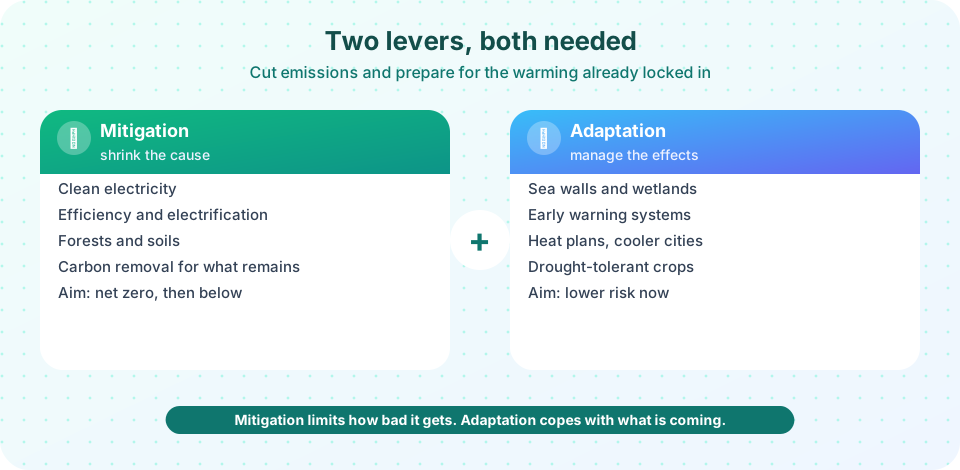
Once you know how the climate responds and what the risks are, the next question is what to do about it. Climate science and the IPCC separate the answer into two families of action. Mitigation tackles the cause: it reduces greenhouse gas emissions or removes carbon from the air. Adaptation tackles the effects: it adjusts systems to the climate that is coming.
Neither works alone. Mitigation cannot undo the warming already locked in, and adaptation has limits that grow as warming increases. This chapter explains both, with numbers: where emissions come from, how a carbon budget works, which measures are available and what they cost, and how communities make themselves more resilient.
What you will learn in this chapter
- Where greenhouse gas emissions come from, by gas and by sector.
- What net zero means and why total cumulative emissions matter.
- The main mitigation options in energy, land, industry and carbon removal.
- How adaptation works, and what its limits are.
Where emissions come from
Greenhouse gas emissions are usually reported in carbon dioxide equivalent (CO₂-eq), which converts other gases using their warming effect. According to the IPCC's Sixth Assessment Report (Working Group III), net anthropogenic emissions in 2019 were about 59 gigatonnes of CO₂-eq.
By gas, the shares were roughly:
| Gas | Share in 2019 | Main sources |
|---|---|---|
| CO₂ from fossil fuels and industry | about 64% | Burning coal, oil and gas; cement |
| CO₂ from land use and forestry | about 11% | Deforestation, land change |
| Methane (CH₄) | about 18% | Livestock, rice, fossil fuel leaks, landfills |
| Nitrous oxide (N₂O) | about 4% | Fertilizers, manure |
| Fluorinated gases | about 2% | Refrigerants, industry |
By sector, again for 2019 and in round numbers: about 34% from energy supply (electricity and heat), about 24% from industry, about 22% from agriculture, forestry and other land use, about 15% from transport, and about 6% directly from buildings (more when you include the electricity they use). A rough rule is that most emissions come from producing and using energy, and a substantial minority from land and food.
Mitigation: shrink the cause
Adaptation: manage the effects
Net zero
Net zero and the carbon budget
Because CO₂ lasts for centuries, warming depends mostly on the cumulative amount emitted. As long as net CO₂ emissions are above zero, global temperature keeps rising. To halt warming, emissions must reach net zero: the point where any remaining human-caused emissions are balanced by human-caused removals. The IPCC found that in pathways limiting warming to 1.5 °C with no or limited overshoot, global net zero CO₂ is reached around 2050, and around 2070 for 2 °C pathways. Other greenhouse gases, especially methane, matter too, but they behave differently: methane lasts only about a decade, so cutting it lowers warming relatively quickly.
The idea of a carbon budget follows from the near-linear relationship between cumulative CO₂ and warming: for a given temperature target and probability there is a finite amount of CO₂ left to emit. Lesson 2 of this chapter explains it with numbers.
Mitigation is a systems problem
The Kaya identity, which you will meet in the next lesson, splits emissions into population, wealth, energy efficiency and the carbon intensity of energy. Mitigation therefore needs action on several fronts at once: clean electricity (solar, wind, hydropower, nuclear), electrification of transport and heating, efficiency, changes to industry processes, better land and food systems, and, for what remains, carbon removal. The costs of solar, wind and batteries fell dramatically in the 2010s, which changed the economics of the whole problem.
Adaptation: living with the climate we have
Adaptation includes hard infrastructure (sea walls, drainage), nature-based solutions (mangroves, wetlands, urban trees), and institutions and behavior (insurance, early-warning systems, heat action plans, changing planting dates, rules about where to build). The IPCC defines "limits to adaptation" as points beyond which a system cannot adjust to protect its valued objectives. Some limits are soft (money, knowledge, governance) and some are hard (a coral reef cannot be moved, a flooded island cannot be raised enough).
What each lesson covers
- Emissions and the carbon budget: the Kaya identity, cumulative emissions and remaining budgets.
- The mitigation toolbox: energy, industry, land, methane and carbon removal, with the arithmetic of what works.
- Adaptation and resilience: types of adaptation, costs, limits and fairness.
- Chapter review: the wedge picture and a ten-question quiz.
Common misconceptions
"Adaptation is giving up." Adaptation and mitigation are partners. The less we mitigate, the harder and costlier adaptation becomes, and some losses cannot be adapted to at all.
"Net zero means zero emissions." Net zero means remaining emissions are offset by removals. Real net-zero pathways first cut emissions by roughly 90% or more.
"Individual actions are all that matter." Personal choices count, but emissions come mostly from energy systems, industry and land use, which depend on infrastructure and policy.
Try it
The first demonstration plots 2019 emissions by sector using the IPCC's rounded shares, converting percentages into gigatonnes.
Press Run (or Ctrl + Enter) to see the result here.
Program input · what you'd type while the program runs
Type the answers before you press Run, one per line. Each time the program reads a line (with input()), it gets the next line from this box.
The second demonstration is a small net-zero accounting calculator in the console.
Press Run (or Ctrl + Enter) to see the console output here.
No output.
Check your understanding
Quick check · 5 questions
of 5 answered You scored / 5 · perfect!
-
1. What is the difference between mitigation and adaptation?
Mitigation addresses the causes of climate change; adaptation addresses the impacts. -
2. Which sector had the largest share of 2019 emissions (IPCC AR6)?
Energy supply, mostly electricity and heat, contributed about 34%. -
3. What does net zero CO₂ mean?
Net zero balances residual emissions with human-caused removals. -
4. Why is methane cut often valued for a quick effect?
Because methane has a short lifetime, cutting emissions lowers warming within decades. -
5. A 'hard limit' to adaptation is
Hard limits are biophysical; soft limits are social or economic and can change.
Summary
- Mitigation cuts emissions or removes carbon; adaptation manages the effects.
- In 2019 emissions were about 59 Gt CO₂-eq: mostly fossil CO₂, then methane and land CO₂; energy supply and industry lead by sector.
- Because CO₂ accumulates, warming stops only at net zero CO₂, around 2050 for 1.5 °C pathways.
- Both mitigation and adaptation are required, and adaptation has hard and soft limits.
Track your progress
Create a free account to tick off lessons and pick up where you left off on any device.
of Climate Science lessons completed