


















Lesson 12 of 48 · Energy Balance and Greenhouse Effect
Chapter overview: energy balance and the greenhouse effect
Preview the physics that sets Earth's temperature: sunlight in, infrared out, the greenhouse blanket, feedbacks and climate sensitivity, with a first interactive temperature model.
Why is the average temperature of Earth's surface about 15 °C and not -18 °C or 100 °C? The answer is a bookkeeping problem. A planet that is not heating up or cooling down must radiate to space exactly as much energy as it absorbs from the Sun. Everything that changes the climate, from a volcanic eruption to a rise in carbon dioxide, works by upsetting this balance and forcing the planet to find a new temperature at which the books balance again.
This chapter builds that picture in five steps: how objects radiate (lesson 2), how to compute the temperature of a planet from its energy budget (lesson 3), how greenhouse gases change the answer (lesson 4), and how feedbacks and climate sensitivity amplify the response (lesson 5). A review closes the chapter.
What you will learn
- State the principle of energy balance and why it fixes a planet's temperature.
- Preview the key quantities: solar constant, albedo, emission temperature, greenhouse effect and climate sensitivity.
- Find your way around the lessons in this chapter.
- Use a first, simple interactive model of Earth's temperature.
Key terms
Radiation: energy carried by electromagnetic waves. Solar constant: the sunlight power reaching the top of the atmosphere, about 1,361 W/m². Albedo: the fraction of sunlight reflected. Emission temperature: the temperature a planet would need to radiate away the energy it absorbs, about 255 K for Earth. Radiative forcing: a change in the energy balance, in W/m². Climate sensitivity: the equilibrium warming for a doubling of CO₂.
The big picture in three sentences
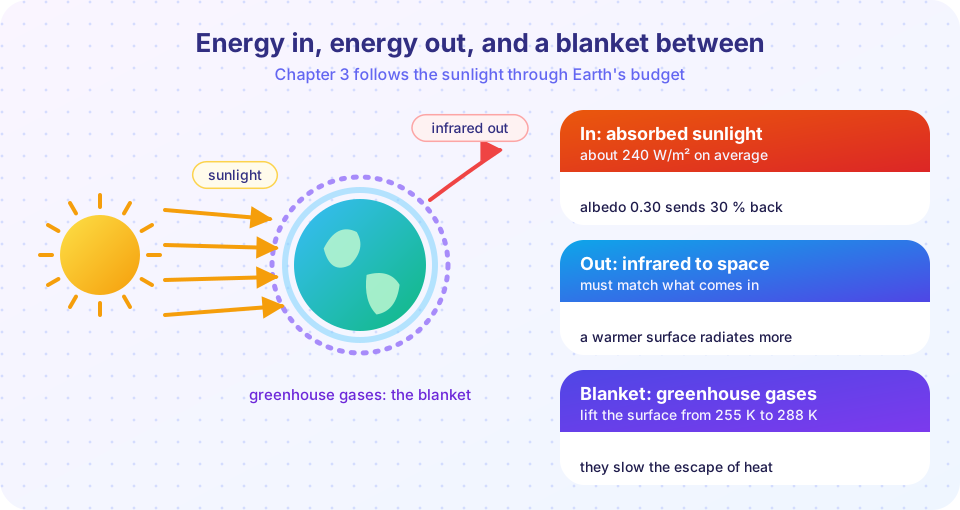
Earth absorbs about 240 W/m² of sunlight on average (after reflecting 30 %). To be in balance it must radiate 240 W/m² of infrared to space. Because greenhouse gases make the atmosphere partly opaque to infrared, the layer that radiates to space is high and cold, so the surface below must be much warmer than 255 K to push enough heat through: that excess is the greenhouse effect of about 33 K.
Step 1: Radiation
Step 2: Balance
Step 3: Blanket
Step 4: Response
Roadmap
| Lesson | What you will do |
|---|---|
| Radiation and blackbody curves | Learn why the Sun shines in visible light and Earth in infrared; use E = σT⁴ and Wien's law |
| Planetary energy balance and albedo | Derive the 255 K emission temperature and test it on other planets |
| The greenhouse effect | See how absorbing gases lift the surface to 288 K; learn the logarithmic CO₂ law |
| Feedbacks and climate sensitivity | Meet water vapor, ice-albedo, lapse rate and cloud feedbacks and the idea of 3 °C per doubling |
| Chapter review | One-page recap of the relations, flashcard practice and a long quiz |
A first look at the numbers
Two quantities start everything: the power of the Sun at Earth's distance, and how that power is spread over a sphere. The Sun's luminosity is L = 3.828 × 10²⁶ W, and Earth's mean distance is 1.496 × 10¹¹ m. Spreading the luminosity over a sphere of that radius gives the solar constant. The first TryIt computes it.
Press Run (or Ctrl + Enter) to see the result here.
Program input · what you'd type while the program runs
Type the answers before you press Run, one per line. Each time the program reads a line (with input()), it gets the next line from this box.
The second example is a model you can play with straight away. Earth's temperature follows from σ·ε·T⁴ = S(1 - α)/4, where α is the albedo and ε is a number that stands for how well the planet radiates to space (1 for a bare planet; smaller when greenhouse gases are present). With ε = 0.61, the model reproduces 288 K. Lesson 4 explains where that number comes from. This is a teaching model, not a full climate model.
A guided tour of the numbers
Four numbers recur through the chapter, and it helps to have a feel for each before you start. The first is 1,361 W/m², the solar constant. It is roughly the power of a small electric heater (1.4 kW) spread over one square meter in full sunlight above the atmosphere. The second is 0.30, Earth's planetary albedo: about three-tenths of the light is reflected straight back to space by clouds, air and bright surfaces. The third is 255 K, the temperature at which Earth would radiate away its absorbed sunlight if there were no greenhouse gases. The fourth is 288 K, the observed global mean surface temperature. The difference between the last two, 33 K, is the story of the greenhouse effect, and the rest of the chapter is about the physics that produces it and about how that physics responds to change.
You can already get a feel for why balance is stable by asking what happens if it is briefly upset. Suppose the planet suddenly absorbed 1 W/m² more than it emitted. It would warm, and because the emitted energy rises as the fourth power of temperature, the extra radiation grows quickly with temperature until it again matches the input. Balance is therefore not a delicate coincidence. It is where the planet is pulled, and any imbalance corrects itself. This restoring behavior is called the Planck feedback, and it is the foundation of climate stability.
Why this chapter matters for the rest of the course
Everything that follows depends on this chapter. Climate models (chapter 5) are, in the end, elaborate bookkeeping of the same energy flows, solved in three dimensions and across time. Impacts (chapter 6) follow from the temperature change that the energy imbalance produces. Mitigation (chapter 7) is the effort to bring the imbalance down by reducing greenhouse gases, and the carbon budget calculation follows directly from the logarithmic law and the sensitivity that you will meet in lessons 4 and 5. Policy (chapter 8) rests on quantities such as the radiative forcing and the temperature targets stated in degrees above the pre-industrial level. If you understand why the planet is at 288 K and what would change it, you understand the scientific core of the entire subject.
A useful way to study the chapter is to keep one question in mind throughout: what changes the balance, and how does the planet respond? Lesson 2 gives the laws for radiation. Lesson 3 shows how to apply them to a planet. Lesson 4 explains the blanket. Lesson 5 explains what the system does when you disturb it. At each step, work the numbers yourself in the TryIts: the chapter is built so that each calculation uses the result of the one before.
Check your understanding
Quick check · 4 questions
of 4 answered You scored / 4 · perfect!
-
1. For a planet in energy balance, which statement is true?
Balance means energy in equals energy out. A mismatch heats or cools the planet until balance returns. -
2. Why is sunlight divided by 4 when we compute Earth's average absorbed energy?
The ratio of sphere area to disk area is 4. -
3. What is the difference between Earth's emission temperature and its surface temperature?
The 33 K gap is the natural greenhouse effect. -
4. In the temperature knob, what does lowering ε from 1.0 to 0.61 represent?
A smaller effective emissivity stands for infrared being trapped, so the surface must be warmer to radiate the same power.
Summary
- A planet's temperature is set by balance between absorbed sunlight and emitted infrared.
- Earth absorbs about 240 W/m² on average; with no greenhouse gases it would radiate from 255 K.
- Greenhouse gases raise the effective radiating layer, so the surface sits near 288 K.
- Feedbacks and climate sensitivity describe how much further the system warms when the balance is disturbed.
Track your progress
Create a free account to tick off lessons and pick up where you left off on any device.
of Climate Science lessons completed