


















Lesson 28 of 48 · Climate Models
Chapter 5 review: climate models
Review energy balance models, GCMs, parameterization, SSP scenarios and uncertainty with a recap table, calculators and a ten-question quiz.
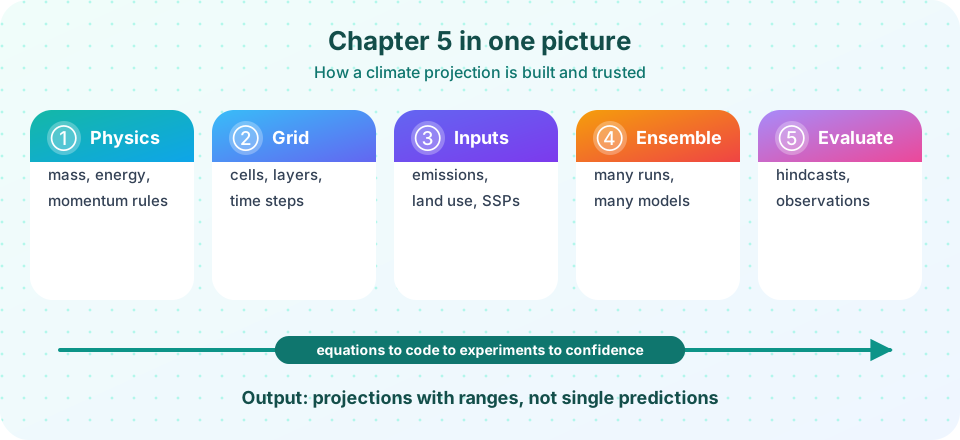
This review pulls the chapter together. You started with a planet reduced to a single temperature, climbed to models with millions of grid cells, and then met the honest question every projection must answer: how sure are we? Use the picture and the table below as a map, try the two calculators, and test yourself with ten questions.
Recap table
| Idea | One-line summary | Key number or formula |
|---|---|---|
| Energy balance | Absorbed sunlight equals emitted infrared | S(1 − α)/4 = σT⁴, Tₑ ≈ 255 K |
| Greenhouse effect | Surface is warmer than Tₑ | about 33 K (288 K vs 255 K) |
| Heat capacity | Sets how fast the planet warms | C dT/dt = F − λT, τ = C/λ |
| Feedbacks | Amplify or damp the response | Planck 3.2, net λ about 1.2 W m⁻² K⁻¹ |
| GCM | Conservation laws on a 3-D grid | about 100 km, tens of layers |
| Resolution cost | Finer grid is much costlier | halving spacing costs about 8× |
| Parameterization | Sub-grid processes as rules | clouds, convection, turbulence |
| ESM | GCM plus carbon cycle and more | calculates CO₂ itself |
| SSP label | Story + 2100 forcing | SSP2-4.5 |
| Uncertainty | Variability, model, scenario | each dominates a different horizon |
| ECS | Warming for doubled CO₂ | 3 °C best, likely 2.5 to 4 |
What an expert holds in mind
An experienced climate scientist uses models in a particular way. First, the physics comes first: the basic warming from extra CO₂ follows from radiation and was calculated well before computers could simulate a global climate. Second, simple and complex models agree on the big picture and differ in detail, and that agreement is evidence that the large-scale result is robust. Third, every claim has a conditional form: "If emissions follow SSP2-4.5, then warming in 2081-2100 is very likely 2.1 to 3.5 °C." Fourth, the ensemble, not a single run, is the unit of evidence.
Quick checks you should be able to do on paper
- Sunlight:
1361 / 4 ≈ 340 W/m²; absorbed with α = 0.30 is238 W/m². - Doubling CO₂ forcing:
5.35 × ln 2 ≈ 3.7 W/m². - Equilibrium warming:
ΔT = F / λ; with λ = 1.2 that is about 3.1 K. - Relative cost of a finer grid:
(old spacing / new spacing)³.
When a number looks wrong, check units and orders of magnitude first. A climate sensitivity of 30 °C per doubling or a 238 kW/m² flux means a slipped decimal, not a discovery.
A worked synthesis question
A modeling group replaces its cloud scheme and finds that the net feedback parameter changes from λ = 1.2 to λ = 1.0 W m⁻² K⁻¹. What does that do, and how should the group respond?
First, the sensitivity. With F₂ₓ = 3.71 W/m², ECS rises from 3.71 / 1.2 = 3.1 °C to 3.71 / 1.0 = 3.7 °C, an increase of about 0.6 °C, or 20%. Second, the speed: with C = 8, the time constant τ = C/λ grows from 6.7 to 8 years, so the surface takes slightly longer to approach equilibrium. Third, the judgment: a single changed number is not a reason to trust or reject the model. The group should test the new scheme against observed cloud properties from satellites, check that the climatology, the seasonal cycle and El Niño are still realistic, run the historical hindcast to see whether the 20th-century warming is still reproduced, and compare with constraints from paleoclimate. If the new model is more realistic in the processes but warmer in the response, that is a scientific finding to report, and the model becomes one more member of the multi-model ensemble. No single model is "the answer"; the ensemble and the independent lines of evidence together set the assessed range.
Try it
This calculator wraps the chapter's main formulas in one function. Change the inputs and see how albedo, forcing and feedback change the answers.
Press Run (or Ctrl + Enter) to see the result here.
Program input · what you'd type while the program runs
Type the answers before you press Run, one per line. Each time the program reads a line (with input()), it gets the next line from this box.
Now a flashcard drill in the console editor. Run it to print the questions and answers, then try answering aloud before reading the answer.
Press Run (or Ctrl + Enter) to see the console output here.
No output.
Check your understanding
Quick check · 10 questions
of 10 answered You scored / 10 · perfect!
-
1. Which equation gives Earth's effective temperature?
Absorbed sunlight equals emitted radiation; solving for T gives about 255 K. -
2. Which is the correct reading of the 33 K difference between 288 K and 255 K?
It is the warming produced by natural greenhouse gases and clouds, present long before humans. -
3. In C dT/dt = F − λT, doubling the heat capacity C will
Equilibrium is F/λ and does not involve C; C only sets the time constant. -
4. Halving grid spacing in a model costs about
Four times as many columns and twice as many time steps. -
5. Which of these is parameterized rather than resolved in a typical 100 km model?
Convection happens at scales of a few kilometers, much smaller than a 100 km cell. -
6. What distinguishes an Earth system model from a plain GCM?
ESMs add biogeochemistry so CO₂ concentration can respond to climate. -
7. A weather forecast and a climate projection differ mainly because
Weather is a sensitive initial-value problem; climate is a boundary-condition problem about long-term statistics. -
8. Which source of uncertainty can society reduce by its choices?
The future emission path is a human choice; the other sources are natural or scientific. -
9. TCRE of about 0.45 °C per 1000 GtCO₂ means
Warming tracks cumulative emissions almost linearly, which is the basis of carbon budgets. -
10. Which statement about ranges is correct?
Ranges report calibrated confidence. For climate sensitivity the high tail is longer, so risk is skewed.
Summary
- Energy balance gives Tₑ ≈ 255 K; the greenhouse effect adds about 33 K.
- Heat capacity sets speed; feedbacks set the size of the response.
- GCMs and ESMs solve conservation laws on grids, with parameterized sub-grid processes.
- SSP labels join a story with a forcing level; ensembles sample uncertainty.
- ECS best estimate is about 3 °C; carbon budgets follow from TCRE.
Track your progress
Create a free account to tick off lessons and pick up where you left off on any device.
of Climate Science lessons completed