


















Lesson 25 of 48 · Climate Models
The energy balance model
Derive Earth's effective temperature from sunlight, albedo and the Stefan-Boltzmann law, then add heat capacity and feedbacks to see how climate responds.
Every climate model, however large, rests on one idea: a planet is warm when it takes in as much energy as it gives off. The energy balance model is that idea written as an equation. It ignores clouds, winds and oceans on purpose, and in return it lets you calculate the temperature of a planet on the back of an envelope.
In this lesson you will derive Earth's temperature without any greenhouse gases, compare it with the real value, add a heat capacity so the planet can warm up over time, and see how feedbacks decide how much a given push on the climate really matters.
What you will learn
- Derive the factor of four between sunlight on a disk and the global average.
- Calculate Earth's effective temperature from the solar constant and albedo.
- Explain why the real surface is about 33 K warmer.
- Use a time-dependent energy balance with heat capacity and a feedback parameter.
Key terms
Solar constant (S): sunlight per square meter at Earth's distance, about 1361 W/m². Albedo (α): the fraction of sunlight reflected, about 0.30 for Earth. Effective temperature (Tₑ): the temperature of a perfect emitter that radiates the same power as the planet. Radiative forcing (F): a change in the energy balance, in W/m², caused by something like added CO₂. Climate feedback parameter (λ): how much extra energy the planet loses to space per kelvin of warming, in W/m² per K.
Step 1: how much sunlight arrives?
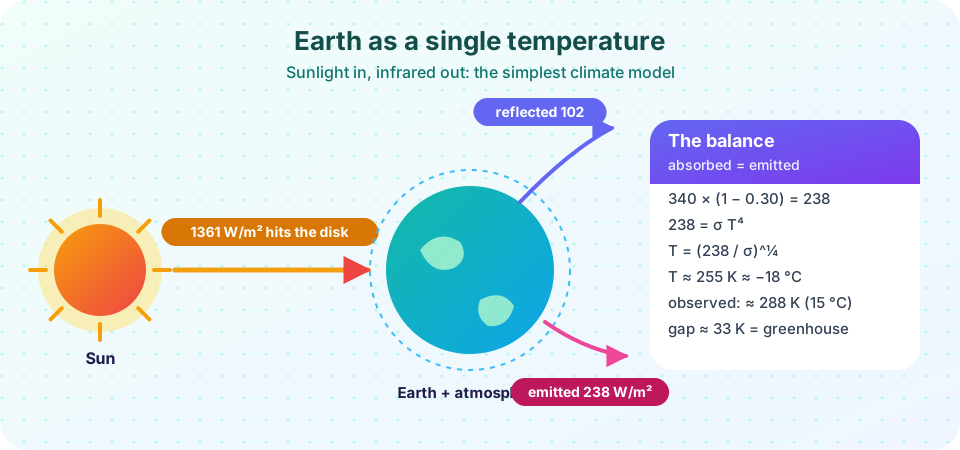
At Earth's distance the Sun delivers about S = 1361 W/m² to a surface facing it directly. But Earth is a sphere, and only a circle of area πR² faces the Sun at any moment, while the whole surface has area 4πR². Spread the intercepted power over the entire sphere and the average input is
S / 4 = 1361 / 4 ≈ 340 W/m²
The factor of 4 is the ratio of a sphere's surface to its shadow. It surprises many people the first time: the Sun is overhead only in the tropics, and the poles and the night side get nothing, yet the global average is a quarter of the headline number.
Step 2: how much is absorbed?
Clouds, snow, ice, desert, ocean and air scatter some sunlight straight back to space. Satellite measurements put this reflected fraction, the albedo, near α = 0.30. About 30% of 340 W/m² is 102 W/m² bounced away, leaving
absorbed = (S / 4)(1 − α) = 340 × 0.70 ≈ 238 W/m²
Step 3: how much is emitted?
Every object radiates according to the Stefan–Boltzmann law. Per square meter, an ideal emitter at absolute temperature T gives off
power = σ T⁴, σ = 5.670 × 10⁻⁸ W m⁻² K⁻⁴
In steady state, power in equals power out:
(S / 4)(1 − α) = σ Tₑ⁴
Tₑ = [ (S/4)(1 − α) / σ ]^(1/4)
Work the numbers: 238 / 5.670e-8 = 4.20e9. The square root is about 64,800, and the square root of that is about 254.5. So Tₑ ≈ 255 K, which is −18 °C.
The gap
The global mean surface temperature is about 288 K (15 °C). The difference of about 33 K is the natural greenhouse effect. The surface is warm because greenhouse gases (water vapor, CO₂, methane and others) absorb infrared from the surface and re-emit it, partly downward. Seen from space, Earth radiates 238 W/m² from a cold, high layer of the atmosphere, near 255 K, while the surface below sits much warmer.
A one-layer greenhouse model
You can mimic this with one idealized atmospheric layer that absorbs all the infrared from the ground and radiates equally up and down. Then the layer must emit 238 W/m² to space, so it also sends 238 W/m² down. The ground receives 238 W/m² of sunlight plus 238 W/m² from the layer and must emit 476 W/m²:
σ Ts⁴ = 2 × 238 = 476 → Ts = 255 × 2^(1/4) ≈ 303 K
That overshoots the real 288 K because a real atmosphere does not absorb everything, and heat leaves the surface by evaporation and convection as well as radiation. But the model shows the mechanism clearly: a layer that absorbs infrared makes the ground warmer than the planet's effective temperature.
Other planets
The same formula works for neighbors. Venus reflects about 77% of sunlight and receives about 2601 W/m², giving Tₑ ≈ 227 K, colder than Earth's effective temperature. Yet Venus's surface sits near 737 K, because its dense CO₂ atmosphere creates an enormous greenhouse effect. Mars, with a thin atmosphere, has Tₑ ≈ 210 K and a surface not far from that.
Step 4: change the balance and watch the planet warm
Now put in a disturbance. Suppose the balance is knocked out of equilibrium by a forcing F, for example extra CO₂ that blocks 3.7 W/m² of outgoing infrared (roughly what doubling CO₂ does). The planet now has an energy surplus. It warms, and a warmer planet emits more, shrinking the surplus. Write the surplus as a heat capacity C times the warming rate:
C dT/dt = F − λ T
Here T is the temperature change from the starting equilibrium, and λ is the climate feedback parameter. The solution is an exponential approach to a new equilibrium:
T(t) = (F / λ)(1 − e^(−t/τ)), τ = C / λ
With C = 8 W yr m⁻² K⁻¹ (the heat capacity of the atmosphere, land and upper ocean in these units) and λ = 1.2 W m⁻² K⁻¹, the time constant is τ ≈ 6.7 years and the equilibrium warming is 3.7 / 1.2 ≈ 3.1 K. The size of the final warming depends on λ, not on C; the heat capacity only sets how fast the planet gets there.
Sensitivity and feedbacks
If the planet warmed with no other changes, the warming itself would add about 3.2 W/m² of outgoing radiation per kelvin (the "Planck response", from differentiating σT⁴). Doubling CO₂ would then warm Earth by about 3.7 / 3.2 ≈ 1.2 K. The real number is larger because warming triggers feedbacks:
- Water vapor (amplifying): warm air holds more vapor, itself a greenhouse gas.
- Ice-albedo (amplifying): melting ice exposes darker land and ocean that absorb more sunlight.
- Lapse rate (reducing in the tropics): the upper troposphere warms more than the surface and radiates more efficiently.
- Clouds (uncertain, probably amplifying): the largest source of spread among models.
These push the net λ down from 3.2 to about 1.2, giving a best estimate for the equilibrium climate sensitivity of about 3 °C per doubling of CO₂. The IPCC's sixth assessment gives a likely range of 2.5 to 4 °C.
Multiple equilibria
In the 1960s Mikhail Budyko and William Sellers showed that adding an ice-albedo feedback to an energy balance model can produce two stable climates for the same sunlight: the warm one we live in and a fully glaciated "snowball Earth." The geological record suggests that Earth passed through snowball episodes about 700 million years ago. The point for you: a simple model can reveal behavior (tipping between states) that a pile of data would hide.
Common misconceptions
"Earth's temperature is 255 K." That is the effective temperature as seen from space. The surface is about 288 K.
"The greenhouse effect violates the second law of thermodynamics because a cold atmosphere cannot warm a warmer surface." The atmosphere does not warm the surface by being hotter. It reduces how easily the surface loses heat, so a warmer surface is needed to push the same power out. A blanket on a person works the same way.
"The model says doubling CO₂ gives exactly 1.2 K." That is the no-feedback value. Feedbacks matter a great deal, which is why measuring them is a research priority.
Try it
Compute effective temperatures for Earth, Venus and Mars from solar flux and albedo. Compare them with observed surface temperatures to see the greenhouse boost each planet has.
Press Run (or Ctrl + Enter) to see the result here.
Program input · what you'd type while the program runs
Type the answers before you press Run, one per line. Each time the program reads a line (with input()), it gets the next line from this box.
Now add heat capacity. This simulation steps the equation C dT/dt = F − λT forward in time for a sudden doubling of CO₂ and compares different feedback strengths.
Press Run (or Ctrl + Enter) to see the result here.
Program input · what you'd type while the program runs
Type the answers before you press Run, one per line. Each time the program reads a line (with input()), it gets the next line from this box.
A third demonstration looks at how sensitive the effective temperature is to albedo: the more reflective the planet, the colder it gets.
Check your understanding
Quick check · 5 questions
of 5 answered You scored / 5 · perfect!
-
1. Why is the global average sunlight about 340 W/m² when the solar constant is 1361 W/m²?
Sunlight is intercepted over a disk of area πR² but spread over a surface of 4πR², so the average is S/4. -
2. With albedo 0.30, how much sunlight does Earth absorb on average?
340 × (1 − 0.30) = 238 W/m². -
3. What does the 33 K gap between 255 K and 288 K represent?
Greenhouse gases make the surface warmer than the planet's effective radiating temperature. -
4. In C dT/dt = F − λT, which quantity sets the final equilibrium warming?
At equilibrium dT/dt = 0, so T = F/λ. Heat capacity C only sets how fast the planet gets there. -
5. Which feedback is amplifying (makes warming larger)?
More water vapor in a warmer atmosphere traps more infrared. The Planck response is the baseline cooling that stabilizes the planet.
Summary
- Average sunlight is
S/4 ≈ 340 W/m²; with albedo 0.30 about 238 W/m² is absorbed. - Balancing that against
σT⁴gives an effective temperature of about 255 K. - The surface is about 288 K, and the difference is the natural greenhouse effect.
- With heat capacity,
C dT/dt = F − λTgives an exponential approach toT = F/λ. - Feedbacks lower λ and raise sensitivity to about 3 °C per CO₂ doubling.
Track your progress
Create a free account to tick off lessons and pick up where you left off on any device.
of Climate Science lessons completed