


















Lesson 46 of 48 · Projects and Practice
Climate science glossary
A plain-language glossary of 40 climate science terms covering the climate system, energy balance, models, impacts, mitigation, adaptation and policy.
Every field has its own vocabulary, and climate science borrows words from physics, chemistry, ecology, economics and politics. This glossary collects the key terms from the whole course in one place, with short definitions you can reread before an exam or a news article. Terms are grouped by theme, and many link to the lesson where they are explained. Entries cite typical numbers where they help, but remember that ranges and conventions change as the science improves.
What you will learn
- Define 40 core terms in your own words.
- Link each term to the part of the course where it is used.
- Distinguish look-alike pairs such as weather and climate, or forcing and feedback.
Energy balance and the climate system
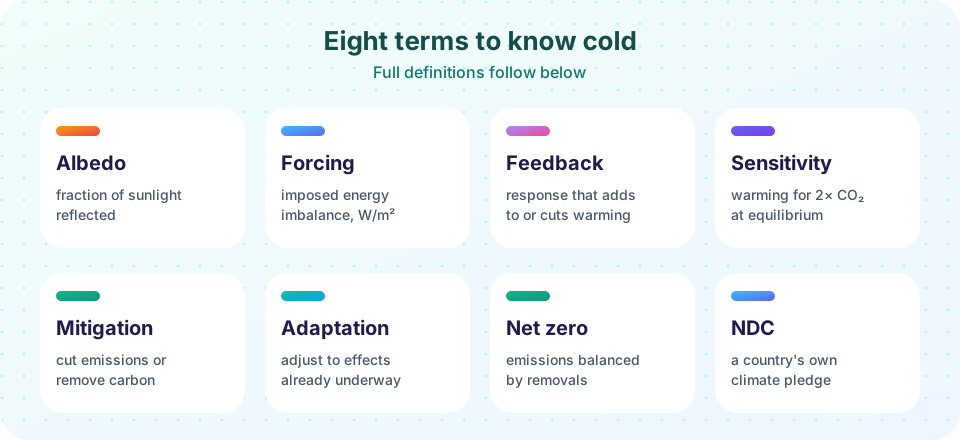
Albedo: the fraction of incoming sunlight that a surface or planet reflects; Earth's average is about 0.30.
Radiative forcing: a change in Earth's energy balance, in W/m², caused by something external such as added CO₂ or a volcanic eruption.
Feedback: a response to warming that amplifies it (positive feedback, such as extra water vapor) or reduces it (negative feedback, such as the increase in outgoing infrared radiation).
Climate feedback parameter (λ): the extra energy lost to space per kelvin of warming, in W m⁻² K⁻¹; smaller values mean stronger amplification.
Effective temperature: the temperature of a perfect emitter radiating the same power as the planet; about 255 K for Earth.
Greenhouse effect: the warming of the surface that results because gases absorb infrared radiation and re-emit part of it downward; about 33 K for Earth's natural effect.
Heat capacity: the energy needed to warm something by one kelvin; the ocean's is far larger than the atmosphere's, so it slows climate change.
Stefan-Boltzmann law: a body at temperature T radiates power per area proportional to T⁴.
Models and projections
Climate model (GCM): a computer program that solves the laws of physics for the atmosphere, ocean and other components on a grid.
Earth system model (ESM): a climate model that also calculates the carbon cycle, vegetation and sometimes ice sheets and chemistry.
Parameterization: a simple formula that represents the average effect of a process too small for the model grid, such as a cloud.
Ensemble: a set of simulations, from many models or with different starting conditions, used to sample uncertainty.
Scenario (SSP): a consistent story of future society and emissions, labeled by forcing in 2100, for example SSP2-4.5.
Equilibrium climate sensitivity (ECS): the long-term warming for a doubling of CO₂; best estimate 3 °C, likely 2.5 to 4 °C.
Transient climate response (TCR): the warming at the time CO₂ has doubled after rising 1% a year; about 1.8 °C.
TCRE: warming per unit of cumulative CO₂ emissions, about 0.45 °C per 1000 Gt.
Internal variability: natural fluctuations within the climate system, such as El Niño, that occur without any change in forcing.
Attribution: estimating how much human influence changed the likelihood or intensity of an observed change or event.
Impacts and risk
Risk: the potential for harm, arising from the combination of hazard, exposure and vulnerability.
Hazard: a climate-related physical event or trend, such as a heat wave or sea level rise.
Exposure: the presence of people, ecosystems or assets in places where they could be harmed.
Vulnerability: the tendency or predisposition to be adversely affected, shaped by poverty, health, governance and capacity.
Sea level equivalent: the sea level rise that would result if a given mass of land ice melted entirely.
Thermal expansion: the increase in the volume of seawater as it warms.
Clausius-Clapeyron relation: the rise in the water vapor capacity of air with temperature, about 6 to 7% per °C.
Wet-bulb temperature: the lowest temperature reached by evaporative cooling; a measure of combined heat and humidity stress.
Ocean acidification: the lowering of seawater pH as the ocean absorbs CO₂; surface pH has fallen from about 8.2 to 8.1.
Coral bleaching: loss of color when stressed corals expel their symbiotic algae.
Tipping point: a threshold beyond which a small change triggers a large, often self-reinforcing and hard-to-reverse shift.
Hysteresis: a system whose path back differs from its path forward, so recovery needs more than reversing the driver.
Compound event: two or more hazards occurring together or in sequence, producing greater harm than each alone.
Mitigation and adaptation
Mitigation: reducing greenhouse gas emissions or enhancing sinks to limit climate change.
Adaptation: adjusting to actual or expected climate and its effects to moderate harm.
Net zero: the state in which remaining human-caused emissions are balanced by human-caused removals.
Carbon budget: the total CO₂ that can still be emitted for a given temperature goal and probability.
Kaya identity: emissions equal population × GDP per person × energy per GDP × CO₂ per energy.
CO₂-equivalent (CO₂-eq): a measure that expresses the warming effect of other gases as the mass of CO₂ with the same effect.
Global warming potential (GWP): the warming effect of a pulse of a gas relative to CO₂ over a time horizon, usually 100 years.
Carbon dioxide removal (CDR): methods that take CO₂ from the air and store it durably, such as direct air capture or reforestation.
Maladaptation: an action that raises vulnerability or risk elsewhere or later.
Resilience: the capacity of a system to absorb shocks and recover.
Policy and communication
IPCC: the Intergovernmental Panel on Climate Change, which assesses published climate science for governments.
UNFCCC: the UN Framework Convention on Climate Change (1992), the treaty under which COP meetings are held.
NDC (nationally determined contribution): a country's own pledge under the Paris Agreement, updated every five years.
Global stocktake: the five-yearly review of collective progress under the Paris Agreement.
Carbon price: a charge, through a tax or tradable permits, on each tonne of CO₂ emitted.
Social cost of carbon (SCC): the estimated present value of the damage from emitting one extra tonne of CO₂.
Carbon leakage: the shift of emissions to places with weaker climate policy.
FLICC: five techniques of science denial: Fake experts, Logical fallacies, Impossible expectations, Cherry-picking, Conspiracy theories.
Inoculation: warning people about a misleading technique in advance so they can resist it.
Look-alike pairs
Some terms are easy to confuse.
- Weather vs climate. Weather is the state of the atmosphere on a particular day; climate is the statistics of weather over decades.
- Forcing vs feedback. A forcing is imposed from outside (more CO₂); a feedback is the system's own response to warming (more water vapor).
- ECS vs TCR. ECS is the final equilibrium warming for doubled CO₂; TCR is the warming when CO₂ doubles at a steady rise, before the deep ocean has caught up.
- Mitigation vs adaptation. Mitigation addresses the cause; adaptation addresses the effects.
- Projection vs prediction. A projection is conditional on a scenario ("if emissions follow SSP2-4.5"); a prediction claims what will happen.
- Net zero vs zero. Net zero allows balanced removals; zero emissions means none at all.
- Hazard vs risk. A hazard is the physical event; risk also depends on who is exposed and how vulnerable they are.
Try it
This tiny glossary search runs in the console. Add your own terms to the list and search for a word.
Press Run (or Ctrl + Enter) to see the console output here.
No output.
Now a drill that picks random terms and shows the definition first, so you practice recalling the word.
Press Run (or Ctrl + Enter) to see the console output here.
No output.
Check your understanding
Quick check · 5 questions
of 5 answered You scored / 5 · perfect!
-
1. Which pair correctly distinguishes a forcing from a feedback?
Added CO₂ is a forcing; more water vapor in warmer air is a feedback. -
2. What is the difference between ECS and TCR?
TCR is lower because deep-ocean heat uptake delays warming. -
3. What does 'net zero' mean?
Net zero allows balanced residual emissions and removals. -
4. Which term describes the potential for harm combining hazard, exposure and vulnerability?
That is the IPCC's definition of risk. -
5. A 'projection' differs from a 'prediction' because it is
Projections say what happens if a particular emission path is followed.
Summary
- The glossary covers 40 terms across energy balance, models, impacts, mitigation and policy.
- Look-alike pairs (weather and climate, forcing and feedback, ECS and TCR, mitigation and adaptation) are the usual sources of confusion.
- Use definitions, numbers and examples together to remember terms.
Next: Cheat sheet
Track your progress
Create a free account to tick off lessons and pick up where you left off on any device.
of Climate Science lessons completed