


















Lesson 38 of 48 · Mitigation and Adaptation
Chapter 7 review: mitigation and adaptation
Review emission sources, the Kaya identity, carbon budgets, the mitigation toolbox and adaptation with a wedge picture, recap table and ten questions.
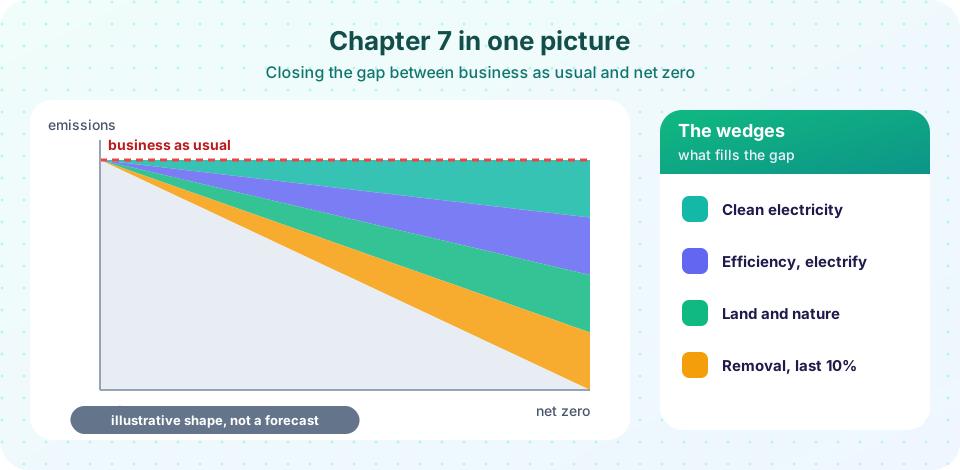
This review pulls together the chapter's main message: limiting warming means shrinking the gap between where emissions are heading and where they must go, and a world that is already warmer must also learn to cope. The picture below shows the idea as wedges, each one a family of action.
Recap table
| Topic | Key idea | Numbers |
|---|---|---|
| Emission sources | Mostly CO₂ from fossil fuels, then methane and land | 2019: about 59 Gt CO₂-eq |
| Sectors | Energy supply and industry lead | Energy about 34%, industry about 24% |
| Net zero | Residual emissions balanced by removals | CO₂ net zero around 2050 for 1.5 °C |
| Kaya identity | Four factors multiply | Carbon and energy intensity are the main levers |
| TCRE | Warming tracks cumulative CO₂ | About 0.45 °C per 1000 Gt |
| Carbon budget | CO₂ left for a target | 500 Gt (1.5 °C, 50%) from 2020 |
| Linear cut time | T = 2B / E₀ |
500 / 40 gives 25 years |
| GWP-100 | Gas comparison | Methane about 30, N₂O about 273 |
| Heat pump | COP 3 to 4 | 3 units of heat per unit of electricity |
| Learning rate | Cost falls per doubling | Solar about 20 to 25% |
| Removal | Supplement for residual emissions | Not a substitute for cuts |
| Adaptation | Structural, nature-based, social | Limits and maladaptation |
Connecting the chapter
Pick a place, for example a coastal city, and trace both levers. Mitigation lowers future hazard: the city cuts emissions by switching to clean electricity and heat pumps, but its effect on global temperature depends on what everyone does. Adaptation lowers risk immediately: mangroves, raised buildings and warning systems protect people from the hazards that are coming regardless. The balance of effort depends on timing. Mitigation has global, long-term benefits; adaptation has local, quicker benefits. A sensible plan does both.
Three principles from the chapter are worth remembering.
- Cumulative matters. CO₂ accumulates, so total emissions, not the year of a target, drive warming.
- Cut first, remove second. Removal is needed for residual emissions but is costly and uncertain at scale.
- Adaptation has limits. The higher the warming, the sooner hard limits are reached.
When you see a pledge ("net zero by 2050"), ask: How large are the cuts before removals? Which sectors? Does it include methane? Is the budget consistent with the temperature target?
A worked synthesis question
A country of 70 million people (about 0.9% of the world) emits 400 Mt of CO₂ a year, and the world has a remaining budget of 500 Gt for 1.5 °C at 40 Gt a year. What does the budget mean for this country, and how would it plan?
If the budget were shared by population, the country's share would be 0.9% × 500 Gt ≈ 4.5 Gt, which is 4,500 / 400 ≈ 11 years at constant emissions, close to the global ratio of 12.5 years because the country's emissions per person are close to the world average. A straight-line decline to zero would take about 2 × 4.5 Gt / 0.4 Gt ≈ 22 years. Sharing by population is only one principle. Other countries argue for sharing by historical responsibility, ability to pay, or current emissions, and different rules give very different answers, which is why fairness is a central issue in negotiations. For planning, the country would work through the Kaya factors and the toolbox: clean the electricity first (the largest and cheapest cut), electrify transport and heating, raise efficiency, tackle industry and methane, protect land sinks, and plan for adaptation alongside. The arithmetic shows why a decade of delay is costly: it consumes most of the budget while the toolbox is still being built.
Try it
This tool recomputes the main arithmetic of the chapter. Change the budget and emissions to see how the numbers shift.
Press Run (or Ctrl + Enter) to see the result here.
Program input · what you'd type while the program runs
Type the answers before you press Run, one per line. Each time the program reads a line (with input()), it gets the next line from this box.
Now a flashcard run.
Press Run (or Ctrl + Enter) to see the console output here.
No output.
Check your understanding
Quick check · 10 questions
of 10 answered You scored / 10 · perfect!
-
1. Which sector had the largest share of 2019 greenhouse gas emissions according to the IPCC?
Energy supply contributed about 34%. -
2. In the Kaya identity, which factor is the CO₂ released per unit of energy?
Carbon intensity captures the fuel mix. -
3. With a remaining budget of 500 Gt and emissions of 40 Gt per year, a straight-line decline to zero takes
T = 2B / E₀ = 2 × 500 / 40 = 25 years. -
4. Which statement about TCRE is right?
That near-proportionality is the basis of carbon budgets. -
5. A heat pump with COP 3.5 uses 1 kWh of electricity. How much heat does it deliver?
COP is heat delivered divided by electricity used. -
6. Why is carbon removal not a substitute for cutting emissions?
Removal is needed for residual emissions but cannot offset 40 Gt of annual CO₂. -
7. Which is an example of maladaptation?
False security can increase exposure and risk. -
8. What is a 'soft limit' to adaptation?
Soft limits arise from social or economic constraints. -
9. Methane's GWP-100 of about 30 means
GWP compares the effect of a pulse of gas with CO₂ over a time horizon. -
10. Why does a learning rate of 20% help explain falling solar costs?
Wright's law links cost to cumulative production.
Summary
- Emissions come mostly from energy; most warming tracks cumulative CO₂.
- Carbon budgets turn a temperature target into tonnes, and delay forces steeper cuts.
- The toolbox spans clean power, efficiency, land, industry, methane and removal.
- Adaptation reduces harm now but faces hard and soft limits.
- Both levers, and fairness between those who emit and those who suffer, belong in any plan.
Track your progress
Create a free account to tick off lessons and pick up where you left off on any device.
of Climate Science lessons completed