


















Lesson 27 of 48 · Water, Nutrients and Transport
Xylem and phloem transport
How water climbs 100 meters up a tree and how sugar flows to roots and fruit: the cohesion-tension theory, the pressure-flow hypothesis, and tree height limits.
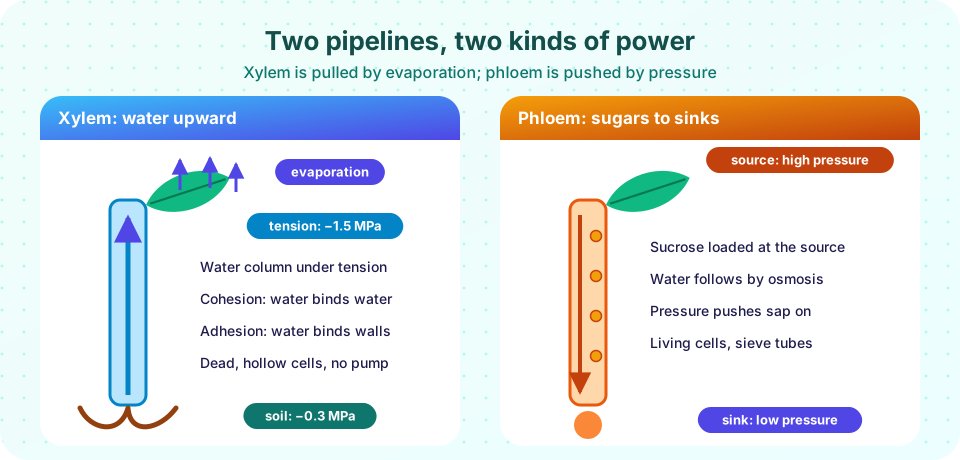
A coast redwood can stand more than 115 meters tall. Its topmost needles are above the roof of a 35-story building, yet they are supplied with water drawn from the soil with no heart, no pump and no muscle. At the same time, sugars made in those needles reach roots deep underground, and in spring the flow reverses, with stored sugar rising to feed new buds. Two separate sets of pipes do these jobs, and they work on completely different principles. Xylem is pulled by evaporation. Phloem is pushed by osmotic pressure. This lesson explains both and shows why a tree cannot grow forever.
What you will learn
- What xylem and phloem cells look like and why they are built differently.
- How the cohesion-tension theory explains water rising in tall trees.
- How the pressure-flow hypothesis explains movement of sugar from source to sink.
- What limits tree height, and what embolism means.
Key terms
Tracheid and vessel element: water-conducting xylem cells; both are dead and hollow at maturity, with lignified walls.
Cohesion and adhesion: attraction between water molecules, and between water and cell walls.
Cavitation (embolism): breaking of the water column, leaving an air bubble that blocks a conduit.
Sieve tube element: living phloem cell with no nucleus, connected end to end by sieve plates.
Source and sink: a region that exports sugar (a mature leaf) and a region that imports it (roots, fruits, young leaves).
Xylem: dead pipes that carry water
Mature xylem conduits are dead. The living contents break down and leave empty, hollow tubes whose walls are thickened with lignin, a stiff polymer that stops them from collapsing under suction. All vascular plants have tracheids: long thin cells with tapered ends that pass water through pits in the walls. Flowering plants also have vessel elements, wider cells joined end to end with open or partly open ends (perforation plates), forming continuous pipes that can be centimeters to meters long. Wider pipes carry much more water, but they are more vulnerable to breakage.
Because the conduits are dead, they have no membranes. Water inside them moves by bulk flow, driven by a pressure difference, and that is exactly what the next section explains.
The cohesion-tension theory
The idea, developed by Henry Dixon and John Joly in 1894 and independently by Eugen Askenasy in 1895, has three linked parts.
- Evaporation creates tension. As water evaporates from mesophyll cell walls, the remaining water is drawn into tiny pores between cellulose fibers. Its surface curves and the surface tension pulls the water inward, putting the water column under negative pressure (tension). The leaf's Ψ drops to values such as −1 to −2 MPa on a sunny day.
- Cohesion transmits the pull. Water molecules stick together through hydrogen bonds. Inside a narrow, clean conduit, they can resist very large tensions without breaking, so a continuous thread of water stretches from the leaf all the way down to the root.
- Adhesion supports the thread. Water also sticks to the hydrophilic cellulose and lignin of the wall, which keeps the column from slipping and helps hold it against gravity.
The sun, in effect, powers the system. The energy that evaporates water pulls the column up, and the plant spends no metabolic energy on the lift itself.
How much tension does a tall tree need?
Gravity alone costs about 0.01 MPa per meter of height (0.00981, from ρ g h with water's density 1,000 kg/m³). Friction in the narrow conduits at least doubles that. So raising water 100 meters needs a pressure difference of roughly 1 MPa for gravity plus another 1 MPa or so for resistance. The leaf at the top therefore sits at around −2 MPa or lower. Since many species' xylem starts to cavitate somewhere between about −1.5 and −4 MPa, there is a limit. In 2004 George Koch and colleagues measured redwoods and estimated that hydraulic limits would stop height at roughly 122 to 130 meters, close to the tallest living trees.
When the column breaks
A bubble that nucleates in a conduit can expand in a water column under tension, filling it with vapor and air. This is cavitation, and the blocked conduit is embolized. Some are refilled, others are bypassed through pits, and many trees produce new xylem every year to replace lost capacity. Droughts, freezing and thawing, and very low soil water all raise the number of embolisms, which is why prolonged drought can kill even big trees.
Root pressure and guttation
Roots can also push. When soil is moist and transpiration is low, as in the cool of the night, ions pumped into the xylem lower its Ψ, water follows, and a small positive pressure builds (typically 0.05 to 0.2 MPa). You can see the result as drops at the leaf edges of grasses and strawberries in the early morning, called guttation. Root pressure is far too weak to lift a tall tree's water, and in most plants most of the time the pull from above does the work.
Phloem: living pipes that carry sugar
Phloem conduits are alive. Sieve tube elements have a membrane and cytoplasm but have lost their nucleus and most organelles, so each is kept alive by a neighbor, the companion cell, which does the metabolic work. End walls between sieve tube elements are perforated sieve plates, so cell contents flow almost freely from cell to cell. Sap in the phloem contains mostly sucrose (often 10% to 25% by weight, so around 0.3 to 0.7 M) together with amino acids, hormones, and some RNAs and proteins.
Early evidence that phloem carries food came from girdling. Marcello Malpighi cut a ring of bark off a tree in the 1670s and saw the bark swell above the cut as sugar piled up and the roots below starve. Modern work uses aphids: an aphid's mouthpart (stylet) can be cut off, and the sap that keeps oozing from the stump shows the pressure and the sugar concentration in a single sieve tube.
The pressure-flow hypothesis
Ernst Münch proposed in 1930 that the phloem is a simple osmotic machine. Imagine two bags of sugar solution connected by a tube and each sitting in water.
- Loading at the source. Leaf cells make sucrose and companion cells pump it into the sieve tubes, often using proton-sucrose symporters driven by an H⁺ gradient. This is active transport and costs ATP.
- Water follows. High sugar lowers Ψs in the sieve tube, so water enters from the nearby xylem by osmosis. Turgor pressure there rises, often to around 1 MPa.
- Bulk flow. The pressure difference pushes sap toward regions of lower pressure.
- Unloading at the sink. In a root or fruit, sucrose is removed and used or converted to starch. Ψs rises, water leaves, and the pressure falls, which keeps the gradient going.
Sap moves at roughly 0.5 to 1 meter per hour in many plants, thousands of times faster than diffusion could manage over such distances. The same sieve tube can carry sugar in different directions at different seasons, because source and sink are defined by function, not by position. A leaf that is still growing is a sink; once it matures it becomes a source. A potato tuber is a sink in summer and a source for the new sprouts in spring.
Xylem and phloem compared
| Feature | Xylem | Phloem |
|---|---|---|
| Cells at maturity | Dead, hollow, lignified | Living (sieve tubes with companion cells) |
| Carries | Water and minerals | Sugars, amino acids, hormones |
| Direction | Mostly up | Source to sink (up or down) |
| Driving force | Evaporation pull (tension) | Pressure from osmosis (push) |
| Pressure in the conduit | Negative | Positive |
| Needs ATP in the conduit | No | Yes (loading, and to keep cells alive) |
Common misconceptions
"Capillary action lifts water up trees." Capillarity can raise water only a few centimeters in a narrow plant conduit. Cohesion-tension, powered by evaporation, does the real lifting.
"Phloem goes down and xylem goes up, always." Xylem flow is upward in a sense, but phloem direction depends on where the source and sink are. Spring growth draws sugar upward from roots.
"Xylem and phloem are one pipe." They are different cells with different jobs, usually side by side in vascular bundles.
Try it
The first plot shows how the leaf water potential needed to lift water rises with tree height for three levels of conduit resistance.
Press Run (or Ctrl + Enter) to see the result here.
Program input · what you'd type while the program runs
Type the answers before you press Run, one per line. Each time the program reads a line (with input()), it gets the next line from this box.
The second shows why wide vessels carry so much more water. The flow follows the Hagen-Poiseuille law, where the volume per second rises with the fourth power of the radius.
Press Run (or Ctrl + Enter) to see the result here.
Program input · what you'd type while the program runs
Type the answers before you press Run, one per line. Each time the program reads a line (with input()), it gets the next line from this box.
Check your understanding
Quick check · 5 questions
of 5 answered You scored / 5 · perfect!
-
1. What mainly pulls water up the xylem of a tall tree?
Evaporation from leaf cell walls creates tension, and cohesion of water molecules pulls the column up from the soil. -
2. Why is mature xylem able to carry water without using ATP in the pipe itself?
Xylem conduits are dead, lignified tubes; bulk flow occurs because of tension created at the leaf. -
3. In the pressure-flow model, why does water enter the sieve tube at a source?
Sugar loaded at the source lowers Psi_s in the sieve tube, water enters, and turgor pressure rises. -
4. Roughly how much hydrostatic pressure per meter of height must the xylem overcome because of gravity alone?
rho g h = 1000 x 9.81 Pa per meter, which is about 0.0098 MPa per meter. -
5. A potato tuber in spring is best described as
Source and sink are roles. Storage organs import sugar while filling and export it when they supply new growth.
Summary
- Xylem consists of dead, lignified tracheids and vessels; phloem consists of living sieve tubes with companion cells.
- Cohesion-tension: evaporation makes tension, cohesion transmits it, adhesion supports the water thread.
- Gravity costs about 0.01 MPa per meter, and friction roughly doubles that, which limits trees to about 120 to 130 meters.
- Embolisms break the column; plants bypass, refill or replace them.
- Pressure flow moves sucrose from sources (loading, high pressure) to sinks (unloading, low pressure), roughly 0.5 to 1 m/h.
Track your progress
Create a free account to tick off lessons and pick up where you left off on any device.
of Botany and Plant Science lessons completed